
essaysStartup GuideApplication WritingPlain English
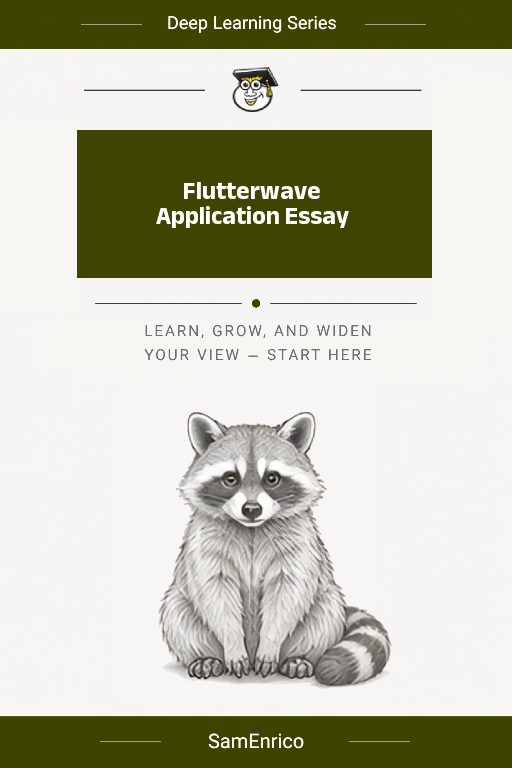
Flutterwave Application Essay eBook
Write your YC application in plain English, not co
Write your YC application in plain English, not corporate speak, like Flutterwave did.
Formats
Free sample
Chapter 1: The Synergy Trap--Every year, twenty thousand founders sit down to write their Y Combinator application. And every year, nineteen thousand of them make the same fatal mistake on the very first sentence.They try to sound like a bank.Not a small bank. Not a regional bank. A global, soulless, regulatory-compliant, board-approved, risk-managed, jargon-spewing bank that has never had an original thought in its entire existence. They write things like: "We leverage disruptive fintech infrastructure to incentivize financial inclusion across emerging markets." They read that sentence back.
They nod. They think: This sounds professional. Then they submit it. And then they get rejected.Here is what Y Combinator partners actually see when they read that sentence: nothing. Not a single concrete image.
Not a single human being. Not a single problem they can touch. Just a pile of words that cost you nothing to write and cost the reader everything to decode.Flutterwave did not write that sentence.Flutterwave wrote: "We had to incorporate in every African country just to pay our developers."That sentence contains a verb you can picture (incorporate). A number you can count (every country). A human being (developers).
A specific problem (paying them). And a consequence that anyone who has ever worked for a paycheck understands: if you cannot pay people, you have no company.That sentence got them into Y Combinator. That sentence helped build a company now valued at over three billion dollars. And that sentence is the entire reason this book exists.Welcome to the first chapter of The Flutterwave Application Essay. By the time you finish this book, you will never write corporate gibberish again.
But first, we need to understand why smart people write stupid things. We need to understand the trap. And then we need to learn how to escape it.The Fear That Drives Bad Writing Let us start with a confession. I have written bad corporate sentences. You have written bad corporate sentences.
Every founder who has ever applied to YC has written at least one sentence they are embarrassed to read out loud. The question is not whether you have done it. The question is why.The answer, drawing from Rand Fishkin's excellent book Lost and Founder: A Painfully Honest Field Guide to the Startup World, is fear. Pure, simple, almost understandable fear.Founders are afraid of three things when they write their YC application.First, they are afraid of sounding small. Y Combinator has funded Stripe, Airbnb, Dropbox, Coinbase, Instacart, Reddit, Door Dash, and dozens of other companies you use every day.
These are giants. And you, reading this book, are probably not a giant yet. You are three people in a rented apartment with a prototype that crashes every third time you run it. That feels small. So you reach for big words to make yourself feel bigger.
"Leverage" sounds bigger than "use." "Incentivize" sounds bigger than "pay." "Disruptive" sounds bigger than "different." You are not trying to deceive anyone. You are trying to protect yourself from the fear that you do not belong in the same sentence as Stripe and Airbnb.Second, they are afraid of sounding unsophisticated. You have read the tech press. You have seen the funding announcements. You know that every successful startup describes itself as a "platform" that "utilizes machine learning" to "optimize outcomes." You do not want to be the only founder who says "We help people find dog walkers" when everyone else is saying "We leverage AI-powered pet care logistics." So you mimic the language of the press releases.
You adopt the vocabulary of the winners. You assume that if you sound like them, you will become like them.Third, and most dangerously, they are afraid of sounding risky. Every startup has risks. Your technology might not work. Your customers might not pay.
Your competitors might crush you. Your regulatory environment might change overnight. These risks are real. And the instinct of every human being facing a risk is to hide it. You do not walk into a job interview and say "I was fired from my last position for missing deadlines." You do not ask someone on a first date and say "I have been told I am emotionally unavailable." You hide the risk.
You paper it over with nice words. You say "I am looking for new challenges" instead of "I got fired." And you do the same thing in your YC application. You write "We have partnered with leading financial institutions" instead of "We have not actually integrated with any banks yet, but we have a meeting scheduled."This fear is understandable. It is also fatal.Why Corporate Language Destroys Trust Let us conduct a simple experiment. I am going to give you two sentences.
Both describe the same company. One was written by a founder who is afraid. One was written by a founder who is not. Read them and tell me which one you trust more.Sentence A: "Our platform utilizes state-of-the-art encryption protocols to ensure enterprise-grade security for our clients' sensitive data assets."Sentence B: "We encrypt everything. If someone steals our server, they get a hard drive full of garbage."Which founder would you fund?
Which founder sounds like they have actually thought about security? Which founder sounds like they have touched the problem with their own hands?Sentence B, obviously. And not because it is shorter, though it is. Not because it uses simpler words, though it does. But because Sentence B contains evidence that the writer has actually done something.
They did not just read about encryption standards on Wikipedia. They implemented them. They thought about what happens when a server gets stolen. They have an answer. Sentence A has no evidence of anything except a thesaurus.Here is the deeper problem with corporate language: it is designed to hide risk, but startups succeed by exposing insight.Consider the difference between a bank and a startup.
A bank exists to manage risk. It does not want you to know exactly what it is doing with your money, because if you knew, you might get nervous. So banks use language that is vague, reassuring, and imprecise. "Your funds are held in a diversified portfolio of investment-grade securities." That sentence is designed to make you feel safe without telling you anything specific. A startup, by contrast, exists to exploit insight.
A startup has a secret. It sees something that others do not see. And the only way to communicate that secret is to be specific. To name the thing that others miss. To say exactly what is broken and exactly how you plan to fix it.Corporate language is the language of risk management.
Plain English is the language of insight discovery. And Y Combinator funds insight discovery.The Flutterwave Test Here is a simple diagnostic tool you can use on your own writing. I call it the Flutterwave Test, because Flutterwave's application passed it with flying colors and almost every rejected application fails it.The Flutterwave Test works like this: copy your company's description. Replace your company's name with the name of your closest competitor. Now read the sentence.Does it still make sense?Does it still sound impressive?Does it still describe…
This is the end of the free sample. Get the eBook to keep going. Buy now
About this book
Details
- Author
- Hathaway Jesse
- Publisher
- SamEnrico
- Language
- English
- Genre
- essays, Startup Guide, Application Writing, Plain English
- Released
- 2026-05-30
- Pages (approx.)
- 132
- Available as
- eBook, Audiobook

Read better in the ZLOADR app
Your eBooks on your phone or tablet. Sign in with your SamEnrico account and start reading.
More by Hathaway Jesse
 Loneliness Yoga Studio GuideHathaway Jesse$11.99
 Networking for Parents GuideHathaway Jesse$11.99
 Flexible Work RequestHathaway Jesse$11.99
 Senior Wisdom SharingHathaway Jesse$11.99
 Beauty Tech Capital AllocationHathaway Jesse$11.99
 The Recovery Nutrition PlanHathaway Jesse$11.99
 Pandemic Anxiety TranceHathaway Jesse$11.99
 Prostate Cancer TriumphHathaway Jesse$11.99
 Antwerp Heist Judge RulingHathaway Jesse$11.99
 The Phantom of the Pentagon: How a Fake General Fooled the MilitaryHathaway Jesse$11.99
 The Golden Age of Axum: Africa's First Global PowerHathaway Jesse$11.99
 The Diplomat's Dilemma: How Kofi Annan Navigated the Rwandan GenocideHathaway Jesse$11.99
You may also like
 YouTube Video Essay DepthLeon Lala$11.99
 TOEFL Independent Essay GuideMintz Alex$11.99
 Music Theory Essay GuideWilkinson Maisha$11.99
 Expository Essay AI PromptsApplegate Dalia$11.99
 Exam Essay MemorizationMcgovern Johna$11.99
 Compare Contrast Essay PromptsOntiveros Marx$11.99
 College Application Essay GuideSisson Aimee$11.99College Application Essay GuideSisson Aimee$11.99
 The 100 Word Essay ChallengeAli Luciana$11.99
 Journalism Essay PromptsThatcher Williemae$11.99
 Finance Essay PromptsShrader Lamont$11.99
 Cause Effect Essay GPT GuideBland Jacelyn$11.99