
Non-FictionSelf-HelpFirst Responder
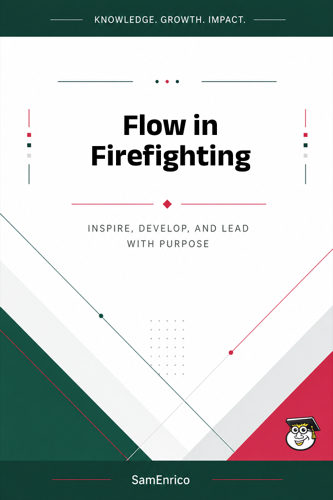
Flow in Firefighting eBook
Emergency responders achieving flow during crisis.
Emergency responders achieving flow during crisis.
Formats
Free sample
Chapter 1: The Quiet Inside the Roar--The thermal alarm on his SCBA screamed at 1,200 breaths per minute — a sound designed to penetrate panic, and it succeeded. Firefighter Mike Donovan was lost. Not metaphorically. He had no idea which direction was out. The hose, his only tether to the world, had gone slack three steps ago.
His mask was fogged from the inside, sweat mixing with the strange calm of impending death. He had less than four minutes of air remaining. Maybe two, if his heart didn't stop first.And then, something happened that he would spend the next decade trying to understand.He stopped fighting.Not the fire. He stopped fighting himself. The screaming alarm became a metronome.
The smoke resolved into patterns. His hand found the wall — not the hose, not his partner's boot, but the wall — and he remembered, from a drill three years ago, that in this building layout, the wall led to a window. He crawled. He broke the glass. He took a breath of outside air that tasted like gasoline and freedom.
He was out.He had no memory of making a single decision in the last ninety seconds. He simply moved. Later, his captain would say he "went blank in the best possible way." His wife would say he came home hollow-eyed and silent. Mike would say, "I don't know what happened. I just… wasn't there anymore.
And that saved my life."He had discovered, without knowing its name, the quiet inside the roar.This book is about that quiet. It is about the neurochemical state that turns a dying firefighter into a survivor, that turns chaos into a choreography, that transforms the most dangerous profession on earth into something that feels, for fleeting moments, like flying. It is called flow. And every firefighter has brushed against it — usually without recognition, almost always without the ability to summon it on command.This chapter will change that. It will give you a language for what happened to Mike Donovan.
It will show you why some firefighters freeze and others flow, why the same brain that can kill you in panic can also save you with effortless precision, and why the difference between those two outcomes is not courage, not experience, not even luck — but a biological state that you can learn to trigger, sustain, and trust.Welcome to the neurochemistry of rescue.The Myth of the Unshakable Firefighter Before we can understand flow, we must first dismantle a lie that has killed more firefighters than any flashover or structural collapse. The lie is this: the best firefighters are the ones who feel nothing.The fire service has historically worshiped emotional suppression. The stoic captain. The rookie who doesn't flinch. The veteran who walks out of a pediatric cardiac arrest and eats lunch without missing a bite.
We have mistaken numbness for strength, dissociation for professionalism, and the slow death of emotional engagement for something to admire.Here is the truth that the last twenty years of neuroscience have made undeniable: the firefighters who perform best under extreme stress are not the ones who feel nothing. They are the ones who feel exactly the right amount — and who have trained their nervous systems to ride that arousal like a surfer rides a wave, neither drowning in it nor beaching themselves on the flat shore of detachment.Flow is not the absence of emotion. Flow is the mastery of it. It is the state where your arousal level — your heart rate, your cortisol, your adrenaline, your norepinephrine, your dopamine — settles into what neuroscientists call the Window of Tolerance. Not too high.
Not too low. Just right.The firefighter who feels nothing is not in flow. They are in a dissociative state that degrades pattern recognition, slows reaction time, and erases the very emotional information — fear, urgency, concern — that the brain needs to prioritize threats. The firefighter in flow, by contrast, feels everything that matters and nothing that doesn't. They are fully present, fully alive, and fully capable.The Window of Tolerance: Your Brain's Goldilocks Zone In the 1990s, psychiatrist Dan Siegel introduced a concept that would revolutionize our understanding of trauma and performance: the Window of Tolerance.
Within this window, a person can receive, process, and respond to information effectively. Outside it, two things happen.If arousal drops too low — if the firefighter becomes numb, exhausted, or dissociated — they enter a state of hypoarousal. The brain slows down. Reaction times lengthen. Critical details are missed.
This is the firefighter who stands at the back of the truck while the crew advances, who cannot remember the building layout they reviewed thirty seconds ago, who feels "checked out" and moves like a sleepwalker.If arousal spikes too high — if the firefighter becomes overwhelmed by fear, panic, or rage — they enter a state of hyperarousal. The amygdala, the brain's smoke detector, hijacks the prefrontal cortex, the seat of reasoned decision-making. Tunnel vision sets in. Fine motor skills degrade. The firefighter may freeze, flee, or fight indiscriminately.
This is the firefighter who drops their tool and runs, who cannot find the nozzle they were holding two seconds ago, who hears their captain's voice but cannot parse the words.Flow lives in the narrow band between these two cliffs. In the Window of Tolerance, the prefrontal cortex remains online. Working memory functions. Heart rate variability — a key biomarker we will return to — remains high, indicating that the parasympathetic nervous system is actively balancing sympathetic arousal. The firefighter is alert but not hypervigilant, focused but not fixated, urgent but not panicked.The challenge, of course, is that the fireground is explicitly designed to shove you out of this window.
Heat, smoke, noise, disorientation, the weight of your gear, the lives depending on you — these are not neutral inputs. They are biological triggers engineered by evolution to push you into hyperarousal. The question is not whether the fire will try to break your window. It will. The question is whether you have trained your nervous system to stay inside it anyway.The Neurochemistry of Rescue: A User's Manual for Your Brain To understand how flow feels, we must first understand the chemicals that create it.
This is not academic trivia. This is the difference between knowing why you crashed after that big fire and blaming yourself for being weak.Let us begin with the stress response, because it is the default setting of the mammalian brain under threat. When you perceive danger — the thermal alarm, the floor sagging, the sudden silence of a flashover about to occur — your amygdala sends an emergency signal to your hypothalamus. This activates the sympathetic nervous system. Within seconds, your adrenal glands release two chemicals: adrenaline (epinephrine) and cortisol.Adrenaline is the engine of fight or flight.
It increases heart rate, dilates airways, shunts blood to large muscle groups, and sharpens sensory input — but at a cost. In high doses, adrenaline degrades fine motor control (your hands shake), narrows peripheral vision (tunnel vision), and impairs complex problem-solving (you can run or punch but cannot calculate structural loads). Cortisol, the longer-acting stress hormone, mobilizes glucose for energy but, when sustained, damages the hippocampus and impairs memory formation.These chemicals are not…
This is the end of the free sample. Get the eBook to keep going. Buy now
About this book
Details
- Author
- Shifflett Toby
- Publisher
- SamEnrico
- Language
- English
- Genre
- Non-Fiction, Self-Help, First Responder
- Released
- 2026-06-10
- Pages (approx.)
- 153
- Available as
- eBook, Audiobook

Read better in the ZLOADR app
Your eBooks on your phone or tablet. Sign in with your SamEnrico account and start reading.
More by Shifflett Toby
 Abandoned Cart RecoveryShifflett Toby$12.99
 The Focus Habit HandbookShifflett Toby$11.99
 Positive Self Talk WorkbookShifflett Toby$11.99
 Virtual Event CommunicationShifflett Toby$11.99
 Vineyard Sunset RelaxationShifflett Toby$11.99
 The Senior Advance DirectiveShifflett Toby$11.99
 Mountain Lake Serenity GuideShifflett Toby$11.99
 Self Hypnosis for Achilles TendonitisShifflett Toby$11.99
 The Last Letter of the Titanic’s Unsung Hero: A Forgotten Story of CourageShifflett Toby$11.99
 The Last Broadcast: The Fall of Saigon in Real TimeShifflett Toby$11.99
 How to Produce Detergent and SOAPShifflett Toby$11.99
 A Collector's Handbook to the Wolseley 1500Shifflett Toby$11.99
You may also like
 Hong Kong Handover 1997Dunn Johnnie$11.99
 Zumba For Postnatal Recovery CourseNeal Christian$11.99
 Zumba for BeginnersLadner Nikia$11.99
 YouTube Comment Mining GuideHumes Pandora$12.99
 Worry Box MeditationCarlin Rudy$11.99
 Workplace Stress MeditationNguyen Lynn$11.99
 Workplace Stress and Sleep RepairHawley Ivory$11.99
 Workplace Perfectionism CureDelaney Jeffry$11.99
 Workplace Injustice Anger GuideWallen Isabelle$11.99
 Work Addiction and Burnout LinkGreenwood Ester$11.99
 Women in Yoga and WellnessBeattie Galina$11.99
 Women in Stand Up ComedyChun Evangeline$11.99