
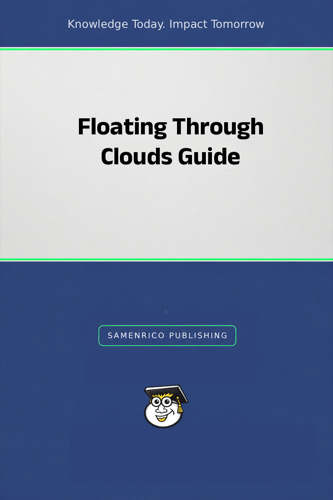
Floating Through Clouds Guide eBook
Drifts between cumulus, feeling mist and sun.
Drifts between cumulus, feeling mist and sun.
Formats
Free sample
Chapter 1: Learning to Unlearn-- Every child knows how to float through clouds. Then they grow up, and they forget.I learned this lesson from a four-year-old. Her name was Maya, and she was the daughter of a friend. One summer afternoon, I was lying on a blanket in a park, trying to explain cloud drifting to a group of adults who kept asking practical questions. “How long should I do it?” “What if my neck gets sore?” “Is there an app for this?” I was losing them.
Then Maya wandered over, flopped onto her back without asking permission, pointed at the sky, and said, “That one looks like a giraffe eating a pancake. No, wait. Now it looks like my grandpa’s hat. No, now it’s a river. Can we stay here until it turns into a dragon?”She was already drifting.
She hadn’t been taught. She hadn’t read a book or taken a workshop or downloaded an app. She simply looked up and let her imagination merge with the cloud’s movement, the same way she might let bathwater run through her fingers without once asking whether the water was “doing it right.”The adults on the blanket fell silent. They weren’t jealous of a child. They were remembering something they had lost.This chapter is about that loss and, more importantly, about the recovery.
Before we can learn the specific practices of cloud drifting—the three modes, the breathing techniques, the emotional weather charts that appear later in this book—we have to unlearn the habits that keep us stranded on the ground. Those habits are not your fault. They were trained into you by schools that demanded attention to measurable outcomes, by workplaces that turned time into money, by smartphones that reduced wonder to a scroll. But they are yours to undo.The good news is that unlearning happens faster than learning. You do not need years of meditation retreats or a Ph D in atmospheric science.
You need fifteen minutes and a willingness to be bored. Because boredom, as you will discover, is the doorway back to drifting.The Three Habits That Chain You to the Ground Before we can float, we need to name what holds us down. Not to blame ourselves for it—blame is just another form of gravity—but to see the chains clearly. Once you see a chain, you can begin to loosen it.Habit One: The Demand for Productivity You have been trained to believe that every moment must produce something. If you are waiting in line, you should check email.
If you are walking to the store, you should listen to a podcast. If you have ten free minutes, you should “make the most of them.” This habit is so deeply embedded that most people feel actual anxiety when they have unplanned time with nothing to produce. The anxiety is not natural. It is learned. And it is the single greatest barrier to cloud drifting because cloud drifting produces nothing.
No output. No deliverable. No progress. You cannot put it on a resume. You cannot quantify it.
You simply do it, and then it is gone, like the cloud itself.Habit Two: The Tyranny of the Name Remember the four-year-old? She didn’t need to know the Latin name for cumulus humilis. She didn’t need to distinguish between mediocris and congestus. She just saw. Adults, by contrast, often reach for labels as a way of controlling what they see.
“That’s a cumulonimbus. It might rain later. I should bring an umbrella.” In three seconds, we have moved from looking to forecasting. The name became a tool for prediction, which became a tool for control, which became a wall between us and the cloud itself. Naming is not inherently bad—later chapters will teach you specific names that deepen intimacy—but the habit of naming to control is a chain.
It says: I don’t trust my direct experience. I need a category to feel safe.Habit Three: The Fear of Stillness Most adults cannot sit still for three minutes without external stimulation. Try it right now. Set a timer for three minutes. Do not look at your phone.
Do not read. Do not talk. Just sit. For most people, the first minute is fine. The second minute brings a small wave of restlessness.
The third minute feels interminable. That restlessness is the fear of stillness—not a fear of being harmed, but a fear of being alone with yourself without anything to distract you. Cloud drifting requires stillness. Not physical stillness necessarily (Walking Drift exists, as you will see in Chapter 5), but attentional stillness. You stop chasing.
You stop scrolling. You just are. That is terrifying for a mind that has been trained to believe that stillness is wasted time.These three habits—the demand for productivity, the tyranny of the name, and the fear of stillness—are the gravity that keeps you looking at clouds instead of floating through them. The rest of this chapter is an antidote to each one.Unlearning Productivity: The Worthless Practice The first unlearning exercise is called the Worthless Practice. I chose that name deliberately.
It offends the productivity habit. Good.Here is how it works. Find a place where you can see a cumulus cloud. Any cumulus will do. Humilis, mediocris, congestus—it does not matter for this exercise.
Lie down or sit back so that your neck is comfortable. Then set a timer for ten minutes. During those ten minutes, you are forbidden from doing anything that could be described as productive. You cannot check your phone. You cannot plan your day.
You cannot analyze the cloud’s weather implications. You cannot even mentally compose a to-do list. If a productive thought arises—and it will, probably within the first thirty seconds—you notice it, say “not now,” and return your attention to the cloud.That is the whole exercise. Ten minutes of non-productive attention.Most people fail the first time. Not because they are bad at it, but because the productivity habit is so strong that they don’t even notice when they start planning dinner while looking at a cloud.
That’s fine. Failure is data. When you catch yourself being productive, you have just done something remarkable: you have observed the habit in action. Most people never see it. They just live inside it, like fish who don’t know they are in water.After the ten minutes are over, do not debrief yourself.
Do not ask “Was that valuable?” That question is productivity sneaking back in. Instead, simply notice any physical sensations. Are your shoulders lower than they were ten minutes ago? Is your jaw less clenched? Is your breathing slower?
These are not measures of success. They are just information.Repeat the Worthless Practice once a day for five days. By the fifth day, the ten minutes will feel shorter. Not because you have become more productive at being unproductive—that is a paradox that will make your head spin—but because your nervous system is beginning to remember that stillness is not dangerous. Stillness is just stillness.
The cloud does not demand anything from you. You do not have to earn the right to watch it.Unlearning the…
This is the end of the free sample. Get the eBook to keep going. Buy now
About this book
Details
- Author
- Perdue Terrilyn
- Publisher
- SamEnrico
- Language
- English
- Genre
- Non-Fiction, Self-Help, Clouds
- Released
- 2026-06-06
- Pages (approx.)
- 150
- Available as
- eBook, Audiobook

Read better in the ZLOADR app
Your eBooks on your phone or tablet. Sign in with your SamEnrico account and start reading.
More by Perdue Terrilyn
 Flow AffirmationsPerdue Terrilyn$11.99
 Affirmations for IntrovertsPerdue Terrilyn$11.99
 Cobblestone Village WalkPerdue Terrilyn$11.99
 The Focus and Nutrition GuidePerdue Terrilyn$11.99
 Esports Athlete's Self HypnosisPerdue Terrilyn$11.99
 Stress Shingles Outbreak LinkPerdue Terrilyn$11.99
 ABCDE for SalespeoplePerdue Terrilyn$11.99
 The Ghosts of Salamanca: Wellington’s Phantom WarPerdue Terrilyn$11.99
 The Velvet Noose: Argentina's Art-Loving KillerPerdue Terrilyn$11.99
 How to Produce Digital Note Taking PensPerdue Terrilyn$11.99
 How to Become a MelterPerdue Terrilyn$11.99
 A Collector's Handbook to the Wolseley IiPerdue Terrilyn$11.99