
Non-FictionSelf-HelpShort Practice
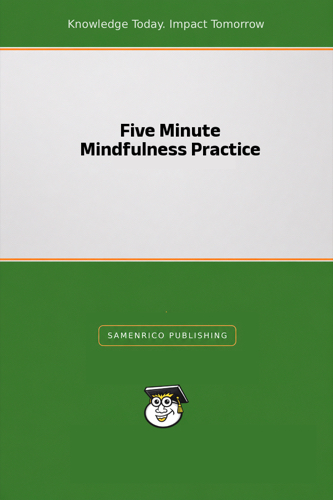
Five Minute Mindfulness Practice eBook
Short daily meditations for busy beginners.
Short daily meditations for busy beginners.
Formats
Free sample
Chapter 1: The 300-Second Lie...--You have been lied to. Not maliciously, and not by any single person, but by a cultural story repeated so often it has hardened into fact. The story says that mindfulness requires silence, solitude, and a substantial chunk of uninterrupted time. It says you need a cushion, a clean room, and the ability to silence your mind completely. It says if you cannot sit for twenty minutes, you might as well not sit at all.That story is wrong.
And this chapter exists to prove it.The lie has a name, and we call it the "duration bias." It is the deeply held, rarely examined belief that longer equals better. We apply it to everything: workouts, conversations, work sessions, and yes, meditation. A sixty-minute yoga class must be better than a fifteen-minute one. A two-hour meditation retreat must be more transformative than a ten-minute home practice. This logic seems obvious, even undeniable.
But when scientists actually tested it, they discovered something surprising: the relationship between meditation duration and benefit is not linear. It is logarithmic.In plain English, the first few minutes of a practice deliver most of the benefits. The next ten minutes deliver some additional benefit. The twenty minutes after that deliver very little. Diminishing returns is not a flaw of meditation—it is the shape of nearly every human skill.
The first cookie tastes incredible. The tenth cookie tastes like regret. The first minute of a run feels terrible. The tenth minute feels terrible in a different way, but your fitness improved most in the first minute. Mindfulness works the same way.
The benefits are front-loaded.This is excellent news if you are busy. This is excellent news if you have children, a commute, a demanding job, or any of the other thousand responsibilities that make "finding time" feel like a cruel joke. You do not need an hour. You do not need twenty minutes. You need five minutes or less.
And you need to know that this is not a consolation prize or a beginner's version. It is not "meditation light" or "mindfulness for people who cannot commit." It is a different approach entirely, one that is better suited to modern life than the monastic model we have been trying to fit ourselves into.The Neuroscience of Micro-Sessions Let us talk about your brain. Specifically, let us talk about the prefrontal cortex—the part of your brain located right behind your forehead that is responsible for focus, decision-making, impulse control, and emotional regulation. The prefrontal cortex is the CEO of your brain. When it is well-rested and well-trained, you can concentrate on your work without checking your phone every thirty seconds.
You can resist the second cookie. You can respond to a frustrating email rather than reacting to it. When your prefrontal cortex is fatigued, you make impulsive decisions, lose your temper, and stare at your screen without actually seeing it.Here is what the research shows: the prefrontal cortex fatigues quickly. After about ninety minutes of focused work, your CEO starts to get sloppy. This is not a character flaw.
It is biology. Your brain consumes twenty percent of your body's energy despite being only two percent of your body's mass. Focused attention is metabolically expensive. The solution, counterintuitively, is not more focus. The solution is micro-breaks—tiny pauses that allow the prefrontal cortex to recover.A study from the University of Illinois found that participants who took brief, frequent breaks performed significantly better on a sustained attention task than those who tried to power through without breaks.
The optimal break length? Forty seconds to five minutes. The optimal break activity? Not checking email or social media (which taxes the prefrontal cortex further). The optimal break activity was doing nothing—or better yet, a micro-meditation.This is the neuroscience behind the "micro-session." When you practice mindfulness for five minutes, you are not "fitting in" a smaller version of a real practice.
You are doing the exact type of practice that your brain needs most: a brief, restorative pause that trains the prefrontal cortex to recover more quickly. Over time, these micro-sessions change the structure of your brain. MRI studies of long-term meditators show increased gray matter density in the prefrontal cortex and decreased gray matter density in the amygdala (the brain's fear center). The same studies show that these changes occur with as little as ten minutes of daily practice. Five minutes will also produce changes—they will just take slightly longer to accumulate.
But because you will actually do five minutes every day, while you might skip twenty-minute sessions, the five-minute approach wins in the long run.The Consistency Over Duration Principle Here is a truth that the wellness industry does not want you to hear: a five-minute practice you actually do is infinitely more valuable than a sixty-minute practice you skip. Infinitely. Not "slightly more." Not "arguably better." Infinitely. Because the sixty-minute practice you skip produces zero benefit. Zero.
The five-minute practice you do produces real, measurable benefits. This is not opinion. It is arithmetic.Let us look at the data. A 2017 study published in the journal Mindfulness followed two groups of beginners over eight weeks. The first group was asked to meditate for twenty minutes per day.
The second group was asked to meditate for five minutes per day. At the end of eight weeks, both groups showed significant reductions in self-reported stress and anxiety. The twenty-minute group showed slightly larger reductions, but the drop-out rate told a different story. Forty percent of the twenty-minute group quit before the study ended. Only twelve percent of the five-minute group quit.
When the researchers calculated the total minutes of meditation actually completed, the five-minute group substantially outperformed the twenty-minute group—simply because they actually did it.This is the consistency over duration principle. It applies to exercise, language learning, and every other habit worth building. The person who walks for ten minutes every day will walk more total minutes per year than the person who runs for an hour every Saturday and then quits in February. The person who meditates for five minutes every morning will experience more total mindfulness benefits than the person who meditates for an hour once a month. Consistency compounds.
Duration does not.This principle is the foundation of everything that follows in this book. You are not being asked to "make time" for meditation. You are being asked to steal time—sixty seconds here, five minutes there—from the margins of your existing day. You are being asked to practice in the cracks: between meetings, while coffee brews, during the first minute of a red light, in the bathroom stall, in bed before sleep. These are not inferior practice locations.
They are the only practice locations that exist for busy people. And they work.The STOP Method: Your Emergency Rescue Knowing that five minutes works is one thing. Knowing what to do with those five minutes is another. This book will give you dozens of practices, but one stands above the rest for its sheer utility and speed. It is called the STOP method, and it is adapted from Mindfulness-Based Stress Reduction (MBSR), the most rigorously…
This is the end of the free sample. Get the eBook to keep going. Buy now
About this book
Details
- Author
- Spellman Rosalva
- Publisher
- SamEnrico
- Language
- English
- Genre
- Non-Fiction, Self-Help, Short Practice
- Released
- 2026-06-05
- Pages (approx.)
- 144
- Available as
- eBook, Audiobook

Read better in the ZLOADR app
Your eBooks on your phone or tablet. Sign in with your SamEnrico account and start reading.
More by Spellman Rosalva
 Cognitive Diversity GuideSpellman Rosalva$11.99
 Outsourcing for Church LeadersSpellman Rosalva$11.99
 The SMART for Business GuideSpellman Rosalva$11.99
 Growth Mindset In RelationshipsSpellman Rosalva$11.99
 The Investment Loss GuideSpellman Rosalva$11.99
 Flow Journal WorkbookSpellman Rosalva$11.99
 Financial Self Compassion GuideSpellman Rosalva$11.99
 The Man Who Invented the Modern Navy: John Philip Holland and the Birth of the SubmarineSpellman Rosalva$11.99
 Operation Blackout: The Fall of the Sinaloa Cyber CartelSpellman Rosalva$11.99
 The Essential Guide to Alternative RapSpellman Rosalva$11.99
 How to Produce Punching and Training BagsSpellman Rosalva$11.99
 How to Produce Electronics AccessoriesSpellman Rosalva$11.99
You may also like
 Hong Kong Handover 1997Dunn Johnnie$11.99
 Zumba For Postnatal Recovery CourseNeal Christian$11.99
 Zumba for BeginnersLadner Nikia$11.99
 YouTube Comment Mining GuideHumes Pandora$12.99
 Worry Box MeditationCarlin Rudy$11.99
 Workplace Stress MeditationNguyen Lynn$11.99
 Workplace Stress and Sleep RepairHawley Ivory$11.99
 Workplace Perfectionism CureDelaney Jeffry$11.99
 Workplace Injustice Anger GuideWallen Isabelle$11.99
 Work Addiction and Burnout LinkGreenwood Ester$11.99
 Women in Yoga and WellnessBeattie Galina$11.99
 Women in Stand Up ComedyChun Evangeline$11.99