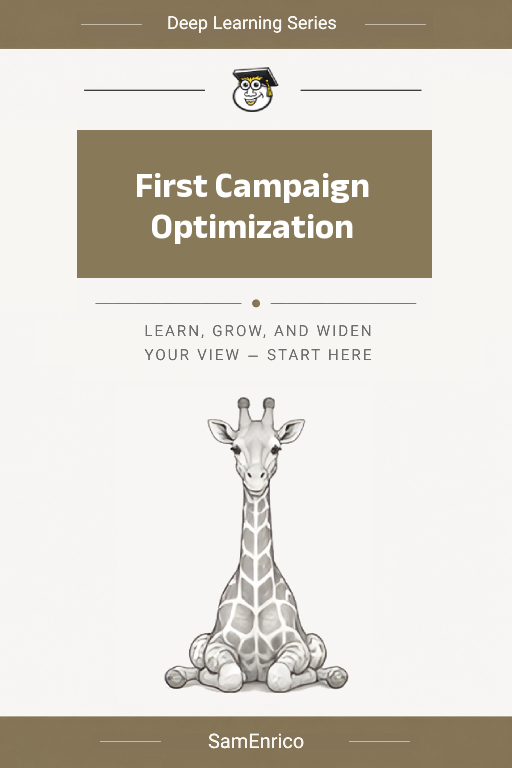
First Campaign Optimization eBook
Optimizes first Facebook ad campaign after 3-5 day
Optimizes first Facebook ad campaign after 3-5 days by adjusting underperforming ads, budgets, and targeting.
Formats
Free sample
Chapter 1: The Anxiety Gap...--–- The screen glowed at 2:13 AM. Seventy-three dollars had been spent. Forty-one link clicks. Zero purchases. Your finger hovered over the “Pause” button, trembling slightly.You are not alone.Every day, thousands of advertisers—savvy business owners, experienced marketers, even certified media buyers—do the exact same thing.
They launch a Facebook ad campaign with high hopes. They check it four hours later. No sales. They check it again before bed. Still nothing.
By morning, the anxiety has curdled into certainty: This campaign is a failure. I need to stop the bleeding.And then they pause it.That campaign—which might have turned profitable on Day 4, scaled beautifully on Day 7, and generated a 5x return by Day 14—dies at 36 hours old. The advertiser blames Facebook. They blame their product. They blame the algorithm.
But the real killer was not bad creative, poor targeting, or a weak offer. The real killer was the Anxiety Gap—the chasm between the data you have and the data you need, and the emotional panic that fills that void.This chapter exists to close that gap permanently.The Anatomy of Panic: Why Day 1 Feels Like Failure Let us begin with a simple truth that Facebook does not advertise, most gurus will not admit, and your own psychology actively rejects: Day 1 data is statistically meaningless.When you launch a campaign, Facebook’s delivery system does not immediately know who will buy your product. It does not know which placements will work best. It does not know whether Instagram Stories will outperform Facebook Feed, or whether your video ad will resonate more with women aged 25-34 than men aged 35-44.So it does what any intelligent system does: it experiments.During the first 24 to 48 hours, the algorithm enters what engineers call a “probing phase.” It deliberately shows your ad to a diverse range of users across different placements, times of day, and audience segments—not because it thinks those users will convert, but because it needs to gather data. It needs to learn which signals predict a conversion and which signals predict a scroll.This probing has a cost.
Your campaign will spend money on low-quality inventory. Your CTR will look anemic. Your CPM might spike. You might see zero purchases from the first 50 clicks. All of this is normal.
All of this is expected. And all of this triggers the same psychological response: panic.The Psychology of the Anxiety Gap Behavioral economists have studied this phenomenon extensively. It is called “myopic loss aversion” —the tendency to evaluate outcomes too frequently and to feel losses more acutely than equivalent gains.When you check your ad account every hour, you are evaluating performance on a sample size that is too small to be statistically significant. A single purchase or a single dry hour feels enormous. But that feeling is not data.
It is noise.Let me give you a concrete example from my own experience.I once managed a campaign for a direct-to-consumer mattress brand. The average order value was 1,200.Ourtargetcostperacquisitionwas1,200. Our target cost per acquisition was 1,200.Ourtargetcostperacquisitionwas180. On Day 1, we spent $500, generated 27 clicks, and sold exactly zero mattresses. The client called me at 9:00 AM the next morning, frantic.
“The campaign is broken,” he said. “Pause it.”I convinced him to wait three more days.On Day 2, we sold one mattress—but at a 210CPA,stillabovetarget.On Day3,wesoldtwomattresses:oneat210 CPA, still above target. On Day 3, we sold two mattresses: one at 210CPA,stillabovetarget.On Day3,wesoldtwomattresses:oneat190 CPA, one at 170.On Day4,thealgorithmexiteditslearningphase.Wesoldsevenmattressesatanaverage CPAof170. On Day 4, the algorithm exited its learning phase. We sold seven mattresses at an average CPA of 170.On Day4,thealgorithmexiteditslearningphase.Wesoldsevenmattressesatanaverage CPAof165.
By Day 7, we were consistently hitting $155 CPA, well below target.That campaign ran profitably for fourteen months.If we had paused on Day 1—as the client wanted—we would have left over $2 million in profitable revenue on the table. The Anxiety Gap would have cost us a fortune.Why Your 0.5% CTR Might Be a Winning Signal One of the most common triggers of the Anxiety Gap is a low click-through rate. You launch a campaign, check it twelve hours later, and see a CTR of 0.5%. Immediately, you assume your creative is terrible.But CTR is not an absolute measure. It is a relative measure that must be interpreted in context.Consider two scenarios:Scenario A: Your CTR is 0.5%, your CPM is $10, and your frequency is 1.1.Scenario B: Your CTR is 1.5%, your CPM is $45, and your frequency is 2.8.Which campaign is healthier?If you answered Scenario A, you are beginning to understand the Anxiety Gap.
Scenario A has a lower CTR, but the algorithm is delivering impressions at a bargain price. It is still probing, still learning, still finding cheap inventory. Scenario B has a higher CTR, but the CPM is unsustainable. The algorithm is overpaying for clicks on a tiny, hyper-competitive audience. Frequency is already climbing, meaning the same people are seeing the ad multiple times.In Scenario A, the campaign has room to scale.
In Scenario B, the campaign is already hitting a ceiling.The point is this: Do not evaluate CTR in isolation. Always read it alongside CPM and frequency. (We will dive deep into this diagnostic framework in Chapter 3.)The Statistical Case for Patience Let me put some numbers on this.To achieve statistical significance in Facebook advertising—meaning you can be 95% confident that your observed results reflect true performance rather than random chance—you generally need at least 50 conversions per ad set per week. This is why Meta itself uses the “50 conversions per week” threshold for exiting the Learning Phase. (We will cover this extensively in Chapter 2.)On Day 1, you almost certainly do not have 50 conversions.
In fact, for most advertisers, you do not even have 5 conversions. That means any conclusion you draw on Day 1 is statistically unreliable.Here is a practical rule: ignore the first 50 conversions or the first 72 hours, whichever comes later.If you are selling a high-ticket product with a long conversion cycle, you might need to wait 5-7 days before you have enough data to make a decision. If you are selling a low-ticket impulse buy, you might have enough data by Day 2. But in no case—zero, none, never—should you make a permanent decision based on the first 24 hours of data.The Volatility Index: A Tool for Emotional Regulation To help my clients manage the Anxiety Gap, I developed a simple tool called the Volatility Index.The Volatility Index is not a mathematical formula. It is a mental framework that acknowledges the inherent instability of early campaign data.
Here is how it works:Day 1: Expect extreme volatility. Metrics can swing 100% or more. Do not check your ads more than twice. Do not make any changes. Do not draw any conclusions.Day 2: Volatility is still high, but patterns may begin to emerge.
Check your ads once in the morning and once in the evening. You may note trends, but do not act on them yet.Day 3: Volatility has decreased significantly. You now have enough data to begin diagnosing problems—but only for diagnosis, not for major changes. (We will cover the Day 3 Triage in Chapters 4-7.)Day…
This is the end of the free sample. Get the eBook to keep going. Buy now
About this book
Details
- Author
- Sprague Lauralee
- Publisher
- SamEnrico
- Language
- English
- Genre
- Non-Fiction, First 30 Days, Optimization
- Released
- 2026-06-01
- Pages (approx.)
- 109
- Available as
- eBook, Audiobook

Read better in the ZLOADR app
Your eBooks on your phone or tablet. Sign in with your SamEnrico account and start reading.
More by Sprague Lauralee
 Stress Kidney Health GuideSprague Lauralee$11.99
 Mindful Scrolling WorkbookSprague Lauralee$11.99
 Burnout Recovery Return to WorkSprague Lauralee$11.99
 Cleopatra Naval Battle ActiumSprague Lauralee$11.99
 The Genetic Privacy and Insurance GuideSprague Lauralee$11.99
 Monteverdi's Revolution: The Birth of Modern MusicSprague Lauralee$11.99
 How to Start a Boards Made of Asbestos Business (Beginners Guide)Sprague Lauralee$11.99
 Financial Inclusion PitchSprague Lauralee$12.99
 Asset ArtistSprague Lauralee$11.99
 The Breeder's Guide to American Chinchilla RabbitsSprague Lauralee$11.99