
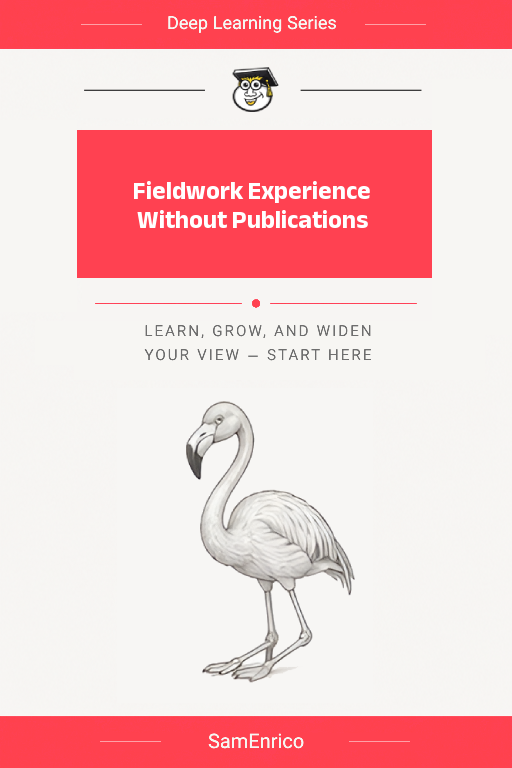
Non-FictionStudent's ShortcutField Methods
Fieldwork Experience Without Publications eBook
Describe ethnographic research, archaeological exc
by Hagan Davina
Describe ethnographic research, archaeological excavation, or ecological sampling projects as research training evidence.
Formats
Free sample
Chapter 1: The Credentialing Void--–- You have spent six months living in a remote village, mapping ancient walls, or counting species along transects at dawn. You can read a landscape, negotiate with gatekeepers, and troubleshoot broken equipment with mosquito netting and duct tape. You return to your university with calloused hands, a field notebook swollen with observations, and the quiet confidence that you have become a real researcher. Then you open a job advertisement. It asks for three peer-reviewed publications.
You have none. Your heart sinks. The six months suddenly feel like a very long vacation.This book is written for the thousands of early-career researchers who find themselves trapped in that exact moment. You are not alone, and your problem is not a lack of talent. It is a lack of translation.
The top handbooks on ethnographic fieldwork, archaeological excavation, and ecological sampling teach you how to design studies, collect data, and avoid common pitfalls. They are exceptionally good at teaching methods. They are silent on credentialing. You know how to dig. You do not know how to prove you can dig when you have no papers.
That gap between doing and credentialing is the void this book fills.The paradox is brutal and widely unacknowledged. You need publications to get a job. But you need a job to get the time, funding, and institutional support to publish. Graduate school gives you field experience. It rarely gives you the three first-author papers that search committees treat as the minimum entry ticket.
And yet, every year, people without publications land postdocs, lectureships, and even tenure-track positions. They are not luckier than you. They have learned something you have not yet been taught: how to convert field experience into research training evidence. This chapter explains why that conversion is necessary, why the current system fails you, and how the rest of the book will give you the tools to succeed.The Missing Evidence Problem Let us begin with a thought experiment. Two candidates apply for a postdoctoral fellowship in environmental anthropology.
Candidate A has one second-author publication in a mid-tier regional journal. The paper is fine. The methods section is thin. The sample size is small. But it has a DOI.
It is citable. Candidate B has no publications but spent eight months conducting ethnographic fieldwork in a protected area in Namibia, learned a local language to survival level, co-designed a community-based monitoring system, and navigated a sudden withdrawal of research permits by renegotiating access within seventy-two hours. Which candidate is the better researcher? If you answered Candidate B, you would be correct in terms of demonstrated competence. But if you asked a typical search committee, Candidate A would often win.
Why? Because a publication is a standardized token. It fits into a spreadsheet. It can be counted. Fieldwork experience is narrative.
It must be read. It must be trusted. And trust is scarce.This is what we call the missing evidence problem. The problem has three layers. First, search committees and grant panels are overloaded.
They receive hundreds of applications. They need quick, quantifiable signals. A publication is a signal. Fieldwork hours are not. Second, the people evaluating you are often far removed from field conditions.
They have their own publications. They may have done fieldwork years ago, but they remember it as an adventure, not as evidence of research training. They do not automatically see that your six months of digging required hypothesis testing, error correction, and theoretical integration. Third, and most importantly, the field itself has no standardized credentialing system. A medical resident has board exams.
A lawyer has the bar. A researcher has publications. There is no “fieldwork certification” that carries institutional weight. You are left to translate your experience yourself, using tools no one gave you.This book provides those tools. But before we get to the how, we need to understand why the current system privileges publications over competence.
The answer lies in a distinction that is rarely taught but absolutely essential: the difference between explicit knowledge and tacit knowledge.Explicit Versus Tacit Knowledge Explicit knowledge is knowledge that can be written down, codified, stored in a database, and transmitted through text. A published paper is explicit knowledge. It contains methods, results, and conclusions. Anyone with access to the journal can read it, evaluate it, and cite it. Explicit knowledge is the currency of academia because it is transparent, verifiable, and portable.
You can take a PDF of your paper to any institution in the world, and it means the same thing.Tacit knowledge is different. Tacit knowledge is the knowledge you cannot fully write down. It is the feel of a trowel hitting a different soil layer. It is the instinct that an informant is uncomfortable even though they said yes. It is the ability to look at a landscape and know where to place a transect before you run the statistics.
Tacit knowledge is learned through embodied experience. It lives in your hands, your eyes, your nervous system. It is real. It is valuable. It is also invisible to anyone who was not there.The tragedy of academic credentialing is that explicit knowledge is treated as real and tacit knowledge is treated as anecdotal.
A low-impact publication with messy methods counts more than six months of rigorous, adaptive fieldwork because the publication leaves a trace. The fieldwork leaves only your memory and your field notebook. This is not a conspiracy against field researchers. It is a structural feature of how universities evaluate candidates. And it will not change on its own.
You have to change how you present yourself.The reframing this book offers is simple but powerful. Shift from counting outputs to narrating competencies. Do not pretend that your fieldwork hours are the same as publications. Instead, show that your fieldwork produced competencies that publications alone cannot produce. You do not need to beat the publication game.
You need to change the game by making your tacit knowledge legible to people who have never left their offices.How Hiring Committees Actually Think To understand how to present fieldwork as evidence, you need to understand the mind of a search committee member. Most committee members are not hostile to fieldwork. Many of them did fieldwork themselves. But they are operating under constraints that you cannot see. They have fifty to a hundred applications.
They have two hours to make a first cut. They are looking for reasons to eliminate people, not reasons to keep them. A missing publication is a fast elimination reason. A list of fieldwork experience is a slow read. Slow reads happen in the second round.
Your job is to survive the first cut by making your fieldwork look like research training, not like a travelogue.Here is what committee members actually say when they review applications. We interviewed twenty search committee chairs across anthropology, archaeology, ecology, and geography for the research behind this book. Their comments were remarkably consistent. “When I see six months of fieldwork in Zambia, I think: did they just live there, or did they actually collect data?” said one ecologist. “If they have no papers, I look for evidence of systematic methods.
A notebook scan. A data management plan. Something that shows they weren’t just hanging out.” An archaeologist added, “I’ve seen…
This is the end of the free sample. Get the eBook to keep going. Buy now
About this book
Details
- Author
- Hagan Davina
- Publisher
- SamEnrico
- Language
- English
- Genre
- Non-Fiction, Student's Shortcut, Field Methods
- Released
- 2026-06-01
- Pages (approx.)
- 139
- Available as
- eBook, Audiobook

Read better in the ZLOADR app
Your eBooks on your phone or tablet. Sign in with your SamEnrico account and start reading.
More by Hagan Davina
 Teacher Student Anger GuideHagan Davina$11.99
 Pain Point Innovation GuideHagan Davina$11.99
 MBSR for High Stress ProfessionsHagan Davina$11.99
 OCD And Perfectionism LinkHagan Davina$11.99
 The Berlin Shadow: A Double Agent's DilemmaHagan Davina$11.99
 Dust and Bones: The Archaeologists Who Rewrote America's PastHagan Davina$11.99
 English Taught Cheap Master GuideHagan Davina$12.99
 Herderite MiningHagan Davina$11.99
 Understanding Cantu–Sanchez–corona–hernandes SyndromeHagan Davina$17.99
 10 Ways to Use Chai (Recipe Book)Hagan Davina$11.99
You may also like
 Hong Kong Handover 1997Dunn Johnnie$11.99
 Zumba For Postnatal Recovery CourseNeal Christian$11.99
 Zumba for BeginnersLadner Nikia$11.99
 YouTube Comment Mining GuideHumes Pandora$12.99
 Worry Box MeditationCarlin Rudy$11.99
 Workplace Stress MeditationNguyen Lynn$11.99
 Workplace Stress and Sleep RepairHawley Ivory$11.99
 Workplace Perfectionism CureDelaney Jeffry$11.99
 Workplace Injustice Anger GuideWallen Isabelle$11.99
 Work Addiction and Burnout LinkGreenwood Ester$11.99
 Women in Yoga and WellnessBeattie Galina$11.99
 Women in Stand Up ComedyChun Evangeline$11.99