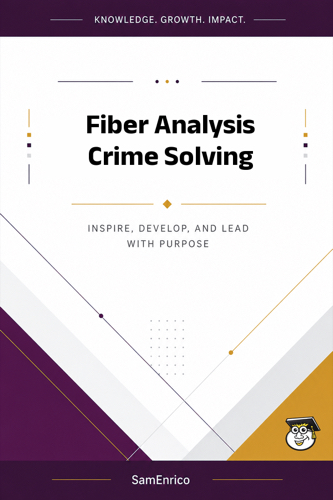
Fiber Analysis Crime Solving
Identifies textile fibers from clothing, carpets,
by Abreu Serina
Identifies textile fibers from clothing, carpets, and upholstery in criminal cases.
Formats
About this book
Free sample
Chapter 1: The Silent Witness...--The body of a ten-year-old girl lay in a field in northern England, her murder unsolved for nearly three decades. The killer had left no fingerprints, no DNA, no eyewitnesses. But he had left something else—something so small that investigators almost missed it. Three red fibers, no longer than a grain of rice, tangled in the victim's clothing. Those fibers would eventually travel across an ocean, survive decades of storage, and name a murderer who believed he had committed the perfect crime.This is the hidden world of fiber forensics—a world where the invisible becomes visible, where a single thread can speak louder than any witness, and where the clothes on your back can betray you long after you have left a crime scene.
It is a world built on a simple but profound truth: every time you enter a space, you leave something behind, and every time you leave, you take something with you. That truth is the bedrock upon which all forensic science rests, but nowhere is it more powerfully demonstrated than in the analysis of textile fibers.Consider the sheer ubiquity of fibers in modern life. The average person encounters thousands of textile surfaces every day—carpets beneath their feet, upholstery in their cars, clothing against their skin, bedding in their homes, towels in their bathrooms, curtains on their windows. Each of these surfaces sheds fibers constantly, invisibly, relentlessly. A single wool sweater can release hundreds of fibers during an hour of normal wear.
A carpet can shed thousands of fibers with every footstep. These fibers are so small—often less than a millimeter in length and thinner than a human hair—that they escape ordinary detection. But they do not escape forensic science.The Principle That Changed Everything In 1910, a French criminologist named Edmond Locard articulated what would become the foundational principle of modern forensic science. Locard's Exchange Principle states, in its simplest form, that every contact leaves a trace. When two objects touch, there is a transfer of material between them.
The murderer leaves something at the crime scene—a hair, a fiber, a drop of blood, a fingerprint—and takes something away…
This is the end of the free sample. Get the eBook to keep going. Buy now
Contents
- Chapter 1
- Chapter 2
- Chapter 3
- Chapter 4
- Chapter 5
- Chapter 6
- Chapter 7
- Chapter 8
- Chapter 9
- Chapter 10
- Chapter 11
- Chapter 12
Details
- Author
- Abreu Serina
- Publisher
- SamEnrico
- Language
- English
- Genre
- Non-Fiction, True Crime, Textile Forensics
- Released
- 2026-06-09
- Pages (approx.)
- 137
- Available as
- eBook, Audiobook

Read better in the ZLOADR app
Your eBooks on your phone or tablet. Sign in with your SamEnrico account and start reading.
More by Abreu Serina
 Social Media Gratitude ShiftAbreu Serina$11.99
 Anki Algorithm ExplainedAbreu Serina$11.99
 Corporate Workaholism GuideAbreu Serina$11.99
 Fencing Self Hypnosis GuideAbreu Serina$11.99
 The Vitamin A GuideAbreu Serina$11.99
 Jomo Kenyatta Mau Mau TrialAbreu Serina$11.99
 Influence For AthletesAbreu Serina$11.99
 The Phantom Trucker: Saudi Arabia's Highway of FearAbreu Serina$11.99
 The Ghosts of Shanghai: A Witness Vanishes in the Opium WarsAbreu Serina$11.99
 How to Start a Magnetic Disc (unrecorded) Business (Beginners Guide)Abreu Serina$11.99
 Online English Tutoring for Chinese Students GuideAbreu Serina$12.99
 Amazon Inventory Limits GuideAbreu Serina$12.99