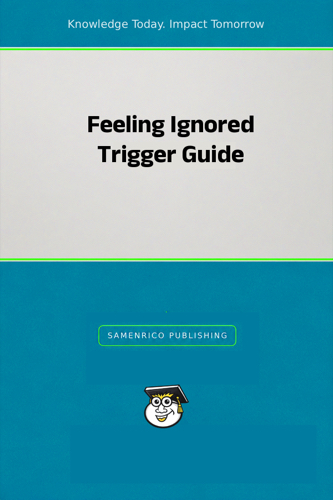
Feeling Ignored Trigger Guide eBook
Identifies being interrupted, overlooked, or exclu
by Mclain Oleta
Identifies being interrupted, overlooked, or excluded as anger sources.
Formats
Free sample
Chapter 1: The Hidden Wound--When Maria sat down for her team meeting on a Tuesday morning, she had no idea that a single five-second moment would ruin her entire day. She had prepared a thoughtful suggestion about streamlining their client intake process—something she had stayed up late refining. As she opened her mouth to speak, her colleague James jumped in, launched into his own idea, and the room turned its attention to him. Maria sat there, mouth slightly open, words dissolving on her tongue. No one noticed.
No one said, "Maria, what were you saying?" The meeting moved on. And Maria spent the next three hours replaying that moment in her head, her face flushing every time she remembered it, her stomach tightening with a feeling she could only describe as shame.She told herself she was being ridiculous. "It's just an interruption," she thought. "Why am I so sensitive? Why can't I just let it go?" By the time she got home, she was exhausted, irritable with her partner for no reason, and convinced that she was fundamentally too weak for corporate life.Here is what Maria did not know: her brain had just registered that interruption as a physical threat.
Not a metaphorical one. Not an "emotional" one in the soft, dismissive sense of that word. A literal, biological, fight-or-flight threat—the same kind her ancestors experienced when they saw a predator. And the shame she felt? That was not a sign of weakness.
That was a sign that her brain was working exactly as it had evolved to work.This chapter exists to give you one thing: permission. Permission to stop calling yourself "too sensitive." Permission to stop apologizing for caring. Permission to understand that the heat you feel when you are interrupted, overlooked, or excluded is not a character flaw—it is biology. And once you understand the biology, you can stop fighting yourself and start learning to work with the magnificent, ancient, sometimes-overprotective system between your ears.The Study That Changed Everything In 2003, a neuroscientist named Naomi Eisenberger at UCLA conducted an experiment that would fundamentally change how we understand social pain. She recruited volunteers to play a virtual ball-tossing game called Cyberball while inside a functional magnetic resonance imaging (f MRI) machine—a device that measures blood flow in the brain to show which regions are active.
The volunteers were told they were playing with two other people online. In reality, the other "players" were computer programs.For the first several tosses, everyone played fairly. The participant received the ball, threw it to someone else, and the game continued. But then something changed. The two other players stopped throwing the ball to the participant.
They threw only to each other. The participant sat there, watching the ball move back and forth between two digital avatars, never coming their way. The exclusion lasted less than two minutes.The results were astonishing. When participants were excluded, the f MRI showed intense activity in a region of the brain called the anterior cingulate cortex—specifically, the dorsal portion. What makes this finding so significant is that this same brain region is also active when someone experiences physical pain.
Getting burned? That lights up the anterior cingulate cortex. Breaking a bone? That lights up the anterior cingulate cortex. And being left out of a ball-tossing game for ninety seconds?
The same exact signature.Eisenberger had discovered what she called the "neural overlap" between social and physical pain. Your brain does not distinguish between a broken arm and a broken heart. It does not have a separate "social ouch" circuit. It uses the same ancient hardware to process a punch to the face and a punch to the ego. As Eisenberger later wrote, "These findings suggest that the experience of social rejection—or even just being ignored—may share a common neurobiological substrate with the experience of physical pain."Let that land for a moment.
When you are interrupted in a meeting, when your text goes unanswered, when you are left off the group email, when your partner scrolls past you on their phone—your brain is processing that event using the same neural tissue that processes a stubbed toe, a burn, or a broken bone. You are not "too sensitive." You are human.The Physiological Cascade: What Happens Inside Your Body The anterior cingulate cortex is only the beginning. When you experience a social snub—an interruption, an overlook, or an exclusion—your body initiates a full-scale physiological cascade that prepares you for a threat. This is the same cascade that kept your ancestors alive when they were separated from their tribe, which in prehistoric times meant almost certain death. Let us walk through what happens in the first ten seconds after you feel ignored.Second One: Your eyes and ears send signals to your thalamus, the brain's relay station.
The thalamus quickly determines that something unexpected and negative has occurred—your voice was not heard, your presence was not acknowledged, you were left out.Second Two to Three: The amygdala, two almond-shaped clusters deep in your brain, sounds the alarm. The amygdala does not think. It does not reason. It reacts. Within milliseconds, it sends distress signals to every major system in your body.
The amygdala's motto is "better safe than sorry"—it would rather mistake a stick for a snake than a snake for a stick. So when it perceives a social threat, it treats that threat as if your life depends on it.Second Four to Five: Your hypothalamus activates the sympathetic nervous system—your fight-or-flight response. It signals your adrenal glands to release a flood of hormones, primarily adrenaline (epinephrine) and norepinephrine. Your heart rate spikes. Your blood pressure rises.
Your breathing becomes shallow and rapid. Blood is redirected away from your digestive system and toward your large muscles, preparing you to run or fight.Second Six to Seven: Your adrenal cortex releases cortisol, the primary stress hormone. Cortisol increases glucose in your bloodstream, enhances your brain's use of glucose, and increases the availability of substances that repair tissues. In a genuine physical threat, cortisol is protective. In response to a social snub, cortisol is simply exhausting.Second Eight to Ten: The physical sensations arrive.
Your face might flush as blood vessels dilate. Your hands might feel cold as blood rushes to your core muscles. Your stomach might tighten or churn as digestion slows. Your jaw might clench. Your shoulders might rise toward your ears.
You might feel a lump in your throat or a tightness in your chest.This entire cascade happens faster than you can say "I feel ignored." By the time you consciously register the emotion—anger, shame, sadness, or some confusing mixture of all three—your body has already mobilized for war. And here is the cruelest part: there is no predator to fight and nowhere to run. You are sitting in a meeting, standing at a party, or staring at your phone. So all that physiological energy has nowhere to go. It circulates through your body, turning into rumination, irritability, exhaustion, and self-doubt.Why Your Brain Cannot Tell the Difference You might be wondering: why would evolution create such a seemingly dysfunctional system?…
This is the end of the free sample. Get the eBook to keep going. Buy now
About this book
Details
- Author
- Mclain Oleta
- Publisher
- SamEnrico
- Language
- English
- Genre
- Non-Fiction, Self-Help, Social Exclusion
- Released
- 2026-06-11
- Pages (approx.)
- 149
- Available as
- eBook, Audiobook

Read better in the ZLOADR app
Your eBooks on your phone or tablet. Sign in with your SamEnrico account and start reading.
More by Mclain Oleta
 Fertility and Embryo AdoptionMclain Oleta$11.99
 Caregiver Burnout In HIV CareMclain Oleta$11.99
 The Miscarriage Nightmare GuideMclain Oleta$11.99
 Anger at Boss Cognitive RestructuringMclain Oleta$11.99
 The Apalachin Conspiracy: Europe's Forgotten Mafia SummitMclain Oleta$11.99
 Understanding OikophobiaMclain Oleta$17.99
 Tenet Healthcare SWOTMclain Oleta$12.99
 Salesforce Remote Internship SecretsMclain Oleta$12.99
 Customer Retention and Loyalty ProgramsMclain Oleta$11.99
 How to Become a Laundry OperatorMclain Oleta$11.99