
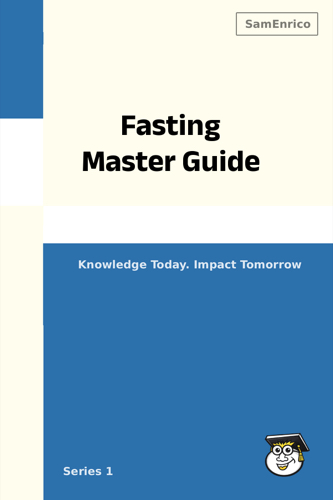
Non-FictionHealth & WellnessComplete
Fasting Master Guide eBook
Complete reference for all intermittent fasting pr
by Darby Johnie
Complete reference for all intermittent fasting protocols.
Formats
Free sample
Chapter 1: Beyond The Calorie...--–- The woman sitting across from me had done everything she was supposed to do. For eight months, she had meticulously recorded every morsel that passed her lips. She weighed her chicken breast on a digital scale. She measured her olive oil by the teaspoon. She never exceeded 1,400 calories per day, not once, not even on her birthday.
She attended spin class three mornings per week and walked her dog two miles every evening. She had lost exactly four pounds in thirty-two weeks. Her doctor had just prescribed metformin for rising blood sugar and atorvastatin for climbing cholesterol. She was forty-one years old, ate less than most of her teenage children, and could not understand why her body refused to cooperate.Her name was Michelle, and her story is not unusual. It is, in fact, the story of millions of people who have been told, with complete confidence and utter wrongness, that weight loss is simple arithmetic.
Eat less than you burn. Move more. Trust the math. When the math does not work, the conclusion is always the same: you must be cheating, or misremembering, or secretly eating spoonfuls of Nutella at midnight. The problem, we are told, is not the advice.
The problem is you.What if the advice is wrong? What if the entire framework of calories in versus calories out is not merely oversimplified but fundamentally, dangerously, backward? What if the body is not a simple furnace but a complex, intelligent system that responds to the timing of food more than the quantity? What if Michelle could have eaten more, not less, and lost weight by changing not what she ate but when?This chapter dismantles the most persistent and damaging myth in modern nutrition: that a calorie is a calorie, that weight loss is subtraction, and that your body is a passive vessel waiting to burn whatever fuel you provide. None of this is true.
Your body is not a furnace. It is a fortress with gates, guards, and a sophisticated communication system that decides, moment by moment, whether to store energy or release it. That communication system is hormonal. And the single most powerful lever you have to change that communication is intermittent fasting.We will begin by destroying the calorie myth completely, leaving no room for resurrection. Then we will build from the ashes a new understanding of how your body actually works—the fed state and the fasted state, the hormones that control every aspect of energy storage, and the metabolic switch that determines whether you are burning sugar or burning fat.
By the end of this chapter, you will understand why Michelle could not lose weight despite doing everything right, and why the solution was not more discipline but a completely different approach.The Great Calorie Deception Let us start with a simple question: if a calorie is a calorie, why do two people eating the exact same number of calories have completely different outcomes? This is not a hypothetical. It is the result of dozens of controlled feeding studies in which researchers locked participants in metabolic wards and fed them precisely measured meals.Consider the 2012 study from the Journal of the American Medical Association. Researchers took two groups of overweight adults and fed them identical calorie deficits—750 calories below maintenance—for eight weeks. One group consumed three meals per day.
The other group consumed three meals per day but restricted all eating to an eight-hour window. Both groups ate the same number of total calories. Both groups had the same macronutrient composition. The only difference was timing.The time-restricted group lost significantly more body fat. Their insulin levels dropped lower.
Their markers of inflammation improved more. The same calories, different timing, completely different metabolic outcomes. How is this possible? The answer is hormones, not arithmetic.Or consider the phenomenon of isocaloric substitution. When researchers replace refined carbohydrates with an equal number of calories from protein or fat, body composition changes even when weight does not.
People lose fat and gain muscle on the same number of calories simply by changing what those calories are made of. The calorie model cannot explain this. The hormonal model can.The fundamental error of the calorie model is that it treats the human body as a passive incinerator. In a bomb calorimeter, a hundred calories of olive oil and a hundred calories of table sugar release the same amount of heat when burned. Your body is not a bomb calorimeter.
It is a living system with receptors, feedback loops, and evolutionary priorities that were shaped over millions of years of feast and famine.When you eat a hundred calories of table sugar, blood glucose spikes rapidly. The pancreas releases a surge of insulin to clear that glucose from your bloodstream. That insulin signals your fat cells to lock their doors. Any glucose not immediately needed for energy is converted to fat and stored. You may feel hungry again within an hour as blood glucose crashes.When you eat a hundred calories of olive oil, blood glucose barely moves.
Insulin does not spike. The fat is digested slowly, absorbed into the lymphatic system, and either burned for energy or stored as fat—but without the insulin surge that makes fat storage so efficient. You feel satisfied for hours.Same calories. Completely different hormonal responses. Completely different effects on your body.
A calorie is not a calorie.The calorie model also fails catastrophically in the real world. If weight loss were simply a matter of eating less, then calorie restriction would produce reliable, sustained weight loss in the majority of people who attempt it. It does not. The long-term failure rate of calorie restriction for obesity treatment is approximately 95 percent. This is not because people are weak.
It is because the body adapts.When you reduce calorie intake without changing eating frequency, your body responds as if it is starving. It lowers resting metabolic rate. It increases hunger hormones. It reduces spontaneous movement. It becomes more efficient at storing fat when food becomes available again.
These adaptations are not failures of willpower. They are ancient survival mechanisms that kept your ancestors alive through famines. Your body is doing exactly what it evolved to do. It is the strategy that is wrong.Defining Intermittent Fasting: An Eating Pattern, Not A Diet Before we proceed into the hormonal details, let us clarify what intermittent fasting actually is. This is essential because the term is often misunderstood and misapplied.Intermittent fasting is not a diet in the conventional sense.
A diet tells you what to eat. It prescribes specific foods, forbids others, and often requires special products, shakes, or meal replacements. Intermittent fasting does none of these things. It is an eating pattern—a schedule that tells you when to eat, not what to eat.This distinction is liberating. You do not need to buy anything.
You do not need to eliminate entire food groups. You do not need to cook separate meals from your family. You simply need to compress your eating into a defined window and extend the period during which you do not eat.That said, a critical reality check: you cannot out-fast…
This is the end of the free sample. Get the eBook to keep going. Buy now
About this book
Details
- Author
- Darby Johnie
- Publisher
- SamEnrico
- Language
- English
- Genre
- Non-Fiction, Health & Wellness, Complete
- Released
- 2026-06-05
- Pages (approx.)
- 158
- Available as
- eBook, Audiobook

Read better in the ZLOADR app
Your eBooks on your phone or tablet. Sign in with your SamEnrico account and start reading.
More by Darby Johnie
 Senior Sexuality And AgingDarby Johnie$11.99
 Priority Matrix TrainingDarby Johnie$11.99
 Teresa and John of the CrossDarby Johnie$11.99
 DBT for Chronic IllnessDarby Johnie$11.99
 Light Therapy for Shift WorkersDarby Johnie$11.99
 Social Support for Quitting TobaccoDarby Johnie$11.99
 NVC for Healthcare GuideDarby Johnie$11.99
 The Silk Road of Brushstrokes: Zhang Zeduan’s *Along the River During the Qingming Festival*Darby Johnie$11.99
 The Balloon Bombers of Tyburn: Britain's Secret Air War (1794)Darby Johnie$11.99
 Service Providers Guide to Fitness CentersDarby Johnie$11.99
 A Collector's Handbook to the Hispano-suiza T60Darby Johnie$11.99
 How to Produce Industrial Marking Equipment and SuppliesDarby Johnie$11.99
You may also like
 Hong Kong Handover 1997Dunn Johnnie$11.99
 Zumba For Postnatal Recovery CourseNeal Christian$11.99
 Zumba for BeginnersLadner Nikia$11.99
 YouTube Comment Mining GuideHumes Pandora$12.99
 Worry Box MeditationCarlin Rudy$11.99
 Workplace Stress MeditationNguyen Lynn$11.99
 Workplace Stress and Sleep RepairHawley Ivory$11.99
 Workplace Perfectionism CureDelaney Jeffry$11.99
 Workplace Injustice Anger GuideWallen Isabelle$11.99
 Work Addiction and Burnout LinkGreenwood Ester$11.99
 Women in Yoga and WellnessBeattie Galina$11.99
 Women in Stand Up ComedyChun Evangeline$11.99