
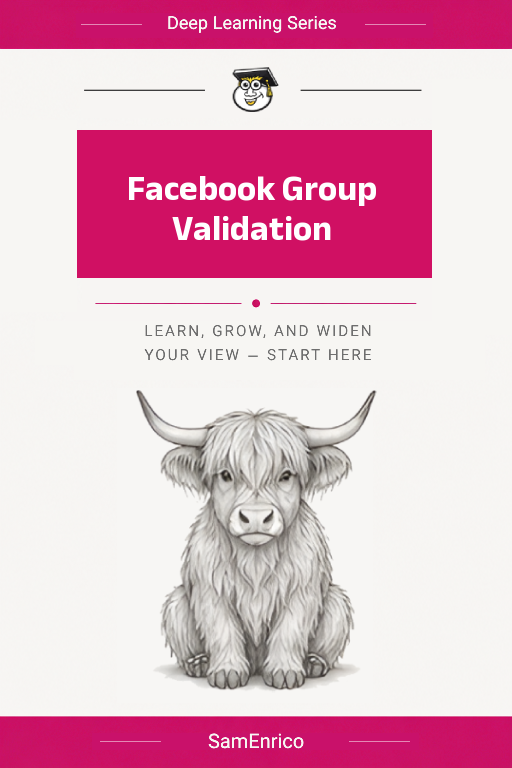
Facebook Group Validation eBook
Test ideas in free Facebook groups. Niche communit
Test ideas in free Facebook groups. Niche communities for targeted feedback.
Formats
Free sample
Chapter 1: The Lurker's Goldmine--–- The first time I lost $15,000, I was proud of myself. Really.I had done everything right. I’d identified a problem (dog owners frustrated with messy water bowls). I’d designed a solution (a spill-proof bowl with a floating lid). I’d sourced manufacturers, negotiated pricing, and ordered 1,000 units.
I’d even built a beautiful Shopify store with professional product photography. Then I launched to… crickets. Seven sales in three weeks. Four of them from my mother.The humiliating part? I had spent six months and fifteen thousand dollars proving something that thirty minutes in the right Facebook group could have told me for free: nobody actually wanted my floating lid.
The problem I solved existed, yes. But the solution I built created a new problem—the lid trapped moisture and grew mold within days. I had never asked a single potential customer before I built.That was my $15,000 education in the difference between a good idea and a validated idea.This book exists because I have since watched hundreds of entrepreneurs make the same mistake. They build apps nobody downloads, courses nobody completes, products nobody buys. They spend months coding, manufacturing, or recording—only to discover that their brilliant solution solves a problem that doesn't exist, or solves it in a way customers hate.The alternative is so simple that most people overlook it.
Before you build anything, you spend 72 hours watching. That's it. No posting. No selling. No "building in public." Just watching.
And in those 72 hours, the market will tell you exactly what to build, how to price it, and what words to use to sell it.This is not theory. This is not "growth hack" noise. This is the difference between gambling and knowing.The $15,000 Mistake That Became a Method After my floating bowl failure, I became obsessed with one question: what is the cheapest, fastest way to know if an idea will sell before I spend money on it? I interviewed founders who had launched successfully. I reverse-engineered their processes.
And I discovered a pattern that surprised me.Almost every successful bootstrapped founder I spoke with had done the same thing before writing a line of code or ordering inventory. They had spent time in Facebook groups. Not posting. Not promoting. Just… lurking.One founder had validated a $40,000 per month software product by spending a week in a Facebook group for struggling real estate agents.
She never posted a single word. She simply read the questions agents were asking each other, then built the tool that answered the most frequently asked question.Another founder had validated a physical product—a specialized backpack for photographers—by watching arguments unfold in a gear review group. Photographers kept complaining that every bag on the market was either too big or too small for their specific kit. He designed a modular bag that solved the exact complaint he saw repeated seventeen times.Neither of these founders had a "launch strategy." Neither had a marketing budget. Neither had an email list.
They had a pain point inventory—a ranked list of exactly what their future customers were frustrated about, written in the customers' own words.This is what I call The Lurker's Advantage. It is the superpower of being willing to shut up and listen before you speak.Why Facebook Groups Are the Internet's Best Focus Group Let me make a provocative statement: Facebook Groups are better than traditional focus groups, survey tools, and customer interviews combined. Here is why.Traditional focus groups cost 5,000to5,000 to 5,000to15,000 per session. You recruit strangers, bring them into a room, and ask them hypothetical questions. They answer with hypothetical answers.
People are notoriously bad at predicting their own behavior, especially when they are being paid to sit in a room with a one-way mirror.Surveys are cheaper but worse. When you send a survey, you are asking people to remember their feelings out of context. The response rate is terrible, and the people who do respond are not representative of your target market. They are representative of "people who fill out surveys," which is a distinct and weird demographic.Customer interviews are better, but they suffer from a different problem: politeness. When you sit across from someone and ask "Would you buy this product?", they will almost always say yes.
They want to be nice. They want to encourage you. They will say "that sounds great" and then never open their wallet.Facebook Groups solve all three problems simultaneously.First, they are free. You are not paying for access to a focus group. You are joining a community that already exists, full of people who are already talking about their problems.Second, the data is unpolluted.
People are not performing for you. They are complaining, venting, asking for help, and sharing hacks with each other. This is raw, unfiltered, emotionally charged language. It is the gold standard of market research.Third, the sample size is massive. A single active group might have 50,000 members generating hundreds of posts per day.
That is more data than you could collect in a year of focus groups.Fourth, the context is perfect. People are speaking from inside their actual lives, not from a hypothetical scenario. When a parent posts at 11 PM asking "How do I get my toddler to stop throwing food?", that is a real problem with real urgency. You cannot manufacture that kind of insight in a survey.The 72-Hour Rule: Why Speed Beats Perfection Here is the most important number in this book: seventy-two.Seventy-two hours is the maximum amount of time you should spend in observation mode before you start testing. I have watched entrepreneurs get stuck in "research paralysis," spending weeks or months reading group posts, taking notes, and never actually validating an idea.
They are using research as a form of procrastination.The 72-Hour Rule exists to prevent this. It is borrowed from the lean startup methodology, but adapted for the speed of social media. In three days, you can gather enough data to make a go/no-go decision on an idea. Not perfect data. Not statistically significant data.
Enough data.Here is what seventy-two hours of focused observation looks like:Day 1: Join and Scan. You join five to ten groups that meet the criteria we will cover in Chapter 2. You scroll through the last seven days of posts in each group. You are looking for patterns, not individual data points. You note the top three recurring questions or complaints in each group.Day 2: Deep Dive.
You choose the three most active groups from Day 1. You read every post from the last forty-eight hours. You click into the comments. You pay special attention to posts with more than twenty comments—these are topics that have struck a nerve. You document the exact phrases people use.Day 3: Synthesis.
You review your notes and look for overlap. Which problems appear across multiple groups? Which complaints use the same language? Which questions keep going unanswered? You rank the problems by frequency and emotional intensity.
By the end of Day 3, you have your Pain Point Inventory.That is it. Seventy-two hours. Then you move to testing.The Pain Point Inventory: Your…
This is the end of the free sample. Get the eBook to keep going. Buy now
About this book
Details
- Author
- Stanfield Alfreda
- Publisher
- SamEnrico
- Language
- English
- Genre
- Non-Fiction, Startup Guide, Lean Methodology
- Released
- 2026-06-01
- Pages (approx.)
- 141
- Available as
- eBook, Audiobook

Read better in the ZLOADR app
Your eBooks on your phone or tablet. Sign in with your SamEnrico account and start reading.
More by Stanfield Alfreda
 Insecurity Root CausesStanfield Alfreda$11.99
 Management Consultant StressStanfield Alfreda$11.99
 TM Posture and Comfort GuideStanfield Alfreda$11.99
 The Relapse Prevention for CannabisStanfield Alfreda$11.99
 The IBS Misdiagnosis GuideStanfield Alfreda$11.99
 The Phantom Battalion: The Lost Legion of GallipoliStanfield Alfreda$11.99
 Understanding Thumb Stiff Brachydactyly Mental RetardationStanfield Alfreda$17.99
 Brazil Invoice Factoring GuideStanfield Alfreda$12.99
 10 Ways to Use Date Sugar (Recipe Book)Stanfield Alfreda$11.99
 Safety SpecialistStanfield Alfreda$11.99
You may also like
 Lean Business Plan TemplateSwart Jannette$11.99
 No Money Idea Validation GuideLevy Joel$12.99
 Zero Cost Pivot GuideJoyner Cammie$12.99
 Solution Interview TechniqueCreech Blythe$12.99
 Reddit Validation MethodBarnette Ellie$12.99
 Quora Question ValidationMcmanus Jenifer$12.99
 Problem Interview TechniqueCordero Mafalda$12.99
 MVP Without Coding GuideRoche Alejandra$12.99
 LinkedIn Poll ValidationMojica Gavin$12.99
 Google Forms Survey GuidePuente Micah$12.99
 Free YouTube Channel GuideNixon Odette$12.99
 Free Video Validation GuideMcallister Tosha$12.99