
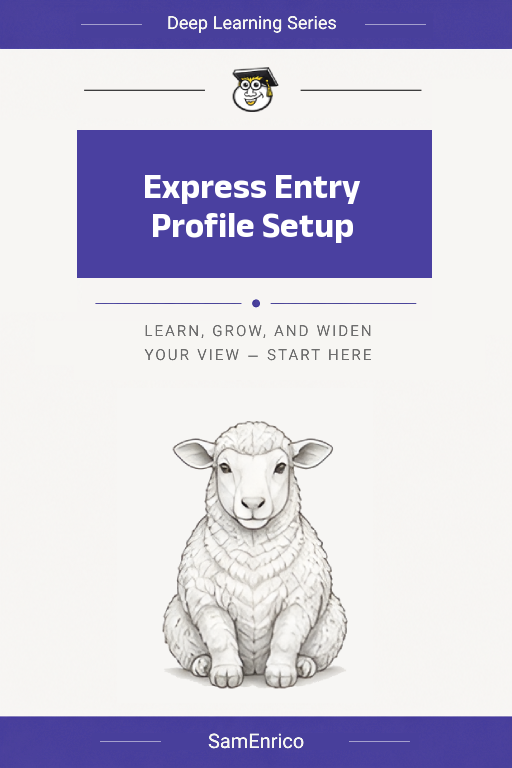
Non-FictionStudent's ShortcutProfile
Express Entry Profile Setup eBook
Create and submit your Express Entry profile inclu
Create and submit your Express Entry profile including education credentials, language tests, and work history.
Formats
Free sample
Chapter 1: The Hidden Trap--Most people who fail Express Entry never see it coming.They spend months—sometimes years—collecting documents, studying for language tests, paying for educational credential assessments, and carefully entering their work history into the IRCC portal. They watch their CRS score climb to 480, then 490, then 510. They feel confident. They feel ready.And then they never receive an Invitation to Apply.Meanwhile, a candidate with a lower CRS score—sometimes dramatically lower—gets an ITA within weeks of submitting their profile. The higher-scoring candidate is left confused, frustrated, and convinced the system is broken.The system is not broken.
The system has changed.And no one told them.If you are reading this book, you have likely heard about Express Entry. You may have already used the CRS calculator. You may have even started collecting documents. But before you spend another dollar on language tests or another hour gathering employment letters, you need to understand one uncomfortable truth:The old rules are dead. Playing the old game will cost you years.This chapter will show you exactly how the Express Entry landscape has transformed since 2024, why your high CRS score may be worthless if it is not attached to the right category, and—most critically—how to determine within the next hour whether you are even eligible to play at all.The Moment Everything Changed On April 23, 2024, Immigration, Refugees and Citizenship Canada (IRCC) conducted what would become its last all-program draw for the foreseeable future.
The cut-off score was 529. Eleven thousand three hundred and seventy candidates received invitations.It looked like business as usual.But the next draw—and the next, and the next—told a different story. Category-based selections for healthcare, STEM, trades, and French-language proficiency began appearing with increasing frequency. General draws, once the backbone of Express Entry, became ghosts. By late 2024, IRCC had pivoted its operational priorities so dramatically that immigration consultants began advising clients to stop chasing high CRS scores and start chasing categories.Why did this happen?The answer lies in Canada's labor market.
Healthcare positions remain critically unfilled. Skilled trades face a retirement crisis. Francophone immigration outside Quebec has become a political and demographic priority. And STEM—particularly technology roles—continues to drive economic growth.IRCC responded by redesigning Express Entry not as a general competition for points, but as a targeted recruitment mechanism for specific economic needs.The result is a two-tier system.Tier One: Category-Bound Candidates – These applicants align with one of IRCC's priority categories (Healthcare, STEM, Trades, French). They compete in separate draws with lower cut-off scores.
In 2025, French-language draws consistently scored between 401 and 430. STEM draws ranged from 450 to 480.Tier Two: Unattached Candidates – These applicants have high CRS scores but no category alignment. They wait for the rare general draws, which—when they occur—require scores above 520. Most never receive an ITA.The candidate with a 480 CRS score in healthcare will almost certainly receive an ITA before the candidate with a 510 CRS score in general management. This is not a bug.
This is the system working exactly as designed.The Multi-Lane Strategy: Why You Need More Than One Path Before the 2024 changes, Express Entry was a single-lane highway. You built the best profile possible, submitted it, and waited. If your score was high enough, you received an ITA. If not, you improved your language scores or gained more experience and tried again.That strategy is now obsolete.Today, a successful Express Entry candidate must think like a portfolio manager, not a test-taker. You are not trying to maximize a single number.
You are trying to position yourself to win in multiple competitions simultaneously.Lane One: Category-Based Draws These are your primary target. As of this writing, IRCC has designated five priority categories:Healthcare occupations – Doctors, nurses, pharmacists, dentists, physiotherapists, and approximately 35 other specific roles STEM occupations – Software engineers, data scientists, cybersecurity specialists, mathematicians, and related technical roles Trades occupations – Carpenters, electricians, plumbers, welders, and other skilled trades French-language proficiency – Any occupation, provided the candidate demonstrates CLB 7 or higher in French (with CLB 5 or higher in English)Agriculture and agri-food – A smaller category with specific occupational requirements If your occupation falls into one of these categories, you have a significant advantage. If it does not, you have two options: change your targeting (by emphasizing different aspects of your existing job duties) or change your qualifications (by adding French proficiency).Lane Two: Provincial Nominee Program (PNP) Alignment Every province except Quebec operates its own immigration programs. Many provinces have streams aligned with Express Entry. When a province nominates you, you receive 600 additional CRS points—effectively guaranteeing an ITA.The critical insight is that you can signal interest to provinces directly through your Express Entry profile.
Some provinces (Alberta, Ontario, British Columbia, Saskatchewan) actively scan the Express Entry pool for candidates who have indicated interest in their province. You do not need to file separate applications for these provinces, though you should understand that this is not universal. Other provinces require separate applications filed directly with the provincial government.We will cover the specific differences between passive and active provinces in Chapter 9. For now, understand that your profile can target category-based draws and provincial nominations simultaneously. The two lanes are not mutually exclusive.Lane Three: General Draws (The Rare Lane)General draws still occur, but they are neither frequent nor predictable.
When they do occur, cut-off scores are extremely high—typically above 520. Unless your CRS score exceeds 520 without relying on a provincial nomination or category bonus, you should not base your strategy on general draws.Treat general draws as a lottery ticket, not a plan.The 67-Point Filter: Your First and Most Important Test Here is where most books get it wrong.They begin with the CRS score. They talk about language tests, educational credentials, work experience, and all the ways to maximize points. And they completely skip the step that disqualifies more candidates than any other.The Comprehensive Ranking System is not the only test you must pass.Before your profile is even eligible for the Express Entry pool, you must first qualify for one of the three economic immigration programs that feed into Express Entry:The Federal Skilled Worker Program (FSWP)The Canadian Experience Class (CEC)The Federal Skilled Trades Program (FSTP)For the vast majority of candidates outside Canada—that is, applicants without Canadian work experience or Canadian education—the relevant program is the Federal Skilled Worker Program.The FSWP has its own separate points grid. You need 67 points out of 100 on this grid just to be eligible to enter the Express Entry pool.
You can have a 550 CRS score and still be ineligible for Express Entry if you fail the 67-point test.This is not a theoretical risk. Immigration consultants report that approximately 15 percent of clients who believe they are eligible for Express Entry actually fail the 67-point test. They only discover this after spending thousands of dollars on document collection and language testing.We are not going to let that happen to you.The Six Factors of the FSW Eligibility Test The FSW points grid evaluates six factors. Some of these factors overlap with the CRS, but the scoring is different. You must calculate your FSW points separately…
This is the end of the free sample. Get the eBook to keep going. Buy now
About this book
Details
- Author
- Perrin Corrina
- Publisher
- SamEnrico
- Language
- English
- Genre
- Non-Fiction, Student's Shortcut, Profile
- Released
- 2026-06-01
- Pages (approx.)
- 135
- Available as
- eBook, Audiobook

Read better in the ZLOADR app
Your eBooks on your phone or tablet. Sign in with your SamEnrico account and start reading.
More by Perrin Corrina
 Reiki Hand Positions GuidePerrin Corrina$11.99
 Shoe Print ReconstructionPerrin Corrina$11.99
 Self Care Anticipatory GriefPerrin Corrina$11.99
 LBO Model Assumptions DatabasePerrin Corrina$11.99
 Morning Block RoutinePerrin Corrina$11.99
 SMART For Education GuidePerrin Corrina$11.99
 Self Hypnosis for Portion ControlPerrin Corrina$11.99
 Emotional Validation for TeensPerrin Corrina$11.99
 The Helvetian Forges: Switzerland's Medieval InnovationPerrin Corrina$11.99
 The Mead Halls of the North: Viking Brewmasters and the Birth of Scandinavian FeastingPerrin Corrina$11.99
 A Collector's Handbook to the Vauxhall Wyvern EixPerrin Corrina$11.99
 How to Produce PET Care ServicesPerrin Corrina$11.99
You may also like
 Hong Kong Handover 1997Dunn Johnnie$11.99
 Zumba For Postnatal Recovery CourseNeal Christian$11.99
 Zumba for BeginnersLadner Nikia$11.99
 YouTube Comment Mining GuideHumes Pandora$12.99
 Worry Box MeditationCarlin Rudy$11.99
 Workplace Stress MeditationNguyen Lynn$11.99
 Workplace Stress and Sleep RepairHawley Ivory$11.99
 Workplace Perfectionism CureDelaney Jeffry$11.99
 Workplace Injustice Anger GuideWallen Isabelle$11.99
 Work Addiction and Burnout LinkGreenwood Ester$11.99
 Women in Yoga and WellnessBeattie Galina$11.99
 Women in Stand Up ComedyChun Evangeline$11.99