
Non-FictionTrue CrimeExplosive Analysis
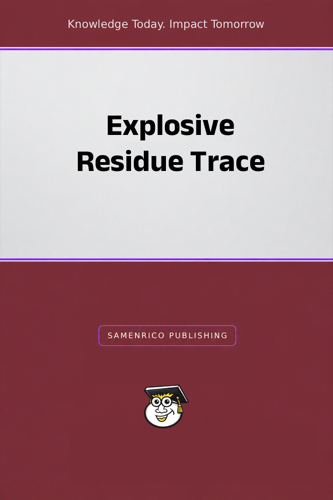
Explosive Residue Trace eBook
Detect explosive compounds on surfaces using foren
Detect explosive compounds on surfaces using forensic chemistry techniques.
Formats
Free sample
Chapter 1: The Invisible Killers...--–- The bomb had already detonated. The fire crew had doused the smoldering wreckage. The medical examiner had removed the remains. The crime scene was, by most definitions, over. But on the cracked dashboard of the burned sedan, on the jagged edge of a shattered window frame, and deep within the fibers of a discarded jacket lying fifty meters from the blast epicenter, something invisible remained.
Millions of molecules of TNT, RDX, PETN, and nitroglycerin – remnants of an explosive device that had been designed to erase itself – clung stubbornly to surfaces, waiting. To the untrained eye, the scene was sterile. To the forensic chemist, it was a library written in molecules, each residue a sentence about what had been made, who had made it, and perhaps, where they had learned to do so.–- This book is about finding those molecular sentences. More specifically, Explosive Residue Trace: Forensic Chemistry for Surface Detection is a comprehensive guide to the science, art, and legal rigor of locating, recovering, identifying, and testifying about trace amounts of energetic materials left behind on surfaces after an explosion, a manufacturing process, or even casual handling. Before we can swab a surface, before we can inject a sample into a gas chromatograph, and before we can stand before a jury and state that the residue “is consistent with TNT,” we must first answer a fundamental question: What, exactly, are we looking for?
This first chapter builds the essential chemical vocabulary for everything that follows. Without a clear taxonomy of energetic materials – their structures, their behaviors, their families, and their fates – the detective work of trace residue analysis is impossible. We must learn to name the invisible killers before we can hunt them.–- The Critical Distinction: Low vs. High Explosives–- The most fundamental division in the world of energetic materials is between low explosives and high explosives. This is not merely a semantic distinction; it determines how a substance behaves, how it is initiated, what kind of residue it leaves, and how that residue must be recovered and analyzed.–- Low explosives undergo deflagration, a rapid combustion that propagates through the material at subsonic speeds (less than the speed of sound in that material, typically below 1000 meters per second).
Deflagration is essentially a very fast burn, driven by the transfer of heat from the burning layer to the unburned layer immediately adjacent. Common examples include black powder (a mixture of potassium nitrate, charcoal, and sulfur) and smokeless powder (primarily nitrocellulose, often with nitroglycerin as a plasticizer). Low explosives are typically used as propellants – in firearms, fireworks, and rocket motors – because they generate large volumes of hot gas that push a projectile rather than shattering its container. Importantly, low explosives rarely leave behind intact parent molecules after deflagration; instead, they produce characteristic inorganic salts (potassium carbonate, potassium sulfate, sulfides) and partially burned organic residues. For the trace analyst, finding black powder residue often means identifying potassium, sulfur, and charcoal fragments rather than intact potassium nitrate.–- High explosives, in contrast, undergo detonation, a supersonic shock wave that propagates through the material at speeds of 3,000 to 9,000 meters per second.
Detonation is not a thermal combustion process; it is a supersonic chemical reaction front driven by the shock wave itself. The reaction zone is only a few millimeters thick, and the entire mass of explosive reacts in microseconds. This produces a shattering effect (brisance) that fragments surrounding materials. High explosives are used in military ordnance, demolition, and improvised explosive devices (IEDs). Critically for this book, high explosives are more likely to leave behind detectable unreacted residues than low explosives.
Why? Because the detonation front moves so quickly that it can outrun complete reaction, especially in regions of the explosive charge far from the initiator (so-called “dead-pressed” zones or areas with poor confinement). A one-kilogram block of military-grade Composition B (RDX and TNT) may leave behind milligrams or even grams of unreacted RDX crystals and TNT prills in the blast debris, particularly if the device was imperfectly constructed or detonated under suboptimal conditions. These residues become the target of the forensic chemist.–- Primary vs. Secondary Explosives: The Initiation Chain–- Within the category of high explosives, a second critical distinction exists: primary explosives and secondary explosives.
This distinction describes the sensitivity of the material to initiation and its role in a detonation train.–- Primary explosives are extremely sensitive to heat, friction, impact, static electricity, or flame. They require very little energy to initiate detonation. Common examples include lead azide [Pb(N₃)₂], mercury fulminate [Hg(CNO)₂], lead styphnate (C₆H₃N₃O₉Pb), and diazodinitrophenol (DDNP). Primary explosives are never used as the main charge in a bomb or shell because they would be far too dangerous to handle and transport; they would likely detonate from the slightest accidental impact. Instead, they are used as the initiator – the detonator – that provides the initial shock wave to set off the main charge.
A typical commercial detonator contains a small quantity (0.1 to 1 gram) of lead azide or DDNP inside a metal or plastic tube. When an electrical current, a burning fuse, or a shock tube delivers energy to the primary explosive, it detonates violently, producing a shock wave of sufficient pressure and duration to initiate the secondary explosive.–- Secondary explosives are much less sensitive and require a strong shock wave (from a primary explosive or a “booster” charge) to detonate. They are the main filling of artillery shells, aerial bombs, land mines, and commercial demolition charges. Secondary explosives are safe to handle, machine, melt, and cast under controlled conditions. Examples include TNT (trinitrotoluene), RDX (Research Department Explosive, also cyclotrimethylenetrinitramine), HMX (High Melting Explosive, also cyclotetramethylenetetranitramine), PETN (pentaerythritol tetranitrate), and TATB (triaminotrinitrobenzene).
Secondary explosives are the primary targets of post-blast residue analysis because they are used in large quantities and, as noted, often leave unreacted residues after detonation.–- The Detonation Train: In a typical military or commercial explosive device, the sequence is: Firing device (fuse, electrical igniter) → Primary explosive (detonator) → Booster (often pressed RDX or PETN) → Main charge (secondary explosive). Each stage amplifies the shock wave. For the trace analyst, each stage leaves its own chemical signature. Finding lead azide residues suggests the presence of a detonator but tells you nothing about the main charge. Finding RDX residue suggests either a booster or a main charge.
Finding both lead and RDX suggests a complete detonation train.–- Chemical Families of Explosives: A Molecular Atlas–- Explosives are not random molecules; they share common structural motifs that confer energetic properties. Understanding these families allows the forensic chemist to predict behavior, select appropriate analytical methods, and interpret fragment ions in mass spectra. The five major families are described below.–- Family 1: Nitroaromatics–- Nitroaromatic explosives are characterized by one or more nitro groups (-NO₂) attached to an aromatic benzene ring. The electron-withdrawing nature of the nitro groups makes the ring electron-deficient, which influences both the explosive sensitivity and the fragmentation patterns in mass spectrometry.–- TNT (2,4,6-trinitrotoluene): The most famous nitroaromatic explosive. Yellow to pale brown crystalline solid, melting point 80.5°C.
TNT is remarkably insensitive (can be melted in steam-heated vessels) and chemically stable. It is used as a pure explosive…
This is the end of the free sample. Get the eBook to keep going. Buy now
About this book
Details
- Author
- Schneider Katrina
- Publisher
- SamEnrico
- Language
- English
- Genre
- Non-Fiction, True Crime, Explosive Analysis
- Released
- 2026-06-06
- Pages (approx.)
- 155
- Available as
- eBook, Audiobook

Read better in the ZLOADR app
Your eBooks on your phone or tablet. Sign in with your SamEnrico account and start reading.
More by Schneider Katrina
 Female Athlete Triad PreventionSchneider Katrina$11.99
 Listen To Understand Not ReplySchneider Katrina$11.99
 Immigrant Automotive Repair Chain GuideSchneider Katrina$11.99
 Wholesaling Cold Calling ScriptsSchneider Katrina$11.99
 Writer's Block SolutionSchneider Katrina$11.99
 The Bicycle BlameSchneider Katrina$11.99
 Coppola Dynasty - Francis Ford CoppolaSchneider Katrina$11.99
 ADHD Childhood Self EsteemSchneider Katrina$11.99
 The Silk Road's Shadow: Ross Ulbricht and the Birth of Bitcoin's Wild WestSchneider Katrina$11.99
 The Siege of Handan: Qin's Ruthless GambitSchneider Katrina$11.99
 The Asura's Curse: How a Fallen Titan Shaped the CosmosSchneider Katrina$11.99
 Resort Management Best PracticesSchneider Katrina$11.99
You may also like
 Hong Kong Handover 1997Dunn Johnnie$11.99
 Zumba For Postnatal Recovery CourseNeal Christian$11.99
 Zumba for BeginnersLadner Nikia$11.99
 YouTube Comment Mining GuideHumes Pandora$12.99
 Worry Box MeditationCarlin Rudy$11.99
 Workplace Stress MeditationNguyen Lynn$11.99
 Workplace Stress and Sleep RepairHawley Ivory$11.99
 Workplace Perfectionism CureDelaney Jeffry$11.99
 Workplace Injustice Anger GuideWallen Isabelle$11.99
 Work Addiction and Burnout LinkGreenwood Ester$11.99
 Women in Yoga and WellnessBeattie Galina$11.99
 Women in Stand Up ComedyChun Evangeline$11.99