
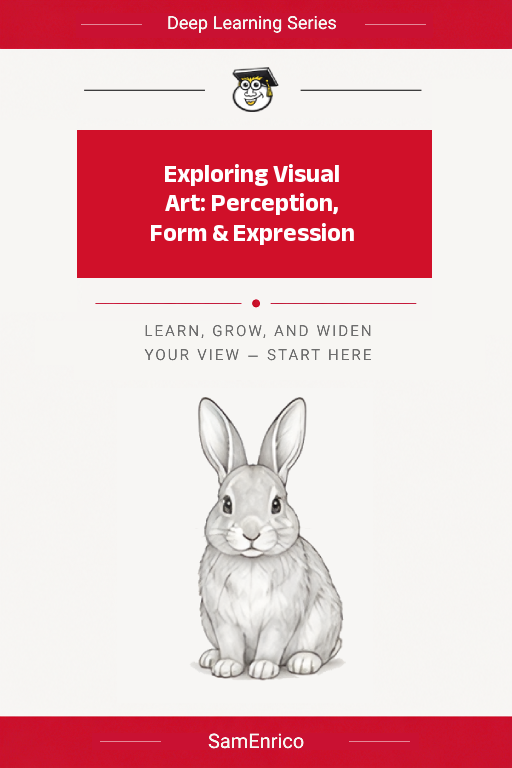
Exploring Visual Art: Perception, Form & Expression eBook
This publication, published by SamEnrico, covers E
by Drury Sari
This publication, published by SamEnrico, covers Exploring Visual Art: Perception, Form & Expression
Formats
Free sample
Chapter 1: The Active Lie...--–- Every morning, you wake up believing that you see the world as it really is. The coffee mug on your nightstand appears brown, round, and still. Your hand reaches out, fingers curl around the handle, and you lift it to your lips without a single conscious thought about how you managed to locate the mug, judge its distance, or coordinate your grip. This effortless fluency is the brain's greatest magic trick—and its most effective lie. You do not see the world.
You see a construction, a prediction, a carefully edited simulation that your brain builds from fragments of sensory data and massive dollops of expectation. The mug is not "brown" in any absolute sense; brown is the label your visual cortex assigns to a specific reflectance pattern under specific lighting. The mug is not "still"; your eyes are constantly making tiny saccadic movements, and your brain stitches the resulting snapshots into the illusion of stability. The mug is not even "there" in the way you think it is; what reaches your retina is a two-dimensional projection that your brain retroactively inflates into three dimensions using unconscious guesswork. This chapter dismantles the camera metaphor once and for all.
Your eye is not a lens. Your brain is not a hard drive. Perception is not recording. It is interpretation, prediction, and creative construction—and understanding this distinction is the single most important step toward visual literacy.The Myth of the Faithful Camera Every introductory art textbook warns against the "camera fallacy"—the mistaken belief that vision works like photography, with light entering the lens, exposing the film, and producing a faithful copy of the scene. But this fallacy is not merely an academic error.
It is the foundational misconception that prevents people from understanding how art works, why optical illusions fool us, and why two people can look at the same painting and see radically different things. The camera fallacy makes you a passive receiver of visual data. It suggests that seeing is easy, automatic, and truthful. It implies that what you see is what is there—no more, no less. All of these implications are false.The human eye does not work like a camera for at least five fundamental reasons.
First, the retina is not uniform like film. It has a tiny central pit called the fovea—about the size of the thumbnail at arm's length—where visual acuity is highest. Outside this pit, resolution drops precipitously. You have high-resolution vision only in a small spot about the size of your thumbnail at arm's length. Everything else is blurry, low-resolution, and largely stitched together from memory and prediction.
Second, your eyes are never still. They make rapid jumps called saccades three to four times per second, each lasting twenty to forty milliseconds. During each saccade, your brain suppresses visual processing to avoid motion blur. You are effectively blind for about ten to fifteen percent of your waking life—and you never notice. Third, the retina has a blind spot where the optic nerve exits the eye.
There are no photoreceptors there. You never see a hole in your vision because your brain fills it in with information from the surrounding area and, remarkably, from the other eye. Fourth, the image projected onto your retina is upside down and reversed left to right. Your brain flips it during processing. Fifth, and most importantly, what reaches your retina is a two-dimensional projection of a three-dimensional world.
Depth, distance, and solidity are not given to the eye. They are computed by the brain.If vision were passive recording, these five facts would be crippling flaws. You would see a blurry, jerky, hole-ridden, inverted, flat mess. But you do not. You see a stable, continuous, high-resolution, upright, three-dimensional world.
That gap—between the impoverished sensory input and the rich perceptual experience—is filled entirely by the active, creative work of your brain. Perception is not sensation. Perception is the brain's best guess about what caused the sensations.Bottom-Up and Top-Down: The Two Directions of Seeing To understand active perception, we need a vocabulary for its two component flows. Bottom-up processing begins with the raw sensory data—photons hitting photoreceptors, edges detected by orientation-selective neurons in the primary visual cortex, motion registered by area MT. It is the signal traveling from the eye to the higher brain.
Bottom-up processing is fast, automatic, and largely unconscious. It is what allows you to notice that something has changed in your peripheral vision without knowing what it is.Top-down processing flows in the opposite direction: from higher cognitive centers down to perceptual systems. It consists of prior knowledge, expectation, context, memory, and attention modulating what you see. Top-down processing is why you can read this sentence even though the letters are ambiguous shapes. It is why you see a face in a few dots and a curved line.
It is why a glass of water looks refreshing when you are thirsty but merely wet when you are not. Top-down processing is the creative half of perception—the half that constructs, interprets, and often invents.Every act of seeing is a collaboration between these two directions. Bottom-up processing provides the raw materials—edges, colors, motion, depth cues. Top-down processing assembles those materials into a coherent scene, fills in missing information, resolves ambiguities, and attaches meaning. The collaboration is not always equal.
When bottom-up signals are strong and clear—a bright red circle on a white background in good light—top-down processing has little work to do. When bottom-up signals are weak, ambiguous, or degraded—a dim shape in fog, a face in shadow, a blurred photograph—top-down processing takes over, sometimes inventing whole objects that are not there.Change Blindness: The Experiment That Broke Passive Perception No demonstration destroys the camera fallacy more effectively than change blindness. In the classic experiment, participants watch a brief video of a conversation between two people. The camera cuts to a different angle, and during the cut, one person swaps places with a completely different actor wearing different clothes. Most viewers do not notice the change.
Even when explicitly told that something will change, only about half of participants detect the substitution. In a more dramatic version, an experimenter stops a pedestrian on a college campus to ask for directions. While the pedestrian is talking, two men carrying a large door walk between them—and the experimenter swaps places with one of the door carriers. The pedestrian continues giving directions to a completely different person. More than half of participants fail to notice the swap.Change blindness proves that you do not see everything.
You see only what you attend to. The rest—the vast majority of the visual world—is not stored, not processed, and not missed. Your brain maintains the illusion of a rich, detailed visual field by assuming that everything will stay the same unless attention is drawn to it. When things change outside the focus of attention, the brain simply does not notice. The camera would notice everything.
You do not.The practical implications for visual art are immediate. A painter controls where you look through contrast, placement, and detail. If you want…
This is the end of the free sample. Get the eBook to keep going. Buy now
About this book
Details
- Author
- Drury Sari
- Publisher
- SamEnrico
- Language
- English
- Genre
- Non-Fiction, Informative, Educational
- Released
- 2026-05-08
- Pages (approx.)
- 135
- Available as
- eBook, Audiobook

Read better in the ZLOADR app
Your eBooks on your phone or tablet. Sign in with your SamEnrico account and start reading.
More by Drury Sari
 Shooting Scene ReconstructionDrury Sari$11.99
 First Generation ImposterDrury Sari$11.99
 Psychiatric Survivor Rights LeaderDrury Sari$11.99
 The Startup Backup PlanDrury Sari$11.99
 Shape Peg System For Visual LearnersDrury Sari$11.99
 Judy Garland Beyond DorothyDrury Sari$11.99
 Pomodoro for ADHD MindsDrury Sari$11.99
 Distraction Free Listening EnvironmentDrury Sari$11.99
 The Visionaries of Stone: How Christopher Wren Rebuilt LondonDrury Sari$11.99
 The Curse of the Black Pharaoh: The Forgotten Tomb of SobekhotepDrury Sari$11.99
 How to Produce Porous Clay TileDrury Sari$11.99
 How to Produce Drain OpenerDrury Sari$11.99