
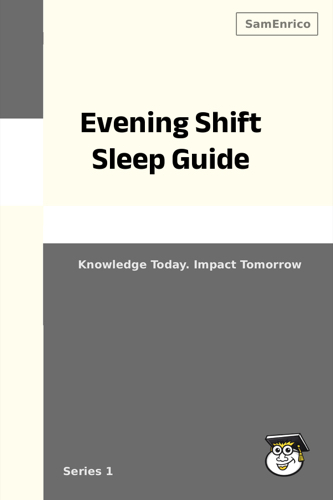
Non-FictionHealth & WellnessEvening Shift
Evening Shift Sleep Guide eBook
Manages 2 PM to 10 PM schedules for social life.
Manages 2 PM to 10 PM schedules for social life.
Formats
Free sample
Chapter 1: The 79% Problem--Every evening at 5:47 PM, Sarah’s phone buzzes with a text from her best friend: “Drinks at 7?” Every evening at 5:48 PM, Sarah types the same reply: “Working until 10. Rain check?” The rain check has been raining for three years. Sarah is thirty-two years old, she works as a hospital lab supervisor from 2 PM to 10 PM, and she has not attended a weekday dinner, a happy hour, a child’s bedtime, or a spontaneous date night in over one thousand days. She is not exhausted. In fact, she sleeps better than most of her day-worker friends.
She is not depressed. She likes her job, her coworkers, and the quiet satisfaction of working while the rest of the world winds down. But she is lonely. And she cannot figure out why a schedule that feels so good biologically feels so terrible socially.This is the central puzzle of the evening shift, and this book exists to solve it.Sarah is not alone. Across the United States and around the world, millions of workers clock in at 2 PM, 3 PM, or 4 PM and clock out at 10 PM, 11 PM, or midnight.
They work in hospitals, call centers, factories, hotels, restaurants, casinos, delivery services, and emergency response. They are nurses, technicians, customer service representatives, chefs, security guards, dispatchers, and warehouse supervisors. They are not night shift workers. They do not fight the primal urge to sleep when the sun goes down. They wake up naturally around 9 AM or 10 AM, feel alert by noon, and hit their stride exactly when day workers are crashing.
Biologically, the evening shift is the easiest shift in the modern economy. But socially, it is the most destructive schedule most people will ever hold.This chapter will do four things. First, it will name the problem with a single, startling statistic that changes how you see your own experience. Second, it will explain why your body loves this schedule even as your friends and family feel abandoned by it. Third, it will walk you through the specific social losses that evening shift workers experience but rarely articulate.
And fourth, it will introduce the core reframe that will guide every chapter that follows: the shift from mourning what you miss to building new prime times in the morning and late night. By the end of this chapter, you will understand why you feel the way you feel, you will stop blaming yourself for struggling with a schedule that is supposed to be easy, and you will be ready to rebuild your social life from the ground up.The 79 Percent Let us begin with the number that changed how researchers understand the evening shift. In a large-scale study of shift work and family life published in the Journal of Occupational Health Psychology, researchers surveyed thousands of workers across different schedules and asked a simple question: Does your work schedule restrict your family and social life? Among traditional day workers, 17 percent said yes. Among night shift workers, 52 percent said yes.
Among evening shift workers—those starting between 12 PM and 4 PM and ending between 8 PM and midnight—79 percent said yes.Read that number again. Seventy-nine percent.Evening shift workers report more social and family restriction than night shift workers, despite sleeping better, feeling less fatigued, and experiencing fewer health problems. Think about what this means. Night shift workers fight their biology every single day. They are sleepy at work, groggy at home, and at significantly higher risk for heart disease, diabetes, depression, and certain cancers.
And yet, only 52 percent of them say their schedule restricts their social life. Evening shift workers, by contrast, feel biologically fine. Their bodies are not fighting the clock. But 79 percent of them feel like their schedule is destroying their relationships. The evening shift is not a sleep problem.
It is a social problem dressed up as a sleep problem.This explains why most advice for shift workers does not work for you. Standard shift work guides focus on managing fatigue, staying awake on the job, and recovering from sleep debt. They assume you are fighting your circadian rhythm. You are not. You do not need help staying awake at 6 PM.
You need help staying connected to people who are eating dinner, putting kids to bed, and going on dates while you are restocking shelves, answering phones, or running lab tests. The standard advice misses the mark because it solves the wrong problem.Dr. Claudia Fischer, a researcher who studies non-standard work schedules at the University of Vienna, puts it this way: “Evening shift workers are invisible in the research literature. They don’t have the dramatic health crises of night workers, so they get ignored. But they have the highest rates of social isolation and relationship breakdown of any shift.
They are drowning in plain sight.” This book is for the drowning. You are not weak. You are not bad at relationships. You are working a schedule that the research world has largely ignored, and you have been trying to solve a social problem with sleep solutions. That ends now.Why Your Body Loves This Schedule Before we can fix the social problem, you need to understand why the evening shift feels so natural to your body.
This is not an accident. It is biology.Humans do not all run on the same internal clock. Your chronotype—your genetic predisposition for morning or evening activity—is as fundamental as your height or your eye color. About 15 percent of the population are extreme morning types, or “Lions.” About 20 percent are extreme evening types, or “Wolves.” The remaining 65 percent are “Bears” who fall somewhere in the middle. Here is what matters for the evening shift: the average circadian rhythm in young adulthood naturally drifts later.
A typical twenty-five-year-old does not feel truly awake until 9 AM, peaks in the late afternoon, and does not feel sleepy until midnight or 1 AM. This means that for most people under forty, a 2 PM start time is closer to their natural rhythm than a 9 AM start time.Let me say that again. For most people under forty, waking up at 9 AM or 10 AM and starting work at 2 PM is more biologically natural than waking up at 6 AM and starting work at 9 AM. The day shift is the unnatural schedule for young adults. The evening shift is the schedule that aligns with your biology.This explains why evening shift workers consistently report better sleep quality and less fatigue than day workers, not to mention night workers.
A 2019 study in the journal Sleep tracked shift workers across all schedules using wrist actigraphy and sleep diaries. Evening shift workers averaged seven hours and forty-eight minutes of sleep per night—more than day workers (seven hours and twelve minutes) and significantly more than night workers (five hours and fifty-three minutes). They also reported fewer instances of insomnia symptoms, less daytime sleepiness, and better mood upon waking. Your body is not betraying you on this schedule. It is thanking you.But here is the paradox that gives this chapter its title.
Your body loves the evening shift. Your social life hates it. And the reason your social life hates it is not because you are doing anything wrong. It is because…
This is the end of the free sample. Get the eBook to keep going. Buy now
About this book
Details
- Author
- Contreras Vannesa
- Publisher
- SamEnrico
- Language
- English
- Genre
- Non-Fiction, Health & Wellness, Evening Shift
- Released
- 2026-06-09
- Pages (approx.)
- 141
- Available as
- eBook, Audiobook

Read better in the ZLOADR app
Your eBooks on your phone or tablet. Sign in with your SamEnrico account and start reading.
More by Contreras Vannesa
 Purpose For ExtrovertsContreras Vannesa$11.99
 NVC for Grief SupportContreras Vannesa$11.99
 IBS Probiotic Selection GuideContreras Vannesa$11.99
 The Twelve Step Meditation BookContreras Vannesa$11.99
 Disappointment Acceptance FrameworkContreras Vannesa$11.99
 Parent Couple Time ManagementContreras Vannesa$11.99
 Cleopatra Royal Treasury ManagementContreras Vannesa$11.99
 The Forgotten Front: Tecumseh's Last Stand at ThamesContreras Vannesa$11.99
 The Invisible Cup: The Secret Battle for Women's Football in the 1970sContreras Vannesa$11.99
 How to Become a Receiving CheckerContreras Vannesa$11.99
 A Collector's Handbook to the Hudson Six (1935)Contreras Vannesa$11.99
 Portfolio Career for ExtrovertsContreras Vannesa$12.99
You may also like
 Hong Kong Handover 1997Dunn Johnnie$11.99
 Zumba For Postnatal Recovery CourseNeal Christian$11.99
 Zumba for BeginnersLadner Nikia$11.99
 YouTube Comment Mining GuideHumes Pandora$12.99
 Worry Box MeditationCarlin Rudy$11.99
 Workplace Stress MeditationNguyen Lynn$11.99
 Workplace Stress and Sleep RepairHawley Ivory$11.99
 Workplace Perfectionism CureDelaney Jeffry$11.99
 Workplace Injustice Anger GuideWallen Isabelle$11.99
 Work Addiction and Burnout LinkGreenwood Ester$11.99
 Women in Yoga and WellnessBeattie Galina$11.99
 Women in Stand Up ComedyChun Evangeline$11.99