
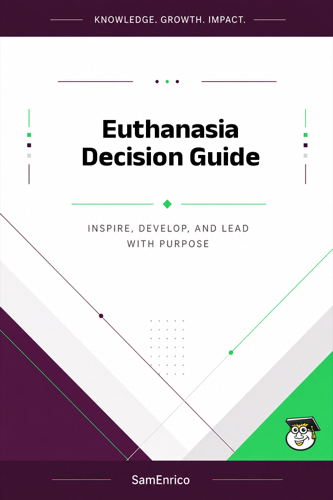
Euthanasia Decision Guide eBook
Cope with the guilt and sorrow of choosing to end
by Bogan Suzie
Cope with the guilt and sorrow of choosing to end your pet s suffering.
Formats
Free sample
Chapter 1: The Love That Breaks You--The exam room has a single window, and you cannot stop staring through it. Outside, a man is walking a small brown dog—nothing remarkable, just a daily routine he has performed a hundred times. The dog sniffs a bush. The man checks his phone. Neither of them knows that across the parking lot, you are sitting on a vinyl exam table, your hand resting on your pet’s flank, trying to decide whether today is the day you say goodbye forever.You did not wake up this morning expecting to be here.
Or maybe you did. Maybe you have been here before, in this exact room or one like it, hearing the same gentle voice say the same terrible words: “We could try this medication, but it won’t cure him. We could do more tests, but they won’t change the outcome. We could wait, but waiting won’t make it better.”And now you are caught in the most painful paradox of pet ownership: the same love that made their life beautiful is what forces you to consider ending it.This chapter is not a checklist. It is not a clinical overview.
It is an invitation to sit with the weight of what you are facing—not to make it lighter, because that would be dishonest, but to make it less lonely. By the time you finish this chapter, you will understand the core framework that guides this entire book. You will know why guilt is not your enemy. And you will have taken the first step toward the only door worth walking through: not the Door of Denial, where you wait out of fear, but the Door of Peace, where you choose out of love.The Paradox You Did Not Ask For Let us name what you are feeling before we try to fix it. You are probably feeling something close to vertigo.
Not the physical kind—the moral kind. You have spent years protecting this animal. You have driven to emergency vets at midnight. You have paid bills you could not afford. You have canceled plans, changed jobs, rearranged your entire adult life around the simple, profound responsibility of keeping another being alive and well.
And now, the same hands that have held, fed, and healed are being asked to consent to an ending.That is the paradox. Not the medical one—the emotional one. Love demands protection. Euthanasia looks like the opposite of protection. It looks like giving up.
It looks like playing God. It looks like failure.But here is the reframe that will take you the rest of this book to fully absorb: Euthanasia is not the end of protection. It is the final, most complete act of protection you will ever give.You did not cause the illness. You did not choose the diagnosis. You did not wake up one morning and decide to make your pet suffer.
What you are doing—what you are considering doing—is stepping into the gap between incurable suffering and gentle release. That gap is where love lives when it cannot cure. That gap is where you are standing right now.Most people who have never made this decision imagine it as a moment of cold calculation. They picture a clipboard, a signature, a needle, and then nothing. That is not what this is.
This is the opposite of cold. This is the hottest, most agonizing fire of love, because you are being asked to absorb pain so that your pet does not have to. That is not failure. That is the deepest form of advocacy.The Two Doors: Denial and Peace Every person who faces this decision eventually stands before two doors. You are standing there now, whether you recognize it or not.The Door of Denial looks like hope.
It is the door that says, “Maybe tomorrow will be better.” “Maybe the vet is wrong.” “Maybe she just needs one more week.” “Maybe I can’t live with myself if I do this today.” This door is not evil. It is made of love—but it is love that has curdled into fear. Fear of loss. Fear of regret. Fear of the silence that will follow.
Fear of being the person who said yes.The Door of Denial keeps you waiting. And waiting. And waiting. It tells you that you are being kind by giving your pet “one more chance.” But here is the truth that no one wants to say out loud: waiting rarely helps the pet. It helps you.
It gives you more time to prepare. More time to say goodbye. More time to avoid the unbearable emptiness that comes after the heartbeat stops. The Door of Denial is not about your pet’s quality of life. It is about your fear of death.The Door of Peace looks like surrender.
It is the door that says, “I cannot cure him, but I can release him.” “I cannot stop the dying, but I can stop the suffering.” “I cannot make this fair, but I can make it gentle.” This door is not easy. It is not the door you want to walk through. But it is the door that leads to quiet grief rather than traumatic memory.Here is the distinction that matters: The Door of Denial leads to a death you did not choose—a natural death that is rarely as peaceful as the phrase suggests. The Door of Peace leads to a death you did choose—not because you wanted it, but because the alternative was worse. One door leaves you wondering “Did I wait too long?” The other door leaves you grieving, but not second-guessing.This entire book is designed to help you walk through the Door of Peace.
Not because it hurts less—it hurts differently. But because the grief on the other side of the Door of Peace is grief you can carry. The grief on the other side of the Door of Denial is grief that carries you.The Central Thesis: Guilt Is Not Proof of Failure Before we go any further, you need to hear the sentence that will become the backbone of everything that follows. Write it down if you need to. Say it out loud.
Memorize it. Because in the weeks and months after your decision, your brain will try to convince you of the opposite.Guilt is not proof of failure. It is evidence of love.Read that again.Guilt is not proof of failure. It is evidence of love.The guilt you feel—the crushing, suffocating, “how could I possibly do this” guilt—is not a sign that you are a bad person. It is not a sign that you are making the wrong choice.
It is a sign that you are capable of deep attachment. It is a sign that this animal mattered to you in a way that cannot be reduced to a transaction or a utility. You feel guilty because you love. The two are not opposites. They are the same current running through two different wires.Most books about pet loss tell you that you should not feel guilty.
They tell you that guilt is irrational, that you did everything you could, that you should be kind to yourself.…
This is the end of the free sample. Get the eBook to keep going. Buy now
About this book
Details
- Author
- Bogan Suzie
- Publisher
- SamEnrico
- Language
- English
- Genre
- Non-Fiction, Self-Help, Euthanasia Grief
- Released
- 2026-06-06
- Pages (approx.)
- 121
- Available as
- eBook, Audiobook

Read better in the ZLOADR app
Your eBooks on your phone or tablet. Sign in with your SamEnrico account and start reading.
More by Bogan Suzie
 Depression and Appetite ChangesBogan Suzie$11.99
 Leitner Box MethodBogan Suzie$11.99
 Bedtime Routine ShortcutBogan Suzie$11.99
 Brooks Koepka Major KillerBogan Suzie$11.99
 Phobia Support GroupsBogan Suzie$11.99
 Decatastrophizing Anger TriggersBogan Suzie$11.99
 Oral Hygiene MasterBogan Suzie$11.99
 The Curse of the Lombardi: How the 49ers Broke the NFL's Longest DroughtBogan Suzie$11.99
 The Boston Strangler: The City Under Siege (1962-1964)Bogan Suzie$11.99
 Service Providers Guide to General RemodelingBogan Suzie$11.99
 How to Become a Manual-arts TherapistBogan Suzie$11.99
 How to Produce Hubs and SwitchesBogan Suzie$11.99