
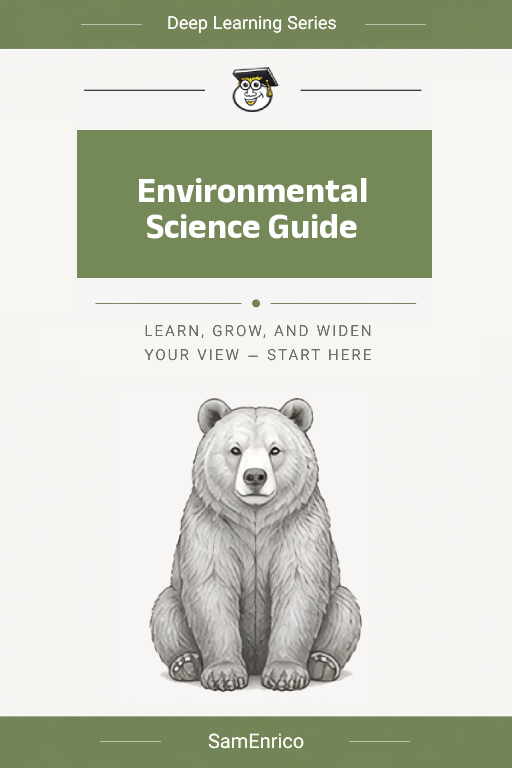
Non-FictionStudent's ShortcutEnvironment
Environmental Science Guide eBook
Compare UK, US, and Australian environmental scien
by Dunn Clyde
Compare UK, US, and Australian environmental science programs with fieldwork opportunities.
Formats
Free sample
Chapter 1: The Dirt Under Your Fingernails...--–- Maria never expected to find her future in a drainage ditch. It was the third week of her field methods course at UC Berkeley, and she was knee-deen in the murky waters of a creek that ran behind a strip mall in Oakland. Her waders had a slow leak. Her notebook was damp. And she had just spent forty-five minutes trying to get a p H reading that made any sense at all.
The water was colder than it looked, the current was stronger than she had anticipated, and somewhere upstream, someone had apparently dumped a considerable amount of dish soap into the watershed. Her professor, a woman who had once spent six weeks camping on an Alaskan glacier, leaned over the bridge railing and shouted down: "Welcome to environmental science. It's not what you thought, is it?"Maria had entered university believing that environmental science was about saving whales, hugging trees, and attending climate strikes with handmade signs. She had imagined herself in a clean lab, wearing a white coat, peering at samples through a microscope while contemplative music played. Nobody had told her about the drainage ditch.
Nobody had told her that she would spend more time driving a beat-up university van than she would spend in a lecture hall. Nobody had mentioned that her most valuable skill would not be memorizing the carbon cycle but learning how to pee behind a bush without anyone noticing. And nobody—absolutely nobody—had explained that the country where she chose to study would determine not just what she learned, but who she would become as a scientist.This is the problem that textbooks refuse to acknowledge. They present environmental science as a universal body of knowledge: the same water quality parameters apply in Oregon and Oxford and Outback Queensland. The same soil horizons exist whether you are digging a pit in Vermont or Victoria.
The same principles of population ecology govern wolves in Yellowstone and hedgehogs in Yorkshire and kangaroos in Yulara. This is true, and it is also dangerously misleading. Because while the science is universal, the practice of that science is intensely local, shaped by three forces that no textbook can capture: the physical environment you work in, the legal and regulatory framework you operate under, and the professional culture you are trained within.The Fieldwork Gap Let Maria's story serve as our first case study. By the time she finished her degree at Berkeley, she had logged over 400 hours of fieldwork across fourteen different sites. She had sampled water in freezing rain, collected soil in 40-degree heat, and counted birds at 5 AM so many times that she stopped needing an alarm clock.
She had learned to drive a van with a trailer, to repair a broken p H meter with duct tape and prayer, and to complete a risk assessment form in her sleep. But here is what her professors never told her: she was unusually lucky. Most American environmental science students graduate with fewer than 100 fieldwork hours, and those hours are often self-funded, logistically chaotic, and competitively allocated. Her program was the exception, not the rule.Meanwhile, across the Atlantic, a student named James was completing his degree at Keele University. His fieldwork looked very different from Maria's.
He never drove himself to a site—the university provided vans and drivers. He never worried about funding—field course costs were rolled into his tuition. He never spent more than five consecutive days in the field—UK residentials are deliberately short and intense. But he also never experienced the solitude of a solo survey, never made an unsupervised decision in the field, and never faced the kind of physical danger that Maria routinely encountered (snakes, bears, abandoned mine shafts). His training was safer, more structured, and more predictable.
It was also, by some measures, less rigorous.And then there is Priya, who chose the University of Western Australia. Her first field season involved a four-night residential at a coastal campus south of Perth, where temperatures hit 38 degrees and a student in her group stepped within a meter of a dugite—one of the most venomous snakes in the country. She learned to carry a Personal Locator Beacon at all times, to check her boots for spiders before putting them on, and to drink three liters of water before lunch. She also learned that Australian fieldwork operates on a "FIFO" model—Fly In, Fly Out—meaning she would spend weeks away from home, living in shared accommodations with her cohort, forming bonds that felt more like military service than university education. By graduation, she had a job offer from the consulting firm that had co-supervised her Honours project.
She also had a heatstroke scare, a snake encounter she still dreamt about, and a collection of field gear that smelled permanently of eucalyptus.Three students. Three countries. Three completely different experiences of what "environmental science" actually means.What Textbooks Won't Tell You Open any best-selling environmental science textbook—and I have read all of them—and you will find chapters on climate modeling, biogeochemical cycles, population dynamics, and environmental policy. You will find diagrams of the carbon cycle, tables of endangered species, and case studies of the Dust Bowl, Love Canal, and Chernobyl. You will learn how to calculate carrying capacity, how to measure biodiversity indices, and how to interpret atmospheric CO2 data from Mauna Loa.
All of this is important. All of this is foundational. And none of it will help you answer the three questions that actually determine your career trajectory.First: Where will you do your fieldwork? Will you be wading through the suburban creeks of California, the peat bogs of Scotland, or the dry sclerophyll forests of New South Wales? The ecosystem you train in becomes your professional home base.
A student who learns hydrology on the Colorado River will speak a different language—both literally and figuratively—than one who learns on the Thames or the Murray-Darling. You will graduate with detailed knowledge of the species, regulations, and environmental problems specific to one region. That knowledge is your currency in the job market. But it also anchors you.Second: Who pays for your fieldwork? In the United States, fieldwork is often self-funded.
Students pay for their own gas, their own motel rooms, their own gear, and their own food. The competition for funded field positions is brutal, and many students graduate with minimal hands-on experience. In the United Kingdom, fieldwork costs are typically folded into tuition, and group travel is provided. The trade-off is that UK students have less autonomy—they go where the professor drives them, on the professor's schedule. In Australia, fieldwork is both funded and autonomous, but the physical demands are higher, and the remote locations mean longer periods away from home.
Each model produces a different kind of scientist: the scrappy American who can fix anything with duct tape; the well-supported Brit who knows how to work efficiently within a team; the rugged Australian who can survive a week in the bush with nothing but a PLB and a lot of sunscreen.Third: What happens after graduation? This is the question that textbooks…
This is the end of the free sample. Get the eBook to keep going. Buy now
About this book
Details
- Author
- Dunn Clyde
- Publisher
- SamEnrico
- Language
- English
- Genre
- Non-Fiction, Student's Shortcut, Environment
- Released
- 2026-05-29
- Pages (approx.)
- 151
- Available as
- eBook, Audiobook

Read better in the ZLOADR app
Your eBooks on your phone or tablet. Sign in with your SamEnrico account and start reading.
More by Dunn Clyde
 Muscle Relaxation SleepDunn Clyde$11.99
 ABCDE For OverwhelmDunn Clyde$11.99
 Detox Medication Error PreventionDunn Clyde$11.99
 After Action Creativity ReviewDunn Clyde$11.99
 Remote Work for ManagersDunn Clyde$11.99
 Napoleon s Exile to ElbaDunn Clyde$11.99
 Empathy for NeurodivergentDunn Clyde$11.99
 Child CPR GuideDunn Clyde$11.99
 The Siege of Rhodes: Suleiman the Magnificent's Unstoppable ForceDunn Clyde$11.99
 Leiden's Starvation: The Siege That Ignited a Nation (1573-1574)Dunn Clyde$11.99
 Ultimate Handbook Guide to Essen : (Germany) Travel GuideDunn Clyde$11.99
 How to Produce ICE PacksDunn Clyde$11.99
You may also like
 Hong Kong Handover 1997Dunn Johnnie$11.99
 Zumba For Postnatal Recovery CourseNeal Christian$11.99
 Zumba for BeginnersLadner Nikia$11.99
 YouTube Comment Mining GuideHumes Pandora$12.99
 Worry Box MeditationCarlin Rudy$11.99
 Workplace Stress MeditationNguyen Lynn$11.99
 Workplace Stress and Sleep RepairHawley Ivory$11.99
 Workplace Perfectionism CureDelaney Jeffry$11.99
 Workplace Injustice Anger GuideWallen Isabelle$11.99
 Work Addiction and Burnout LinkGreenwood Ester$11.99
 Women in Yoga and WellnessBeattie Galina$11.99
 Women in Stand Up ComedyChun Evangeline$11.99