
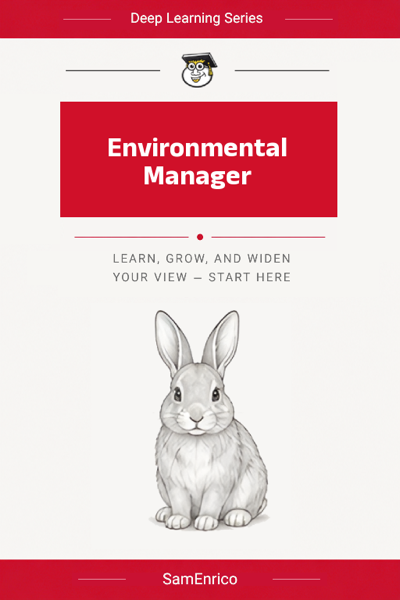
Non-FictionInformativeEducational
Environmental Manager eBook
A Coursebook on Environmental Manager
A Coursebook on Environmental Manager
Formats
Free sample
Chapter 1: Beyond the Binder...–- The first time Maria Reyes watched a permit get denied, she was twenty-seven years old, three months into her first environmental manager role at a midsize chemical blending facility, and utterly convinced that she had done everything right. She had spent two weeks assembling the air permit renewal application, triple-checking every emission factor, every control device efficiency rating, every regulatory citation. The binder was immaculate. The calculations were flawless. And still, the regional EPA office sent back a one-page denial letter citing a single sentence buried in a 2017 guidance memorandum that she had never heard of.
Her facility manager, a fifty-year veteran named Hank who had seen four environmental managers come and go, did not yell. He simply said, "You learned something today. The binder doesn't protect you. Understanding how the system actually moves does."That lesson—that environmental management is not about perfect documents but about navigating complex, living systems of law, people, technology, and nature—is the foundation of everything that follows in this book. Environmental management is not a science problem dressed up in business clothes, nor is it a compliance checklist disguised as strategy.
It is a wicked, messy, deeply human discipline where the only certainty is that you will face problems that have no single correct answer, stakeholders who want contradictory outcomes, and regulations that shift beneath your feet like tidal mud.This chapter dismantles the most dangerous myth in the field: that environmental management is primarily about mastering technical details. It is not. Technical competence is necessary but utterly insufficient. The difference between an environmental manager who survives and one who thrives lies not in their ability to calculate parts per million but in their capacity to recognize wicked problems, apply the 90/10 rule to focus on what truly matters, balance competing bottom lines, and distinguish between reducing harm and preparing for unavoidable change. By the end of this chapter, you will see environmental crises not as puzzles with right answers but as dynamic systems requiring judgment, humility, and strategic patience.The Wicked Problem Paradigm Horst Rittel and Melvin Webber, two planning theorists at the University of California at Berkeley, coined the term "wicked problems" in 1973 to distinguish between the tidy, solvable puzzles of mathematics and engineering and the intractable messes of social policy.
Their original list of ten distinguishing properties remains the single most useful diagnostic tool an environmental manager can carry.A wicked problem has no definitive formulation. You cannot fully understand the problem until you have attempted to solve it, and every attempt changes the problem itself. Consider a manufacturing facility facing community complaints about odor. Is the problem the emission source? The meteorological conditions that trap odors near ground level?
The community's historical distrust of industrial neighbors? The regulatory threshold that allows certain compounds but not others? Each investigation reveals new dimensions, and every partial solution—installing a scrubber, changing production schedules, increasing community outreach—reshapes what the problem means to different stakeholders.A wicked problem has no stopping rule. In tame problems, you know when you are done. A math equation has a correct answer.
A broken machine either runs or does not. But when should you stop trying to reduce emissions? When you reach regulatory compliance? When you achieve zero discharge? When the cost of further reduction exceeds the social benefit?
There is no algorithm, only judgment. And that judgment will be contested.Solutions to wicked problems are not true or false but better or worse, and even "better" is a matter of perspective. The same reduction in air emissions that delights regulators may infuriate workers whose jobs are cut to pay for pollution controls. The same landfill closure that protects groundwater may displace the waste to an incinerator in a neighboring county, shifting the burden rather than eliminating it.Every wicked problem is essentially unique. Climate change in Phoenix looks nothing like climate change in Miami.
A PFAS contamination in a rural Michigan township raises different legal, social, and technical questions than the same chemical in a dense New Jersey industrial corridor. You can learn from precedents, but you cannot copy solutions.Finally, every wicked problem can be explained as a symptom of another problem. The leaking underground storage tank is a symptom of inadequate infrastructure investment, which is a symptom of deferred maintenance, which is a symptom of a business model that prioritizes quarterly earnings over long-term stewardship, which is a symptom of capitalism. At some point, analysis paralysis sets in. The manager's job is not to solve the meta-problem but to act effectively within the problems they can influence.Garrett Hardin's 1968 essay "The Tragedy of the Commons" is often cited as the foundational text of environmental management, and it remains useful but incomplete.
Hardin argued that when multiple actors share a common resource—a pasture, a fishery, the atmosphere—each actor's rational self-interest leads them to overexploit the resource, eventually destroying it for everyone. The solution, he argued, is either privatization or government regulation.But Hardin's model assumes rational actors operating with perfect information and equal power. None of those conditions hold in real environmental management. The chemical plant that releases PFAS may not know the full health effects. The factory manager who falsifies discharge reports is not acting rationally for the collective but strategically for survival within a system that punishes honesty.
And most critically, the tragedy of the commons unfolds across radically unequal power relationships. A low-income community cannot bargain with a multinational corporation on equal terms. A small farm cannot sue a coal mine into compliance. Modern environmental crises are not tragedies of shared resources but tragedies of unequal power, regulatory capture, and the systematic exclusion of vulnerable voices from decision-making.Understanding environmental problems as wicked rather than merely complex changes everything. It shifts the manager's identity from technician to negotiator, from answer-giver to question-asker, from document-filer to relationship-builder.
You are not here to get the binder right. You are here to navigate a living system.The 90/10 Rule: Finding the Leverage Points Vilfredo Pareto, an Italian economist studying land ownership patterns in 1906, observed that approximately 80 percent of Italy's land was owned by 20 percent of its population. This observation evolved into the Pareto Principle, or the 80/20 rule, which has proven remarkably robust across domains: 80 percent of sales come from 20 percent of customers, 80 percent of software crashes come from 20 percent of bugs, and 80 percent of environmental impact comes from 20 percent of sources.In environmental management, the exact ratio varies, but the shape is consistent. Typically, somewhere between 10 and 30 percent of processes, products, or facilities account for 70 to 90 percent of total environmental impact. The 90/10 shorthand—focus on the critical few that cause 90 percent of the problem—is a heuristic, not a mathematical law, but it is the single most powerful tool for avoiding the trap of busywork.Consider a regional hospital system conducting its first comprehensive environmental audit.
The well-intentioned manager could spend months cataloging every light bulb, every recycling bin, every water faucet. But applying the 90/10 rule changes everything. Look first at energy use: Which two buildings consume 70 percent of total electricity? Look at waste: Which three clinical departments generate 80 percent of red-bag medical waste? Look at…
This is the end of the free sample. Get the eBook to keep going. Buy now
About this book
Details
- Author
- Stuckey Maren
- Publisher
- SamEnrico
- Language
- English
- Genre
- Non-Fiction, Informative, Educational
- Released
- 2026-05-11
- Pages (approx.)
- 153
- Available as
- eBook, Audiobook

Read better in the ZLOADR app
Your eBooks on your phone or tablet. Sign in with your SamEnrico account and start reading.
More by Stuckey Maren
 The Assertive Feedback GuideStuckey Maren$11.99
 The Nightmare Childhood GuideStuckey Maren$11.99
 Thermidorian Reaction And Directory GuideStuckey Maren$11.99
 Talent Acquisition Failure AnalysisStuckey Maren$11.99
 Lewis Hamilton Champion StoryStuckey Maren$11.99
 The Celestial Architects of the Nile: Egypt's Stargazers and the Birth of TimeStuckey Maren$11.99
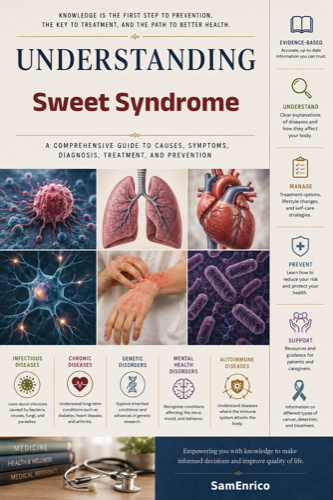 Understanding Sweet SyndromeStuckey Maren$17.99
 How to Start a Absorptiometer (electronic) Business (Beginners Guide)Stuckey Maren$11.99
 WACC for Intangible AssetsStuckey Maren$12.99
 Chinese Supplier Negotiation GuideStuckey Maren$12.99
You may also like
 Hong Kong Handover 1997Dunn Johnnie$11.99
 Zumba For Postnatal Recovery CourseNeal Christian$11.99
 Zumba for BeginnersLadner Nikia$11.99
 YouTube Comment Mining GuideHumes Pandora$12.99
 Worry Box MeditationCarlin Rudy$11.99
 Workplace Stress MeditationNguyen Lynn$11.99
 Workplace Stress and Sleep RepairHawley Ivory$11.99
 Workplace Perfectionism CureDelaney Jeffry$11.99
 Workplace Injustice Anger GuideWallen Isabelle$11.99
 Work Addiction and Burnout LinkGreenwood Ester$11.99
 Women in Yoga and WellnessBeattie Galina$11.99
 Women in Stand Up ComedyChun Evangeline$11.99