
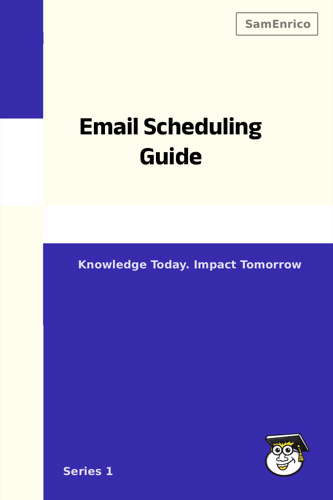
Non-FictionBusiness BriefBoundary Setting
Email Scheduling Guide eBook
Use send later to avoid after hours messages and m
Use send later to avoid after hours messages and manage expectations.
Formats
Free sample
Chapter 1: The 9 PM Betrayal--–- It is 9:17 PM on a Tuesday. You are sitting on your couch, having just finished dinner. The dishwasher is running. Your phone is face-up on the armrest. A notification lights up the screen: an email from your boss.
You pick it up. You did not have to. No one is forcing you. But you do it anyway because somewhere along the way, you learned that this is what good employees do. You read the message.
It is not urgent. It could have waited until morning. But now it is in your brain, and now you are thinking about work, and now your evening is no longer yours.This is the 9 PM betrayal. And you are not the victim. You are both the perpetrator and the receiver of it.The time you hit "send" trains the people around you more effectively than any memo, any team policy, any well-intentioned "we value work-life balance" statement ever could.
When you send an email at 9 PM, you are not merely communicating information. You are broadcasting a constellation of unspoken messages: I am working right now. You should be too. This matter is important enough to interrupt your evening. I value responsiveness over thoughtfulness.
And perhaps most damaging of all: I have not set a boundary, so neither should you.Most professionals do not realize they are doing this. They draft a message after putting the kids to bed, or while waiting for a late-night deployment to finish, or simply because the thought occurred to them and they want to capture it before they forget. They hit send without a second thought. To them, it is efficiency. To the recipient, it is a demand.This chapter is about understanding the problem before we solve it.
Because the "Send Later" button is not magic. It is a tool. And like any tool, its power depends entirely on whether you understand what it is fixing. If you do not recognize the damage caused by after-hours emails, you will use the schedule button as a convenience feature rather than the boundary-setting instrument it was meant to be. You will continue to betray your evenings and the evenings of everyone around you.
You will just do it on a delay.The Hyperactive Hive Mind In his book A World Without Email, Cal Newport introduced a term that should terrify every knowledge worker: the Hyperactive Hive Mind. This is the state of constant, low-grade interruption that has come to define modern office work. It looks like this. You are trying to write a proposal. A Slack message pops up.
You glance at it. It is not urgent, but you reply anyway because leaving it unread feels wrong. You return to the proposal. Three minutes later, an email arrives. You check it.
You forward it to someone. Back to the proposal. A calendar reminder. A teammate taps you on the shoulder. A phone buzzes.By the end of the day, you have spent eight hours at your desk and accomplished approximately forty-five minutes of actual focused work.
The rest was context switching, task swapping, and the slow erosion of your attention span. The Hyperactive Hive Mind is not a failure of discipline. It is a structural feature of how we have designed communication. And email after hours is one of its primary fuel sources.Consider what happens when you send a message at 9 PM. Even if the recipient does not reply immediately, they have still seen the notification.
They have still registered that work exists and that someone else is doing it. The notification itself is a tiny interruption. And here is the cruel math: research from the University of California, Irvine, found that after a single interruption, it takes an average of twenty-three minutes to return to the original task with the same level of focus. Twenty-three minutes. One notification.
Three-quarters of an hour of cognitive tax.Now multiply that by the number of after-hours emails you send and receive each week. If you send just five late-night emails per week, and each one interrupts ten people (direct recipients plus cc'd colleagues), you have collectively stolen nearly twenty hours of focused attention from your team. Twenty hours. That is half a workweek. And you did it while sitting on your couch.This is the Hyperactive Hive Mind in action.
It does not require anyone to be malicious. It does not require a toxic culture. It only requires that no one stops it.The Expectation Cascade There is a second mechanism at work here, and it is even more insidious than the direct interruption. Let us call it the Expectation Cascade.Imagine a team of five people. On Monday, Person A sends an email at 8 PM.
Person B sees it and feels a small pressure to reply. They do not reply at 8 PM—they wait until 7 AM the next morning. But now Person B has checked email at 7 AM, which they previously did not do. On Tuesday, Person B sends an email at 7:30 PM. Person C sees it and, noticing that both A and B are working late, feels that the norm has shifted.
On Wednesday, Person C replies at 9 PM. By Thursday, all five people are sending and checking email well into the evening. No one demanded this. No one wrote a policy. No one even mentioned it in a meeting.
The cascade simply happened.This is how cultures change without anyone deciding to change them. A single late email is not a catastrophe. A thousand late emails, sent by a hundred people over six months, is a completely new set of unspoken expectations.The Expectation Cascade is particularly dangerous because it is invisible. No one tracks the exact moment the team's average response time shifts from 9 AM to 7 AM. No one measures the gradual creep of evening notifications.
By the time anyone notices that they are exhausted and irritable and checking their phone at dinner, the cascade has already done its damage. And the original sender—the person who sent that first 8 PM email on Monday—had no idea they started anything.Synchronous vs. Asynchronous Confusion Part of the problem is that email is a technology with an identity crisis. It was designed as an asynchronous communication tool. Asynchronous means "not happening at the same time." You send a letter.
It arrives days later. You send a fax. It prints out immediately, but the recipient reads it when they choose. Asynchronous communication respects that different people work at different times.Synchronous communication, by contrast, happens in real time. A phone call.
A text message. A Slack huddle. When you send a synchronous message, you reasonably expect a rapid response—within minutes or seconds.Here is the confusion. Most people treat email like a synchronous tool while simultaneously knowing that it is not. They send a message and expect a reply within the hour, but they would never say that expectation out loud because they know it is unreasonable.
The result is a low-grade ambient anxiety. You feel like you should reply quickly, but you cannot articulate why. You feel guilty when you do not, but you cannot point to a rule you have broken.The…
This is the end of the free sample. Get the eBook to keep going. Buy now
About this book
Details
- Author
- Beall Francene
- Publisher
- SamEnrico
- Language
- English
- Genre
- Non-Fiction, Business Brief, Boundary Setting
- Released
- 2026-06-07
- Pages (approx.)
- 139
- Available as
- eBook, Audiobook

Read better in the ZLOADR app
Your eBooks on your phone or tablet. Sign in with your SamEnrico account and start reading.
More by Beall Francene
 South Africa Green CreditsBeall Francene$12.99
 Calorie Counting Quick Start GuideBeall Francene$11.99
 Remote Work Ninja TechniqueBeall Francene$11.99
 Vegan FODMAP Diet HandbookBeall Francene$11.99
 Franchising Your Local Brand Across Borders Operations ManualBeall Francene$11.99
 Blackbeard’s Last Stand: The Untold Battle of OcracokeBeall Francene$11.99
 Understanding Cutis Laxa, Dominant TypeBeall Francene$17.99
 Target Audience One PagerBeall Francene$12.99South Africa Green CreditsBeall Francene$12.99
 A Beginners Guide to Baguazhang (Volume 1)Beall Francene$11.99
 Assistant Project ManagerBeall Francene$11.99
You may also like
 Hong Kong Handover 1997Dunn Johnnie$11.99
 Zumba For Postnatal Recovery CourseNeal Christian$11.99
 Zumba for BeginnersLadner Nikia$11.99
 YouTube Comment Mining GuideHumes Pandora$12.99
 Worry Box MeditationCarlin Rudy$11.99
 Workplace Stress MeditationNguyen Lynn$11.99
 Workplace Stress and Sleep RepairHawley Ivory$11.99
 Workplace Perfectionism CureDelaney Jeffry$11.99
 Workplace Injustice Anger GuideWallen Isabelle$11.99
 Work Addiction and Burnout LinkGreenwood Ester$11.99
 Women in Yoga and WellnessBeattie Galina$11.99
 Women in Stand Up ComedyChun Evangeline$11.99