
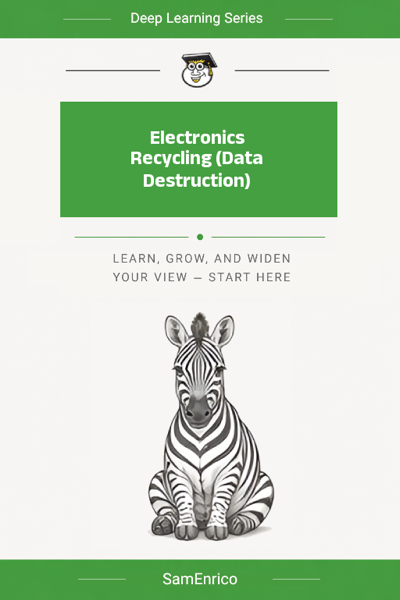
Non-FictionInformativeEducational
Electronics Recycling (Data Destruction) eBook
A Coursebook on Electronics Recycling (Data Destru
A Coursebook on Electronics Recycling (Data Destruction)
Formats
Free sample
Chapter 1: The $4.9 Million Mistake--– In 2019, a woman in Accra, Ghana, bought a used hard drive from a roadside market for the equivalent of $4. She wanted to store family photos. When she plugged it into her laptop, she didn't find space for pictures. She found the complete medical records, Social Security numbers, and psychiatric evaluations of 1,600 American patients.The hard drive had been "professionally recycled" by a Fortune 500 contractor.This book is about how that happens—and how to make sure it never happens to you.The Iceberg That Sinks Companies Every year, organizations spend billions of dollars protecting their live data. Firewalls.
Encryption. Intrusion detection. Security operations centers. Twenty-four-hour monitoring. And yet, almost without exception, these same organizations treat their dead data—the data sitting on retired devices—as if it magically disappears when the device is unplugged.It doesn't.Here is the truth that will transform how you think about electronics recycling: the greatest threat from e-waste isn't environmental.
It's informational.Above the waterline, everyone sees the obvious e-waste. Cracked monitors. Tangled cables. Plastic casings covered in dust. Office managers pat themselves on the back for calling a recycler.
Sustainability reports tout "zero landfill" achievements. CFOs note the small rebate check from recovered materials.Below the waterline, invisible to everyone who isn't looking, lurks the real danger. Intact storage media containing sensitive corporate data. Personal health information. Financial records.
Trade secrets. Passwords. Emails. Legal correspondence. Everything that ever touched that device remains on it until someone actively, deliberately, and verifiably destroys it.A "broken" phone almost always has a perfectly functional memory chip.
A "dead" laptop's solid-state drive retains every password, email, and document ever saved to it. A printer headed for the dumpster contains a hard drive with every document ever printed, scanned, copied, or faxed. The physical appearance of destruction means nothing for data security. Nothing.This chapter will walk you through three real cases where companies faced financial ruin because they trusted a recycler who simply resold their drives. By the end, you will understand why the average improper disposal incident costs $4.9 million—and why your organization is almost certainly at risk right now.The Three Cases That Changed the Industry Case One: The Hospital That Donated Its Patients A major hospital system in the northeastern United States decided to upgrade its computer infrastructure.
Six thousand laptops and desktops were slated for retirement. The IT department, following what they believed was standard procedure, reformatted each drive and donated the machines to local schools.Reformatting. It sounds so final, doesn't it? The word suggests a clean slate, a fresh start, a digital reset button that wipes away the past.It does nothing of the sort.A quick format—the default option on virtually every operating system—simply erases the file allocation table. Think of it as removing the table of contents from a book.
The chapters are still there. The words are still on the pages. You just can't find them without the map. But for anyone with free recovery software downloaded from the internet, that map is trivial to rebuild.A journalist bought one of these donated computers at a school auction for less than fifty dollars. He ran a free data recovery tool that took ninety seconds to install and three minutes to run.
What he found would cost the hospital $3.7 million in HIPAA fines.Seventeen hundred patient records. Names. Birthdates. Social Security numbers. Diagnoses.
Treatment histories. Psychiatric evaluations. The hospital had not just violated patient privacy—they had handed the keys to their entire medical record system to anyone with fifteen dollars and a screwdriver.The hospital's recycler had a website. They had a certificate of insurance. They had a glossy brochure.
None of it mattered because the hospital never verified what actually happened to their data. They assumed that "recycler" meant "data destruction." It did not.Case Two: The Bank That Learned About GLBA the Hard Way A regional bank in the Midwest with approximately two billion dollars in assets decided to consolidate its branch locations. Seventeen branches closed. Hundreds of computers, servers, and network devices were sent to a recycling company that had served the bank for nearly a decade.The relationship was informal. A handshake deal.
The recycler picked up equipment twice a month. The bank's operations manager signed a pickup slip. That was it. No chain of custody. No certificate of destruction.
No audit.The Gramm-Leach-Bliley Act requires financial institutions to have a written data destruction policy. It requires them to vet their service providers. It requires them to maintain proof of proper destruction. The bank had none of these.When a whistleblower came forward with evidence that the recycler was simply reselling drives on e Bay without any data destruction whatsoever, the federal regulators arrived within weeks. The examination was brutal.
The fines totaled $1.2 million. The reputational damage was far worse. Local news ran stories for months. Customers closed accounts. The bank's president resigned.The recycler?
They declared bankruptcy and dissolved the company. The bank's lawsuit against them recovered nothing. The liability never transferred. Under the law, the original data owner remains responsible for breaches regardless of who physically disposed of the device. Hiring a recycler does not transfer liability—it only adds a potential codefendant with shallow pockets.Case Three: The Tech Company That Lost Its Secrets A mid-sized technology company with a valuable patent portfolio decided to upgrade its engineering workstations.
Forty high-end computers used by hardware designers were decommissioned. The company's security team removed the hard drives and physically destroyed them with a drill press—a common but utterly inadequate method.Drilling a hole through a hard drive seems convincing. Metal shavings. Bent platters. The satisfying crunch of destruction.
But here is what most people don't understand about hard drive destruction: a drilled drive often still has ninety percent of its platters intact. The hole destroys perhaps one percent of the data surface. The rest remains perfectly readable to anyone with basic data recovery equipment.A competitor purchased the lot at a bankruptcy auction of the recycler's assets. They paid three hundred dollars for forty drives that had been "destroyed." They recovered over five thousand engineering documents, including schematics, source code, and internal strategy presentations. The resulting trade secret lawsuit dragged on for four years, cost over eight million dollars in legal fees, and ended in a confidential settlement widely reported as favorable to the competitor.The company's chief technology officer told a reporter, "We thought drilling the drives was enough.
We never imagined someone would actually try to recover data from them."Someone always will.The Scale of the Problem To understand why these cases are not anomalies but predictable outcomes, you need to grasp the sheer volume of electronic waste generated every year.Fifty-three point six million metric tons. That is how much e-waste the world produces annually. To put that number in context, it is the weight of approximately three hundred and fifty cruise ships. It is enough garbage trucks filled with electronics to circle the equator. Every person on Earth contributes an average of 7.3 kilograms per year.Of that staggering total, only 17.4 percent is officially recycled through certified channels.
The rest? Landfills. Informal dumps. Illegal export to developing countries where children scavenge for copper and gold while breathing toxic…
This is the end of the free sample. Get the eBook to keep going. Buy now
About this book
Details
- Author
- Kaiser Lucienne
- Publisher
- SamEnrico
- Language
- English
- Genre
- Non-Fiction, Informative, Educational
- Released
- 2026-06-02
- Pages (approx.)
- 136
- Available as
- eBook, Audiobook

Read better in the ZLOADR app
Your eBooks on your phone or tablet. Sign in with your SamEnrico account and start reading.
More by Kaiser Lucienne
 Sexual Abuse Child Self EsteemKaiser Lucienne$11.99
 Attempt Survivor Bipolar StoryKaiser Lucienne$11.99
 Stretching for Truck DriversKaiser Lucienne$11.99
 Loving Kindness for Birth TraumaKaiser Lucienne$11.99
 The Pilot Instagram Comparison TrapKaiser Lucienne$11.99
 The Last Supper’s Secret Recipe: A Culinary Conspiracy Through TimeKaiser Lucienne$11.99
 Legal Risk Mitigation PortfolioKaiser Lucienne$12.99
 Citation Rule Last Minute GuideKaiser Lucienne$12.99
 Understanding Nasopalpebral Lipoma Coloboma SyndromeKaiser Lucienne$17.99
 How to Start a Perishable Prepared Tofu Bean Curd Business (Beginners Guide)Kaiser Lucienne$11.99
You may also like
 Hong Kong Handover 1997Dunn Johnnie$11.99
 Zumba For Postnatal Recovery CourseNeal Christian$11.99
 Zumba for BeginnersLadner Nikia$11.99
 YouTube Comment Mining GuideHumes Pandora$12.99
 Worry Box MeditationCarlin Rudy$11.99
 Workplace Stress MeditationNguyen Lynn$11.99
 Workplace Stress and Sleep RepairHawley Ivory$11.99
 Workplace Perfectionism CureDelaney Jeffry$11.99
 Workplace Injustice Anger GuideWallen Isabelle$11.99
 Work Addiction and Burnout LinkGreenwood Ester$11.99
 Women in Yoga and WellnessBeattie Galina$11.99
 Women in Stand Up ComedyChun Evangeline$11.99