
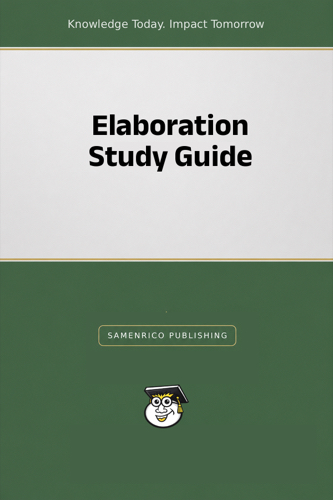
Elaboration Study Guide eBook
Asks how and why questions to deepen understanding
Asks how and why questions to deepen understanding.
Formats
Free sample
Chapter 1: Beyond Highlighting Hell...--You have probably highlighted a sentence in this book already. Go ahead—admit it. Your thumb is resting near the top corner of a page, or you’ve got a mental bookmark of where you stopped reading a moment ago. Maybe you even own a set of colorful gel highlighters, the kind that promised to make studying feel like an artistic endeavor. Here is the uncomfortable truth that the stationery industry does not want you to know: highlighting is almost worthless.
So is rereading. So is the desperate, late-night ritual of copying your notes over and over until your hand cramps. These strategies feel productive. They feel like studying. But according to three decades of cognitive science research, they are among the least effective ways to learn anything.This chapter is going to make you uncomfortable.
It is going to challenge habits you have defended since middle school. And by the time you finish the next few pages, you will understand why most students study harder but not smarter—and why a single shift in how you ask questions can double your learning speed without adding a single extra hour to your study session.Let us start with a story. A few years ago, researchers at Kent State University ran a simple experiment. They gave students a textbook passage to study. One group did what most students do: they read the passage, then read it again, then highlighted the important parts.
Another group did something different. After reading each short section, they stopped and asked themselves a single question: “Why would this be true?” That was it. No extra time. No special training. Just a five-second interruption after every paragraph.When both groups were tested one week later, the students who asked “why” outperformed the highlighters by nearly fifty percent.
Fifty percent. That is the difference between a C and a B, or a B and an A. And they did not study longer. They did not study harder. They just studied differently.That difference is what this book calls elaboration.
And if you learn nothing else from these twelve chapters, learn this: the quality of your questions determines the depth of your understanding.The Studying Lie You Have Been Sold Let me ask you something honest. When you sit down to study for an exam, what do you actually do? If you are like ninety percent of students, your routine looks something like this. You open your textbook or your notes. You read a section.
You might underline a few key sentences. Maybe you rewrite a definition or two. Then you move on. Later, before the test, you read everything again. Maybe you make flashcards.
You feel a sense of accomplishment because you have put in the time. The clock says you studied for three hours. Surely that means something.Here is what the research says about that routine. In a landmark study published in the journal Psychological Science, researchers Jeffrey Karpicke and Henry Roediger III asked students to learn a set of forty vocabulary words. One group studied using the standard method: they read the words and definitions, then read them again, then read them a third time.
Another group used a different method: they read the words, then tested themselves, then studied only the words they had missed. After one week, the students who had simply reread the material remembered only twenty-eight percent of the words. The students who had tested themselves remembered eighty percent.That is not a small difference. That is the difference between failing and passing. And here is the part that should scare you: the students who reread felt more confident.
They had seen the material more times, so their brains told them, “I know this.” But they did not. Their confidence was a lie manufactured by familiarity, not understanding.This is known as the fluency illusion. Your brain confuses ease of processing with depth of learning. When you reread a sentence, it feels easier the second time because you have seen the words before. Your brain interprets that ease as mastery.
But you have not actually learned the information. You have only become familiar with the way it looks on the page. That is like thinking you know how to play guitar because you have watched someone else strum.Elaboration is the antidote to the fluency illusion. Instead of passively consuming information, you actively manipulate it. You ask questions.
You generate explanations. You connect new ideas to old ones. And in doing so, you build a web of understanding that your brain can actually retrieve later. Not because the words look familiar, but because you have transformed them into something meaningful.What Elaboration Actually Is (And What It Is Not)Before we go any further, we need to get our terms straight. This book will use the word elaboration in a very specific way, and understanding this definition is the foundation for everything that follows.In cognitive science, elaboration refers to the process of adding detail, making connections, and generating explanations that go beyond the information given.
When you elaborate, you take a bare fact—say, “mitochondria produce energy”—and you build around it. You ask, “How do mitochondria produce energy?” You connect it to something you already know: “Mitochondria are like batteries for the cell.” You compare it to something else: “Unlike chloroplasts, which capture energy from sunlight, mitochondria convert chemical energy.” You generate a mechanism: “They use a process called cellular respiration to convert glucose into ATP.”Each of those mental actions is a form of elaboration. Each one strengthens the memory trace. Each one creates multiple pathways for your brain to find that information later. And each one requires effort—the kind of effort that rereading and highlighting deliberately avoid.Now, let me clarify something important.
Elaboration is not the same thing as elaborative interrogation, though the two terms are closely related and often confused. Think of them as a hierarchy. Elaboration is the broad umbrella category: any technique that adds meaning, detail, or connection qualifies as elaboration. Elaborative interrogation is a specific, powerful method under that umbrella: asking “how” and “why” questions about the material you are learning. Throughout this book, we will focus primarily on elaborative interrogation because it is the most researched and most effective form of elaboration.
But we will also explore other forms: using analogies, making associations to personal experiences, comparing and contrasting similar concepts, and mapping connections visually.Here is what elaboration is not. It is not highlighting. It is not rereading. It is not copying notes verbatim. It is not summarizing (though summarizing can be a weak form of elaboration if done actively).
It is not underlining. It is not the feeling of recognition you get when you see a term you have encountered before. Elaboration requires you to produce something—an explanation, a question, an analogy, a connection—from your own mind, without looking at the answer.That last part is crucial. Elaboration is generative. You cannot do it passively.
You cannot outsource it to a highlighter or a sticky note. You have to think.Why “How” and “Why” Beat “What” Every Time Let us get specific about…
This is the end of the free sample. Get the eBook to keep going. Buy now
About this book
Details
- Author
- Kuykendall Fay
- Publisher
- SamEnrico
- Language
- English
- Genre
- Non-Fiction, Self-Help, Critical Thinking
- Released
- 2026-06-05
- Pages (approx.)
- 155
- Available as
- eBook, Audiobook

Read better in the ZLOADR app
Your eBooks on your phone or tablet. Sign in with your SamEnrico account and start reading.
More by Kuykendall Fay
 Surrogacy After LossKuykendall Fay$11.99Surrogacy After LossKuykendall Fay$11.99
 Franchising Your Local Brand Across Borders Dress CodesKuykendall Fay$11.99
 Meth Treatment CentersKuykendall Fay$11.99
 NVC Observation Skills GuideKuykendall Fay$11.99
 The Warm Up Question HandbookKuykendall Fay$11.99
 Sperm DNA FragmentationKuykendall Fay$11.99
 Assertiveness LGBTQ GuideKuykendall Fay$11.99
 The Hammer and the Anvil: Charlemagne's Crusade Against the AvarsKuykendall Fay$11.99
 The Unstoppable Season: Beyoncé’s Historic 'Renaissance' World Tour (2023)Kuykendall Fay$11.99
 How to Start a Engines for Motorcycles Business (Beginners Guide)Kuykendall Fay$11.99
 Mastering The Art of Battōjutsu (抜刀術)Kuykendall Fay$11.99
You may also like
 Team Assumption BustingHook Ina$11.99
 Real vs Reel Social MediaKruger Norberto$11.99
 Chunking for Critical ThinkingMarino Darleen$11.99
 Mindfulness for Beginner NaysayersAlonso Palma$11.99
 Elaborative Interrogation MethodBruce Holley$11.99
 Critical Listening for Debates and ArgumentsPrather Candy$11.99
 Collaborative Assumption Busting GuideStanfield Clemmie$11.99
 The Logical Fallacy Persuasion GuideLink Cordell$11.99
 Devil Advocate Role AssignmentCurran Kym$11.99
 Critical Thinking in Teams GuideRoark Elroy$11.99
 The Eisenhower Matrix Critical DistinctionCasas Sandee$11.99
 Red Teaming Creative IdeasWhitley Reta$11.99