
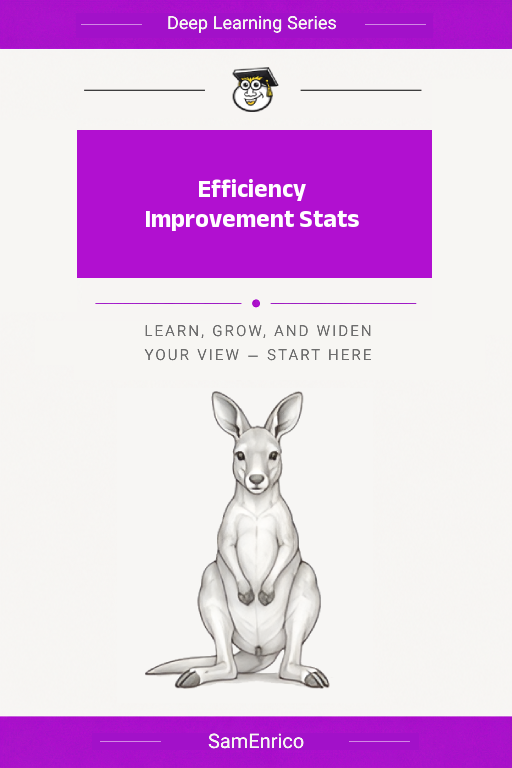
Non-FictionProfessional's Cheat SheetEfficiency
Efficiency Improvement Stats eBook
Include efficiency gains and time savings metrics
by Hahn Vennie
Include efficiency gains and time savings metrics in promotion business case.
Formats
Free sample
Chapter 1: The Silent Killer--– Every morning, across thousands of offices, the same scene plays out. A manager walks into a budget meeting with a promising promotion proposal. The slides are polished. The ideas are solid. The team is excited.
And within fifteen minutes, the finance director delivers the verdict: “The ROI isn’t strong enough. Come back with better numbers.”The manager leaves confused. The promotion never launches. And somewhere in the company, a process continues to bleed hours, money, and momentum that no one was tracking in the first place.This is not a story about bad ideas. This is a story about invisible waste.Meet Alex.
Three years into a marketing manager role at a mid-sized B2B software company, Alex had a reputation for creativity but not for numbers. When the annual planning cycle arrived, Alex proposed a $50,000 automation tool that would reduce manual lead qualification work by an estimated twenty hours per week. The team loved it. The sales director endorsed it. Then the CFO asked one question: “How did you calculate the twenty hours?”Alex hesitated.
The number had come from a gut feeling, not a spreadsheet. The CFO smiled politely and said, “Show me the numbers, and we’ll talk.”The proposal died two weeks later. Not because the idea was wrong, but because Alex could not translate efficiency into a language finance trusted.This chapter is about why that happens, why it happens to most professionals, and why the inability to measure and communicate efficiency gains has become the single greatest obstacle to getting good ideas funded. I call it the silent killer of promotions—not because the work is bad, but because the business case is invisible.The Efficiency Blind Spot Most organizations track revenue with religious precision. Every dollar that comes in is counted, categorized, and forecasted.
But the hours that go out—the time spent on manual tasks, the delays in approvals, the rework caused by unclear handoffs—those disappear into a black hole. No one measures them. No one values them. And yet, every hour lost is an hour that could have been spent on something profitable.Consider a simple example. A sales development representative spends ninety minutes every morning manually copying leads from a web form into a CRM, cleaning up formatting, and assigning them to the right salesperson.
That is ninety minutes of zero strategic value. But because no one tracks “time spent on data entry,” the cost never appears on a profit and loss statement. The business case for a $10,000 automation tool that would eliminate that task cannot point to a line item that says “data entry waste.” So the request gets denied.This is the efficiency blind spot. It is not that efficiency doesn’t matter. It is that efficiency is invisible in the language of finance.The Five Deadly Sins of Promotion Business Cases Over the past decade, researchers and practitioners have identified five recurring mistakes that cause otherwise solid promotion proposals to fail.
These are not technical errors in calculation. They are framing errors—ways of presenting information that guarantee rejection because they do not answer the questions finance actually asks.Let me walk through each one, using Alex’s failed proposal as the cautionary tale.Sin Number One: The Activity Trap The activity trap is the most common mistake in business case writing. It happens when a manager lists what they will do instead of what will change.Alex’s original proposal said: “We will implement an automation tool to manage lead qualification.”That is an activity. It describes an action, not an outcome. Finance does not care about activities.
Finance cares about what activities produce. A better framing would have been: “We will reduce time per lead from four hours to two and a half hours, freeing twenty hours per week for revenue-generating work.”The difference is not semantic. It is structural. Activities are costs. Outcomes are returns.
When you lead with an activity, you are leading with a cost. When you lead with an outcome, you are leading with a return.Most professionals fall into the activity trap because they are trained to describe projects in terms of deliverables. But finance does not buy deliverables. Finance buys changes in measurable business metrics.Sin Number Two: The Intangibles Myth The intangibles myth is the belief that certain benefits—brand lift, team morale, customer satisfaction—cannot be quantified. This belief is almost always wrong.Alex’s original proposal included a bullet point that read: “Will improve brand perception through faster response times.” When the CFO asked for a number, Alex said, “That’s hard to quantify.” The CFO moved on, unimpressed.But brand perception is quantifiable.
Faster response times lead to higher Net Promoter Scores, which correlate with retention rates, which have dollar values. The same is true for team morale: reduced frustration from manual work leads to lower turnover, which saves recruiting and training costs. Even something as seemingly vague as “strategic alignment” can be measured by tracking how many projects get killed early because they no longer fit company priorities.The rule is simple: if it matters, measure it. And if you cannot measure it today, design a way to measure it starting tomorrow. The intangibles myth persists only because professionals give up too easily.Sin Number Three: The Single-Touch Fallacy The single-touch fallacy is the assumption that a result can be attributed to one action when, in reality, multiple actions contributed.Alex’s proposal assumed that any efficiency gains from the automation tool would be solely the result of the tool itself.
But what if the sales team also changed its follow-up process during the same period? What if seasonality reduced lead volume, making the tool look more efficient than it actually was?The single-touch fallacy matters because finance is trained to ask: “How do you know the change was caused by your promotion and not by something else?” Without an answer, the business case collapses.The solution, which we will explore in detail in later chapters, involves control groups, trend line analysis, and attribution filtering. For now, the key insight is that you must isolate your promotion’s impact from everything else happening in the business.Sin Number Four: The Missing Baseline The missing baseline is exactly what it sounds like: no measurement of current state before the promotion begins.Alex’s proposal claimed a reduction from four hours per lead to two and a half hours. But Alex had never actually measured the current time per lead. The four-hour figure was an estimate based on conversations with two salespeople.
When the CFO asked for the data source, Alex had none.A baseline is not optional. It is the anchor against which every future measurement is compared. Without a baseline, you cannot know whether your promotion succeeded, failed, or did nothing at all.Establishing a baseline is rarely difficult. It requires measuring the relevant metric for a period of time before the promotion starts—typically four to twelve weeks, depending on the volatility of the metric. That measurement period becomes your point of comparison.
Everything after the promotion is measured against it.Sin Number Five: The Optimism Bias The optimism bias is the tendency to…
This is the end of the free sample. Get the eBook to keep going. Buy now
About this book
Details
- Author
- Hahn Vennie
- Publisher
- SamEnrico
- Language
- English
- Genre
- Non-Fiction, Professional's Cheat Sheet, Efficiency
- Released
- 2026-06-01
- Pages (approx.)
- 142
- Available as
- eBook, Audiobook

Read better in the ZLOADR app
Your eBooks on your phone or tablet. Sign in with your SamEnrico account and start reading.
More by Hahn Vennie
 Carson Science Communication Style GuideHahn Vennie$11.99
 Atychiphobia Recovery HandbookHahn Vennie$11.99
 Thesis and Dissertation Stress GuideHahn Vennie$11.99
 The Caregiver Agitation Management GuideHahn Vennie$11.99
 Physical Exercise Neuroprotective EffectsHahn Vennie$11.99
 The Troll’s Bridge: A Nordic Architect’s FollyHahn Vennie$11.99
 The Arabic Algorithms: How a 21st-Century Scholar Revolutionized Computer ScienceHahn Vennie$11.99
 Title ExaminerHahn Vennie$11.99
 AI Audit Trail HandbookHahn Vennie$12.99
 Understanding Flynn–aird SyndromeHahn Vennie$17.99
 How to Become a Disc-pad GrinderHahn Vennie$11.99
You may also like
 Hong Kong Handover 1997Dunn Johnnie$11.99
 Zumba For Postnatal Recovery CourseNeal Christian$11.99
 Zumba for BeginnersLadner Nikia$11.99
 YouTube Comment Mining GuideHumes Pandora$12.99
 Worry Box MeditationCarlin Rudy$11.99
 Workplace Stress MeditationNguyen Lynn$11.99
 Workplace Stress and Sleep RepairHawley Ivory$11.99
 Workplace Perfectionism CureDelaney Jeffry$11.99
 Workplace Injustice Anger GuideWallen Isabelle$11.99
 Work Addiction and Burnout LinkGreenwood Ester$11.99
 Women in Yoga and WellnessBeattie Galina$11.99
 Women in Stand Up ComedyChun Evangeline$11.99