
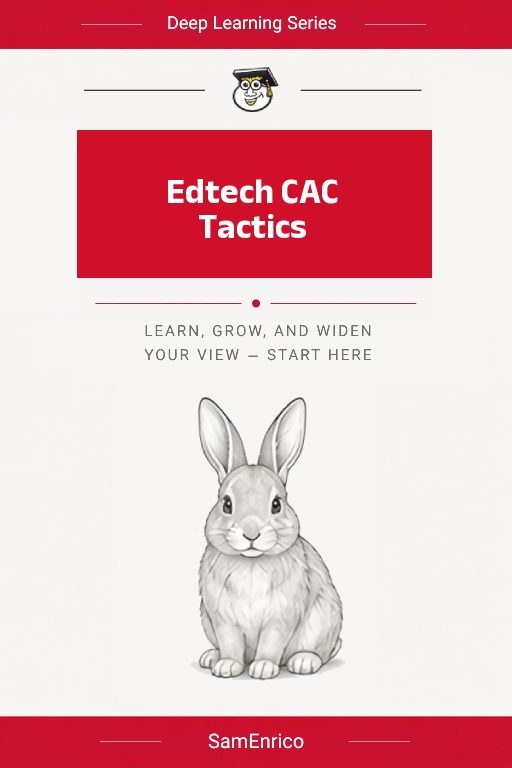
Edtech CAC Tactics eBook
Lower student acquisition costs through content ma
Lower student acquisition costs through content marketing and partnerships.
Formats
Free sample
Chapter 1: The $1,143 Funeral--Let me tell you about the most expensive funeral in Edtech history.The company was called Learn Fast—a name I’ve changed to protect the guilty, though the founders will recognize themselves if they ever read this. They had raised $20 million from a top-tier venture capital firm. They had a product that actually worked: a personalized math intervention tool that helped middle schoolers improve their test scores by an average of 18 percent. They had glowing pilot results from three school districts. They had everything except profitability.In eighteen months, Learn Fast spent $15 million on Facebook and Google ads.They acquired 37,000 paying customers.
Most were parents who bought 29monthlysubscriptions.Asmallernumberwereschoolsthatpaid29 monthly subscriptions. A smaller number were schools that paid 29monthlysubscriptions.Asmallernumberwereschoolsthatpaid5,000 annual licenses. The math looked good on the fundraising deck: $4.2 million in annual recurring revenue, growing 300 percent year over year. The VCs were thrilled.But here is what the VCs did not see. Here is what the founders themselves did not see until the bank account was empty.The average customer paid Learn Fast 312overtheirlifetime.Theaveragecustomercost Learn Fast312 over their lifetime.
The average customer cost Learn Fast 312overtheirlifetime.Theaveragecustomercost Learn Fast467 to acquire.Every single sale lost money. The more they grew, the faster they died.Learn Fast shut down in month twenty-two. The founders walked away with nothing. The investors lost everything. And thirty-seven thousand students lost a tool that actually helped them learn.This book exists because Learn Fast did not have to die.Their product was good.
Their market was real. Their timing was right. But they built their entire growth engine on rented land—Facebook and Google—and when the rent went up, they had no equity left. They are not alone. I have reviewed the books of more than two hundred Edtech companies over the past four years.
The vast majority are unknowingly walking the same path. They are burning cash to acquire customers who will never pay back their acquisition cost. They are celebrating top-line growth while bleeding out in the fine print.And they are doing it because they have been lied to by the very platforms that profit from their failure.This chapter is the funeral. By the time you finish it, you will understand why the old playbook is broken, why the numbers you think you know are probably wrong, and why a single teacher with a You Tube channel beat every well-funded competitor in the world’s fastest-growing education market.Let me start with the number that will change how you see your entire business.The Number That Kills Edtech Companies The average Edtech company spends somewhere between eight hundred and fifteen hundred dollars to acquire a single paying customer.I have seen this number across hundreds of companies. A language learning app on the low end: eight hundred dollars.
A test prep platform in the middle: eleven hundred dollars. A professional certification program on the high end: fifteen hundred dollars or more. The exact number depends on your vertical, your pricing, and your target audience. But the range is consistent enough to be useful.Now ask yourself: what is your average customer worth?If you are a typical B2C Edtech company, your customer pays somewhere between fifteen and fifty dollars per month. They stay for an average of six to twelve months.
Their lifetime value is somewhere between ninety and six hundred dollars. You can do the math yourself, but I will do it for you.At the median: four hundred dollars in lifetime value. At the median CAC: one thousand one hundred forty-three dollars.That is not a business. That is a charity where the donors are your investors and the beneficiaries are Google and Facebook.The survival rule in subscription businesses is the 3:1 ratio. Your lifetime value must be at least three times your customer acquisition cost.
Three to one. If you spend one dollar to acquire a customer, that customer must pay you three dollars over their lifetime. That gives you enough margin to cover your operating costs, your product development, and your overhead, with something left over for profit.Most Edtech companies I review are at 1.5 to 1. At best. Half of what they need.
They are not three-dollar customers for every one dollar spent. They are one-dollar-fifty-cent customers. Every sale loses money. Every new customer pushes them closer to bankruptcy.Here is what is terrifying: most founders do not know this.They look at their top-line revenue. They see it growing.
They celebrate. They raise another round. They increase their ad spend. They celebrate again. And all the while, the hole beneath them is getting deeper.The only reason more Edtech companies have not died is that venture capital has been cheap for the past decade.
Investors tolerated losses in pursuit of market share. They believed that someday, when the company was huge, they could flip a switch and turn off the ad spend and become profitable overnight.That belief was always a fantasy. In the post-2023 market, it is suicide.Interest rates are up. Capital is expensive. Investors are demanding profitability, not growth at any cost.
The companies that survive this decade will be the ones that can acquire customers profitably—or, better yet, acquire customers for close to zero dollars.That is what this book teaches. But before we get to the solutions, we need to understand why the problem is so pervasive.The Growth Industrial Complex There is a machine built to extract money from Edtech founders. I call it the Growth Industrial Complex.It includes the ad platforms: Google, Facebook, Tik Tok, Linked In. It includes the agencies that promise to optimize your campaigns for a monthly retainer. It includes the VCs who encourage you to spend aggressively because their business model depends on rapid scaling.
It includes the Saa S metrics gurus who tell you that "CAC payback period" is the only number that matters, ignoring that a twelve-month payback period is fine if you have infinite capital and disastrous if you do not.Every part of this machine profits when you spend money on paid acquisition. Google makes more when you bid higher. Agencies make more when you spend more. VCs make more when you grow faster, even if that growth is unprofitable, because they plan to sell their shares to the next round of investors before the music stops.No one in this machine profits when you figure out how to acquire customers for free.That is not a conspiracy. It is simply incentive alignment.
Or misalignment, depending on your perspective. The platforms want you to believe that paid advertising is the only scalable path to growth. The agencies want you to believe that you need their expertise to navigate the platforms. The VCs want you to believe that spending is the price of entry.And because all of these voices are louder than the lone founder who says "maybe we should try organic content," most Edtech companies default to the paid playbook. They raise money.
They hire a growth marketer. They turn on Facebook ads. They watch the dashboard go up. And they never stop to ask whether the math works, because everyone…
This is the end of the free sample. Get the eBook to keep going. Buy now
About this book
Details
- Author
- Lentz Charlena
- Publisher
- SamEnrico
- Language
- English
- Genre
- Non-Fiction, Startup Guide
- Released
- 2026-05-29
- Pages (approx.)
- 145
- Available as
- eBook, Audiobook

Read better in the ZLOADR app
Your eBooks on your phone or tablet. Sign in with your SamEnrico account and start reading.
More by Lentz Charlena
 Sleep Paralysis Coping GuideLentz Charlena$11.99
 Remote Work Burnout SolutionsLentz Charlena$11.99
 Job Training Nonprofit Fraud HandbookLentz Charlena$11.99
 Navigating Cross Cultural ConflictLentz Charlena$11.99
 The Post Acute Withdrawal GuideLentz Charlena$11.99
 Blitzkrieg of the Sun King: Marlborough's Triumph at BlenheimLentz Charlena$11.99
 Understanding Xerocytosis, HereditaryLentz Charlena$17.99
 Kim Kardashian: The Blueprint for Influencer BillionsLentz Charlena$11.99
 UserTesting vs CompetitorsLentz Charlena$12.99
 How to Start a Blending of Distilled Spirits Business (Beginners Guide)Lentz Charlena$11.99
You may also like
 Hong Kong Handover 1997Dunn Johnnie$11.99
 Zumba For Postnatal Recovery CourseNeal Christian$11.99
 Zumba for BeginnersLadner Nikia$11.99
 YouTube Comment Mining GuideHumes Pandora$12.99
 Worry Box MeditationCarlin Rudy$11.99
 Workplace Stress MeditationNguyen Lynn$11.99
 Workplace Stress and Sleep RepairHawley Ivory$11.99
 Workplace Perfectionism CureDelaney Jeffry$11.99
 Workplace Injustice Anger GuideWallen Isabelle$11.99
 Work Addiction and Burnout LinkGreenwood Ester$11.99
 Women in Yoga and WellnessBeattie Galina$11.99
 Women in Stand Up ComedyChun Evangeline$11.99