
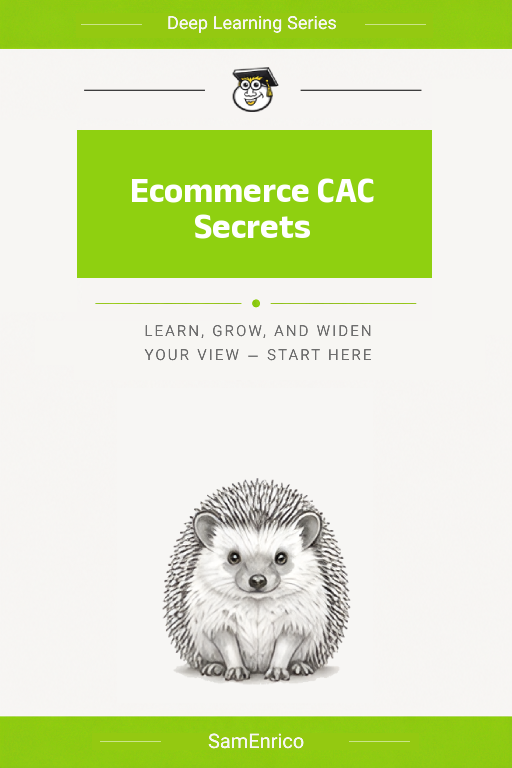
Ecommerce CAC Secrets eBook
Lower online store acquisition costs through email
Lower online store acquisition costs through email capture, SMS marketing, and retargeting sequences.
Formats
Free sample
Chapter 1: The Zero-Click Heist--The most expensive click you will ever buy is the one you have to buy twice.I learned this lesson in the worst possible way: watching 47,000of Facebookadbudgetevaporateinasingleweekwhilemycostperacquisitionclimbedfrom47,000 of Facebook ad budget evaporate in a single week while my cost per acquisition climbed from 47,000of Facebookadbudgetevaporateinasingleweekwhilemycostperacquisitionclimbedfrom22 to $89. The product hadn't changed. The landing page hadn't changed. The creative was the same award-winning video that had driven a 4x ROAS just thirty days earlier. But overnight, the rules of the game had shifted beneath my feet.
Apple’s i OS 14.5 update had dropped, and with it, the tracking cookie that had made Facebook advertising predictable had crumbled to dust.What happened next is the reason you are holding this book. I didn't fix the problem by hiring a better media buyer. I didn't solve it by doubling my budget to brute force my way through the algorithm. I solved it by realizing that I had been approaching customer acquisition entirely backward. I had been paying for clicks.
What I should have been paying for was ownership.The Billion-Dollar Blind Spot Every ecommerce founder wakes up to the same nightmare: rising CPMs, falling conversion rates, and a growing suspicion that the platforms are rigged against them. The data backs this up. Since 2021, average Facebook CPMs have increased 62% while average conversion rates have dropped 34% for most direct-to-consumer brands. Google Shopping ads have seen similar erosion. Tik Tok is already following the same trajectory—cheap now, expensive later.Here is what the platforms don't want you to understand.
Your customer acquisition cost is not a function of your ad creative or your bidding strategy. It is a function of friction. Every time a potential customer clicks an ad, lands on your page, and leaves without giving you a way to reach them again, you have paid for a click that produced zero long-term asset value. You rented attention for a moment and then handed it back to the platform.The brands that are winning right now—the ones scaling profitably while their competitors complain about i OS apocalypse—have discovered a counterintuitive truth. The secret to lowering acquisition costs is not better ads.
It is worse ads that lead to better capture. They have learned to sacrifice the immediate sale for the long-term relationship. They ask for the email address before they show the product. They ask for the phone number before they offer the discount. They have mastered what I call the Zero-Click Heist: turning every anonymous visitor into an owned asset before the page even finishes loading.Why Your Landing Page Is a Leaky Bucket Let me show you the math that changed everything for me.The average ecommerce store converts 2-3% of its traffic into purchases.
That means 97-98% of the people you paid to bring to your site leave without buying. Of those 97%, the vast majority will never return unless you retarget them—which means paying again for another click. You are essentially paying twice for the same potential customer: once to bring them in, and again to bring them back.Now consider an alternative. What if you could convert 30-40% of your traffic into email subscribers? That is not a typo.
Thirty to forty percent. Not buyers, but subscribers. People who have given you permission to contact them directly, for free, forever. When you own the relationship, you don't need to pay for a second click. You simply send an email.This is the Zero-Click Heist.
You steal the customer from the platform before the platform can charge you again. And here is the beautiful part: once someone subscribes, their subsequent purchases carry a marginal acquisition cost of exactly zero dollars. Zero. The ad that brought them in might have cost you $10. But the email that converts them seven days later costs you nothing except the seconds it took to write it.The Micro-Commitment Breakthrough The reason most stores fail at email capture is that they ask for too much, too soon.
A popup that says "Sign up for our newsletter" is asking for a relationship without offering any value. A popup that says "Get 10% off your first order" is better, but it trains customers to wait for discounts. Neither approach works at scale.The breakthrough came when I started studying behavioral psychology, specifically the work of Robert Cialdini and his concept of commitment and consistency. The principle is simple: people have a deep psychological need to act consistently with their prior commitments. If you can get someone to make a small, easy commitment first, they are far more likely to make a larger commitment later.In ecommerce terms, this means asking for the email address before you ask for the sale.
The email address is the micro-commitment. It costs the customer nothing except a few seconds of their time. But once they have given it, they have psychologically crossed a threshold. They have signaled interest. They have invested a tiny piece of themselves in your brand.The most effective implementation I have found is the micro-commit landing page.
Instead of a traditional homepage with product grids, navigation menus, and dozens of distraction points, you create a single-purpose page with one job: capture the email address. The page asks one question—"Want 15% off your first order?"—and provides one input field. Only after the email is submitted does the page redirect to the full product catalog or checkout.The results are staggering. One of my clients, a skincare brand, was running a standard homepage with a 2.1% conversion rate to purchase and a 3.4% email capture rate. After switching to a micro-commit landing page for their cold traffic, email capture jumped to 34%—a tenfold increase.
Purchase conversion actually dropped slightly on the first visit, from 2.1% to 1.8%, because visitors had to take an extra step. But the long-term impact was undeniable. The brand now owned ten times more email addresses from the same ad spend. Over a 90-day period, the customers who came through the micro-commit page had a 47% higher lifetime value because they had been nurtured properly instead of rushed to checkout.The Preference Center Pivot The second major breakthrough came from moving beyond the generic discount popup to what I call the preference center popup. This is the single most underutilized tool in ecommerce marketing, and it will instantly separate you from 99% of your competitors.The insight is brutally simple.
Most brands ask for an email address and then send the same sequence to everyone. This is lazy marketing, and customers can feel it. They unsubscribe because the messages aren't relevant. Each unsubscribe costs you future revenue and damages your sender reputation, which raises your future acquisition costs.The alternative is to ask a question at the point of capture. Instead of "Get 10% off," ask "Who are you shopping for?" with options like "Myself," "A gift," "My partner," or "My child." Or ask "What is your biggest concern?" with options like "Price," "Quality," "Shipping speed," or "Sustainability."These questions serve two purposes.
First, they collect zero-party data—information customers intentionally share because they want better service. This data is infinitely more valuable than behavioral tracking because it reveals intent directly. Second, they immediately segment your new subscriber into…
This is the end of the free sample. Get the eBook to keep going. Buy now
About this book
Details
- Author
- Feldman Keneth
- Publisher
- SamEnrico
- Language
- English
- Genre
- Non-Fiction, Startup Guide
- Released
- 2026-05-30
- Pages (approx.)
- 146
- Available as
- eBook, Audiobook

Read better in the ZLOADR app
Your eBooks on your phone or tablet. Sign in with your SamEnrico account and start reading.
More by Feldman Keneth
 Blue Zone Multi Gen Housing PlanFeldman Keneth$11.99
 Dan Castellaneta Homer VoiceFeldman Keneth$11.99
 Teen Confidence Daily WorkbookFeldman Keneth$11.99
 Cognitive Shuffling TechniqueFeldman Keneth$11.99
 The Solo Brainstorming GuideFeldman Keneth$11.99
 Byzantium’s Lost Genius: The Forgotten Architects of the Scientific RevolutionFeldman Keneth$11.99
 Understanding Woodhouse–sakati SyndromeFeldman Keneth$17.99
 How to Start a Bars Made of Aluminium Business (Beginners Guide)Feldman Keneth$11.99
 Female Founder Depression GuideFeldman Keneth$12.99
 Beyoncé's Renaissance: The Concert Film RevolutionFeldman Keneth$11.99
You may also like
 Hong Kong Handover 1997Dunn Johnnie$11.99
 Zumba For Postnatal Recovery CourseNeal Christian$11.99
 Zumba for BeginnersLadner Nikia$11.99
 YouTube Comment Mining GuideHumes Pandora$12.99
 Worry Box MeditationCarlin Rudy$11.99
 Workplace Stress MeditationNguyen Lynn$11.99
 Workplace Stress and Sleep RepairHawley Ivory$11.99
 Workplace Perfectionism CureDelaney Jeffry$11.99
 Workplace Injustice Anger GuideWallen Isabelle$11.99
 Work Addiction and Burnout LinkGreenwood Ester$11.99
 Women in Yoga and WellnessBeattie Galina$11.99
 Women in Stand Up ComedyChun Evangeline$11.99