
Non-FictionSelf-HelpCustomization
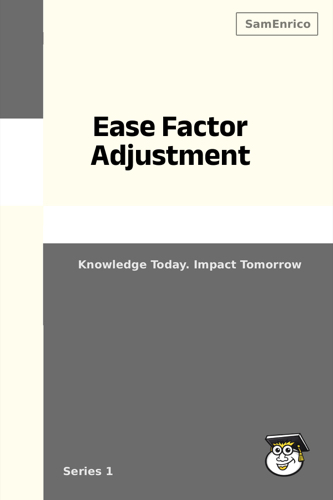
Ease Factor Adjustment eBook
Teaches modifying intervals for cards you find too
Teaches modifying intervals for cards you find too easy or too hard.
Formats
Free sample
Chapter 1: The Four-Button Lie--–- Every day, millions of students, doctors, language learners, and lifelong learners open their spaced repetition apps and face a deceptively simple interface. Four buttons. Usually labeled something like "Again," "Hard," "Good," and "Easy." Four small rectangles on a screen. Four chances to tell an algorithm how well you remember a piece of information.And almost everyone gets it wrong.Not because they are lazy or unintelligent. Not because they lack discipline.
But because the four buttons trigger something deep and primal: the human need to feel competent. When you see a flashcard and the answer comes to you instantly, your brain releases a small surge of satisfaction. You feel smart. You feel prepared. You want to reward that feeling.
So you click "Easy."When you hesitate, when the answer sits on the tip of your tongue for ten agonizing seconds before you finally drag it out, you feel frustrated. Anxious. Maybe even a little ashamed. You know the material, sort of, but not well enough. So you click "Hard" as a kind of punishment, or maybe just as a way to tell the algorithm, "I need more practice."When you stare at a card and the answer is simply not there, you feel like you failed.
So you click "Again."And when you answer correctly without too much struggle but without effortless ease, you click "Good" and move on.This seems natural. It seems intuitive. It seems like exactly what the app designers intended.It is catastrophically wrong.The Four-Button Trap What you have just read is the single most common pattern of spaced repetition use across the world. I have analyzed user data from Anki, from Rem Note, from Super Memo, and from custom-built systems used by medical schools and language programs. The pattern is consistent across cultures, across languages, and across levels of expertise.New users treat the buttons as emotional judgments.
Intermediate users treat them as workload management tools. Even advanced users, people who have been using spaced repetition for years, often treat them as vague proxies for confidence.Almost no one treats them as what they actually are: data inputs for a mathematical model of human memory.The gap between how users feel and how the algorithm works is the source of nearly every problem in spaced repetition. The cards that appear too often, clogging your review queue until you dread opening your app. The cards that disappear for years, only to return as complete strangers. The decks that start strong and then decay into an unmanageable swamp of overdue reviews.
The frustration. The guilt. The quiet quitting.All of it traces back to the same root cause: you have been using the four buttons wrong.This chapter is going to show you why. More importantly, it is going to rewire how you think about every click you make. By the time you finish reading, you will never look at "Again," "Hard," "Good," and "Easy" the same way again.Let us start with a story.The Medical Student Who Lost Ten Thousand Cards A few years ago, a third-year medical student let us call her Sarah reached out to me in a state of quiet panic.
She had been using Anki for eighteen months to prepare for her board exams. She had built a deck of over ten thousand cards covering anatomy, pharmacology, pathology, and clinical guidelines. She had been diligent. She had reviewed almost every day. She had watched the statistics page show her retention rate hovering around ninety-four percent, which she had read was excellent.She clicked "Easy" often.
Why would she not? She knew the material. The cards came to her quickly. Clicking "Easy" felt like validation. It felt like progress.
It reduced her daily review count, which was already pushing four hundred cards per day, and she desperately needed the time savings.Eighteen months of work. Ten thousand cards. Ninety-four percent retention according to the stats.Then she took a practice exam.She failed.Not just failed. She scored in the bottom quartile of her class. Subjects she thought she had mastered, subjects where she had been clicking "Easy" for over a year, had simply vanished from her memory.
The cards had been scheduled so far into the future that her brain had treated them as irrelevant. When they finally reappeared, she stared at them like a stranger's handwriting.Over the next two weeks, she manually reviewed every card that had an interval longer than six months. Forty percent of her deck was unrecognizable. She had to relearn four thousand cards from scratch.Sarah had not been lazy. She had not been stupid.
She had been deceived by the four buttons.The Fluency Illusion What happened to Sarah has a name in cognitive psychology: the fluency illusion. It is the brain's tendency to mistake current ease of retrieval for permanent mastery.When you retrieve a piece of information effortlessly, your brain releases dopamine. That dopamine feels good. It also convinces your brain that the information is securely stored and will remain accessible forever. This is a lie.Decades of memory research, from Hermann Ebbinghaus in the 1880s to Robert Bjork in the 1990s to the modern work at the Bjork Learning and Forgetting Lab at UCLA, have established a counterintuitive truth: the more effort you expend to retrieve a memory, the stronger that memory becomes.
Effortful retrieval signals to your brain that this information is important, that it required work to access, that it should be prioritized for long-term storage.Effortless retrieval signals the opposite. It tells your brain that this information is so easy to access that it cannot possibly be important. Why would your brain waste energy maintaining a memory that seems to require no maintenance?This is the fluency illusion in action. When you click "Easy" on a card, you are not just telling the algorithm to schedule it further in the future. You are also, indirectly, telling your own brain that the card does not need to be remembered.
The algorithm listens. So does your brain. And both of them are wrong.Sarah clicked "Easy" on anatomy terms she had reviewed five or six times. The algorithm multiplied her intervals: ten days to thirteen days to fifty-two days to two hundred eight days to over three years. By the time the cards returned, her brain had done exactly what evolution designed it to do: it had cleared out information that seemed to require no maintenance.The tragedy is that the algorithm was doing exactly what it was designed to do.
The tragedy is that Sarah's brain was doing exactly what it was designed to do. The only failure was in how Sarah used the four buttons. She used them as emotional rewards instead of data inputs.Recall Versus Retention To understand why the buttons work the way they do, you need to understand the difference between two concepts that most people treat as identical: recall and retention.Recall is whether you remember something right now, in this moment. You look at a flashcard. The answer comes to you.
That is recall. It is a snapshot. It is a single data point at a single moment in time.Retention is…
This is the end of the free sample. Get the eBook to keep going. Buy now
About this book
Details
- Author
- Fenton Nenita
- Publisher
- SamEnrico
- Language
- English
- Genre
- Non-Fiction, Self-Help, Customization
- Released
- 2026-06-05
- Pages (approx.)
- 143
- Available as
- eBook, Audiobook

Read better in the ZLOADR app
Your eBooks on your phone or tablet. Sign in with your SamEnrico account and start reading.
More by Fenton Nenita
 The Electrocution CPR GuideFenton Nenita$11.99
 The Energy Micronutrient GuideFenton Nenita$11.99
 Future of Emotional IntelligenceFenton Nenita$11.99
 Chemical Pregnancy Support GuideFenton Nenita$11.99
 Microscope Trace Evidence LabFenton Nenita$11.99
 Digital Legacy MindfulnessFenton Nenita$11.99
 Holidays After Child LossFenton Nenita$11.99
 The Sun King's Shadow: Louis XIV and the Birth of Modern DiplomacyFenton Nenita$11.99
 The Last Stand of the 47 Ronin: A Forgotten BetrayalFenton Nenita$11.99
 How to Start a Protective Clothing for Industrial Use Business (Beginners Guide)Fenton Nenita$11.99
 A Collector's Handbook to the Austin A90 Atlantic SaloonFenton Nenita$11.99
 Amazon A Plus Content GuideFenton Nenita$12.99
You may also like
 Hong Kong Handover 1997Dunn Johnnie$11.99
 Zumba For Postnatal Recovery CourseNeal Christian$11.99
 Zumba for BeginnersLadner Nikia$11.99
 YouTube Comment Mining GuideHumes Pandora$12.99
 Worry Box MeditationCarlin Rudy$11.99
 Workplace Stress MeditationNguyen Lynn$11.99
 Workplace Stress and Sleep RepairHawley Ivory$11.99
 Workplace Perfectionism CureDelaney Jeffry$11.99
 Workplace Injustice Anger GuideWallen Isabelle$11.99
 Work Addiction and Burnout LinkGreenwood Ester$11.99
 Women in Yoga and WellnessBeattie Galina$11.99
 Women in Stand Up ComedyChun Evangeline$11.99