
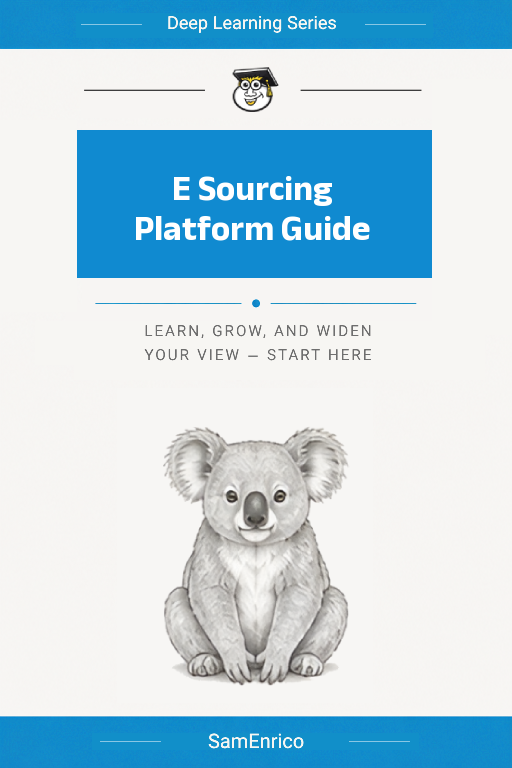
Non-FictionOperational Efficiency ManualE Sourcing
E Sourcing Platform Guide eBook
Implements e-sourcing tools for RFx events, automa
Implements e-sourcing tools for RFx events, automated supplier invitations, bid comparison, and award recommendations.
Formats
Free sample
Chapter 1: The Spreadsheet Trap--Every procurement disaster I have ever witnessed began the same way: with a perfectly organized Excel spreadsheet.The font was Calibri, size 11. The columns were aligned. The conditional formatting highlighted the lowest bid in crisp, reassuring green. And someone, somewhere, was about to make a million-dollar mistake while feeling impressively data-driven.I learned this lesson in a conference room on the thirty-fourth floor of a Chicago high-rise, seven years ago, on a Tuesday that I will never forget. The VP of Supply Chain—a man named Richard who wore suspenders and believed his own press clippings—slammed a stack of paper onto the mahogany table.
"We ran a competitive RFQ," he announced. "Twelve suppliers. Lowest bid wins. That's just good business."The lowest bid was from a supplier called Apex Logistics. Their quote was 22 percent below the next closest competitor.
Richard had already printed the purchase order. The celebration Power Point was ready. The savings would be announced at the quarterly board meeting.I was a twenty-nine-year-old sourcing analyst with no power, no budget, and a nagging sense that something smelled wrong. I had spent the previous week building a should-cost model for the category—a detailed engineering estimate of what the service should actually cost based on labor rates, fuel indices, and equipment depreciation. According to my model, Apex's bid was not aggressive.
It was impossible."You're telling me," Richard said, leaning over my cubicle the next morning, "that you think you know more than twelve suppliers bidding in an open market?""I'm telling you," I replied, "that Apex's bid is 40 percent below our should-cost floor. They can't make money at that price. Which means either they're lying about their capabilities, or they plan to hit us with change orders the moment the contract is signed."Richard laughed. "That's why we have a fixed-price contract."He signed the deal three days later.Eight months after that, Apex Logistics filed for bankruptcy. They had underbid seventeen contracts simultaneously, hoping to win volume and renegotiate later.
When the renegotiations failed, they collapsed. Our production line stopped for eleven days. The cost of emergency replacement suppliers wiped out the "savings" four times over. Richard was asked to "pursue other opportunities." I was asked to write a post-mortem explaining what went wrong.That post-mortem became the foundation of everything I have learned about e-sourcing platforms, and it is why I am writing this book.The Myth of Automated Negotiation Here is the single biggest misconception in procurement today: e-sourcing is just automated negotiation.Vendors are partly to blame. Their marketing materials show happy buyers clicking buttons while pie charts go up and to the right.
Consultants sell "digital transformation" as if installing software is the same thing as changing behavior. And procurement professionals—overworked, understaffed, and desperate for a win—have every incentive to believe that the solution is simply better technology.But automation without intelligence is just speed. And speed in the wrong direction only gets you lost faster.The truth is that e-sourcing platforms are not negotiation tools. They are decision support systems that become powerful only when you understand what happens before the first supplier invitation is sent. The RFx event—whether it is an RFP, RFQ, or auction—is the visible tip of an iceberg.
Beneath the waterline lies strategy, data, stakeholder alignment, and a clear-eyed understanding of what you are actually trying to achieve.This chapter dismantles the myth of automated negotiation and replaces it with a framework for strategic sourcing. You will learn:The critical difference between transactional e-procurement and strategic e-sourcing The four levels of sourcing maturity (and why most organizations are stuck at Level 1)The Upstream Intelligence Gap and why 70 percent of sourcing value is determined before the first bid is received A self-assessment tool to diagnose your organization's current capabilities By the end of this chapter, you will never look at an RFQ spreadsheet the same way again.E-Procurement Versus E-Sourcing: The Strategic Gap Before we go any further, we need to draw a sharp line between two concepts that are often confused but could not be more different.E-procurement is transactional. It handles the purchase of goods from existing contracts and catalogs. When an employee buys office supplies from an approved vendor using a punch-out catalog in SAP Ariba or Couva, that is e-procurement. The work has already been done: the contract is signed, the prices are set, the supplier is qualified.
E-procurement is about execution.E-sourcing is strategic. It happens before the contract exists. E-sourcing is the process of running RFx events, evaluating suppliers, negotiating terms, and selecting award winners. It is about decision-making under uncertainty.Here is why the distinction matters: organizations that confuse the two consistently underinvest in sourcing. They buy sophisticated e-procurement systems, automate their P2P (procure-to-pay) processes, and wonder why they are not seeing meaningful savings.
The answer is obvious once you understand it: you cannot automate the execution of a bad contract into a good outcome.Consider the data from a 2024 Spend Matters benchmark study. Organizations with mature e-sourcing capabilities (running structured RFx events with optimization) achieve average savings of 10-15 percent on addressed spend. Organizations that rely solely on e-procurement (buying from existing catalogs) achieve zero incremental savings because the negotiation is already done.E-procurement preserves value. E-sourcing creates it.This book is about e-sourcing. If you are looking for a guide to punch-out catalogs, invoice automation, or purchase requisition workflows, there are many fine books on those topics.
This is not one of them. We are going upstream, into the messy, ambiguous, high-stakes world of supplier selection, where the decisions you make today determine whether your company thrives or merely survives.The Four Levels of Sourcing Maturity Over the past decade, working with more than two hundred procurement organizations, I have observed a consistent pattern in how companies evolve their sourcing capabilities. I call this the Sourcing Maturity Model, and it has four distinct levels.Level 1: Basic E-Negotiation (Email + Spreadsheets)This is where most organizations start—and where many remain, trapped by habit and inertia.At Level 1, "sourcing" means sending the same Excel spreadsheet to five or six suppliers via email, waiting for responses to trickle in over two to three weeks, then manually comparing the bids by sorting a column. There is no structured RFx template. There are no scoring weights.
There is no audit trail. The entire process depends on the memory and judgment of a single category manager.The risks at Level 1 are staggering. Suppliers submit bids in different formats—some including shipping, some excluding it; some quoting in USD, some in EUR; some offering Net 30 terms, others demanding Net 0 upon receipt. The category manager normalizes the data manually, if at all, introducing errors with every keystroke. There is no way to prove that the process was fair or defensible.
And when a supplier dispute arises (and it will), the only evidence is a chain of emails with ambiguous subject lines.Yet Level 1 persists because it feels familiar. Spreadsheets are comfortable. Email is universal. And the cost of the status quo—the slow bleed of maverick spend, the unnoticed supplier price creep, the missed opportunities for consolidation—is invisible. You…
This is the end of the free sample. Get the eBook to keep going. Buy now
About this book
Details
- Author
- Lorentz Sterling
- Publisher
- SamEnrico
- Language
- English
- Genre
- Non-Fiction, Operational Efficiency Manual, E Sourcing
- Released
- 2026-06-01
- Pages (approx.)
- 156
- Available as
- eBook, Audiobook

Read better in the ZLOADR app
Your eBooks on your phone or tablet. Sign in with your SamEnrico account and start reading.
More by Lorentz Sterling
 Beginner Mindfulness for LonelinessLorentz Sterling$11.99
 Helping A Child Say GoodbyeLorentz Sterling$11.99
 Data Scientist CreativityLorentz Sterling$11.99
 Complicated Grief After Pet LossLorentz Sterling$11.99
 The Dolores Huerta Si Se PuedeLorentz Sterling$11.99
 Understanding Stoll–levy–francfort SyndromeLorentz Sterling$17.99
 Coffee Shop Startup SystemsLorentz Sterling$11.99
 AI Accounting Setup GuideLorentz Sterling$12.99
 Ultimate Handbook Guide to Adelaide : (Australia) Travel GuideLorentz Sterling$11.99
You may also like
 Hong Kong Handover 1997Dunn Johnnie$11.99
 Zumba For Postnatal Recovery CourseNeal Christian$11.99
 Zumba for BeginnersLadner Nikia$11.99
 YouTube Comment Mining GuideHumes Pandora$12.99
 Worry Box MeditationCarlin Rudy$11.99
 Workplace Stress MeditationNguyen Lynn$11.99
 Workplace Stress and Sleep RepairHawley Ivory$11.99
 Workplace Perfectionism CureDelaney Jeffry$11.99
 Workplace Injustice Anger GuideWallen Isabelle$11.99
 Work Addiction and Burnout LinkGreenwood Ester$11.99
 Women in Yoga and WellnessBeattie Galina$11.99
 Women in Stand Up ComedyChun Evangeline$11.99