
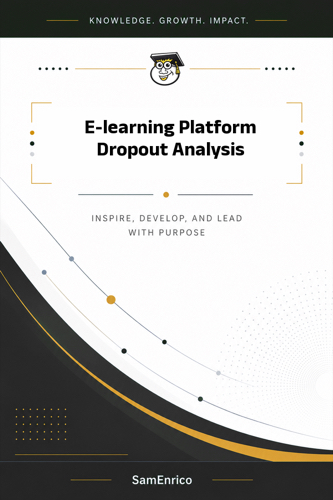
Non-FictionConsumer Mind ReportOnline Learning
E-learning Platform Dropout Analysis eBook
Studies Coursera and Udemy subscription retention
Studies Coursera and Udemy subscription retention and course completion correlation.
Formats
Free sample
Chapter 1: The Leaky Bucket--–- The email arrived at 6:47 AM on a Tuesday. Maria, a marketing manager in São Paulo, had just purchased a $59 monthly subscription to Coursera’s data science specialization. She was excited, hopeful, and absolutely certain that this time would be different. Six months earlier, she had bought three Udemy courses during a flash sale for $29.97. She had opened exactly zero of them.
The guilt from those unopened courses sat in her inbox like unconfessed sins—automated reminders from Udemy reading “We miss you!” that she archived without opening. But this time, she told herself, was different. This time she had paid full price. This time it was a specialization from a real university. This time, she would finish.Two weeks later, Maria canceled her subscription.
She had watched exactly forty-two minutes of video content across four courses. She had completed zero quizzes. She had posted zero questions in the discussion forums. Her digital footprint on the platform consisted of login events—each one shorter than the last—until the logins stopped entirely. Maria was not lazy.
She was not unintelligent. She was not lacking in ambition. Maria was a statistic. Specifically, she was one of the 90 percent.The e-learning industry has a dirty secret that no conference keynote speaker likes to mention. The secret is this: completion rates on most massive open online courses, or MOOCs, hover below 10 percent.
For free courses, the number often drops below 5 percent. For paid courses on open marketplaces like Udemy, the completion rate rises slightly but still struggles to cross the 15 percent threshold. For subscription-based platforms like Coursera, where users pay monthly for access to entire catalogs, the completion rate per enrolled course rarely exceeds 20 percent. What this means, in plain language, is that for every ten students who raise their hand and say “I want to learn this,” nine of them will fail to finish. They will not finish the course.
They will not finish the specialization. They will not finish the certificate. They will simply disappear, leaving behind a trail of abandoned videos, untouched quizzes, and the quiet sound of wasted potential.This book is about those nine students. It is about why they leave, when they leave, and what platforms can do to make them stay. But before we can solve the problem, we must first understand its true scale.
The dropout crisis in e-learning is not a pedagogical failure—or rather, it is not only a pedagogical failure. It is a structural failure, an economic failure, a psychological failure, and a technical failure, all wrapped together in a $50 billion problem that the industry would prefer to ignore. This chapter quantifies that problem, introduces the two faces of dropout, and sets the stage for every solution that follows.The $50 Billion Silent Crisis Let us begin with the math, because the math is unforgiving. The global e-learning market was valued at approximately $315 billion in 2025, with projections exceeding $500 billion by 2030. Of that total, the direct-to-consumer segment—platforms like Coursera, Udemy, ed X, Linked In Learning, and Skillshare—accounts for roughly $45 to $55 billion annually.
This is the money that learners pay directly for access to courses, specializations, and certificates. It is a staggering sum, larger than the box office revenues of Hollywood, larger than the global recorded music industry, and growing at nearly 15 percent per year.Now consider the dropout rate. If 90 percent of enrolled students never finish their courses, then the vast majority of that $50 billion is being collected for incomplete value. Students pay for transformation—the promise of a new skill, a promotion, a career change—and receive, in most cases, nothing but a library of unopened video files. This is not a sustainable business model.
It is not an ethical business model. And yet, it persists because the industry has convinced itself that enrollment is the only metric that matters.The argument from platform executives tends to follow a familiar pattern. “Completion rates are misleading,” they say. “Not every student needs to finish a course to get value. Some students only need one video.
Some students use the platform as a reference library. Some students audit courses without intending to complete them.” There is a sliver of truth in this defense. Yes, some students derive partial value from partial engagement. Yes, the traditional model of “enroll, attend, graduate” does not map perfectly onto the fluid reality of adult learning. But these defenses crumble under the weight of the data.A 2026 study led by Dr.
Adebayo Ogunsakin, analyzing over 226,000 user reviews across fourteen e-learning platforms, found something remarkable. When researchers coded the cancellation reasons provided by users who had voluntarily terminated their subscriptions, only 12 percent of those cancellations were what the study called “satisfied leavers”—users who said they had gotten what they needed and were leaving on good terms. The remaining 88 percent were, in some form, dissatisfied. They left because the platform did not work. They left because the course was too hard.
They left because the course was too easy. They left because they could not find the course in the dashboard. They left because the app crashed. They left because they felt stupid. They left because no one answered their question.
They left because they forgot they had a subscription and only noticed when the credit card bill arrived. In almost nine out of ten cases, the dropout was not a neutral parting of ways. It was a failure.The financial cost of this failure is not limited to the subscription fees that platforms collect for unearned value. There is also the cost of acquisition. The average e-learning platform spends between $40 and $120 to acquire a single paying user through digital advertising, content marketing, and affiliate partnerships.
When that user churns after two weeks—having watched forty-two minutes of video and completed zero quizzes—the platform does not simply lose the subscription revenue. It also loses the acquisition cost. The unit economics become impossible. A platform that spends $80 to acquire a user who pays $59 for one month and then cancels is losing $21 on every transaction, before accounting for hosting, support, and content costs. Multiply that by millions of users, and the industry is hemorrhaging money while celebrating record enrollment numbers.The Two Faces of Dropout: Lazy and Frustrated To understand why students leave, we must first distinguish between two fundamentally different types of dropout.
The Ogunsakin study, which will serve as our empirical backbone throughout this book, identified two clusters of cancellation reasons that accounted for 94 percent of all churn. The study called them Lazy Dropouts and Frustrated Dropouts. These are not judgmental labels. They are diagnostic categories.Lazy Dropouts are users who intended to cancel their subscription but either forgot or found the cancellation process too burdensome. They are “lazy” only in the sense that their dropout requires no active effort—they simply drift away.
The typical Lazy Dropout signs up for a free trial or a promotional offer, uses the platform lightly for a few days, and then stops logging in. When the credit card is charged, they experience a moment of surprise followed by a decision: “I should cancel this.” But cancellation requires clicking through menus, finding the settings page, and confirming…
This is the end of the free sample. Get the eBook to keep going. Buy now
About this book
Details
- Author
- Nielsen Cecille
- Publisher
- SamEnrico
- Language
- English
- Genre
- Non-Fiction, Consumer Mind Report, Online Learning
- Released
- 2026-06-06
- Pages (approx.)
- 124
- Available as
- eBook, Audiobook

Read better in the ZLOADR app
Your eBooks on your phone or tablet. Sign in with your SamEnrico account and start reading.
More by Nielsen Cecille
 The Quiet Conflict WithinNielsen Cecille$11.99
 Assertiveness Group TrainingNielsen Cecille$11.99
 DBT For PTSD EmotionNielsen Cecille$11.99
 Persuasion For CoachesNielsen Cecille$11.99
 Mobile Therapy For Remote RegionsNielsen Cecille$11.99
 Grace Coolidge First LadyNielsen Cecille$11.99
 The Swiss Gold Standard: How Neutrality Built a Banking EmpireNielsen Cecille$11.99
 Burke and Wills: The Epic Quest to Cross a ContinentNielsen Cecille$11.99
 How to Produce ShoelacesNielsen Cecille$11.99
 How to Produce Foot FilesNielsen Cecille$11.99
 Weather and Nature Stock Video NicheNielsen Cecille$12.99
 UK Business Credit Score RangesNielsen Cecille$12.99
You may also like
 Hong Kong Handover 1997Dunn Johnnie$11.99
 Zumba For Postnatal Recovery CourseNeal Christian$11.99
 Zumba for BeginnersLadner Nikia$11.99
 YouTube Comment Mining GuideHumes Pandora$12.99
 Worry Box MeditationCarlin Rudy$11.99
 Workplace Stress MeditationNguyen Lynn$11.99
 Workplace Stress and Sleep RepairHawley Ivory$11.99
 Workplace Perfectionism CureDelaney Jeffry$11.99
 Workplace Injustice Anger GuideWallen Isabelle$11.99
 Work Addiction and Burnout LinkGreenwood Ester$11.99
 Women in Yoga and WellnessBeattie Galina$11.99
 Women in Stand Up ComedyChun Evangeline$11.99