
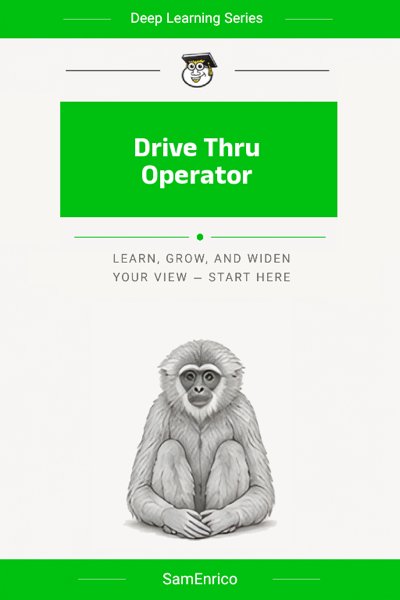
Non-FictionInformativeEducational
Drive Thru Operator eBook
A Coursebook on Drive Thru Operator
A Coursebook on Drive Thru Operator
Formats
Free sample
Chapter 1: The $47 Minute--– The alarm on Maria’s phone buzzes at 4:47 AM. She silences it before it wakes her daughter. The screen shows a notification from the store’s traffic prediction software: “Projected lunch rush: 187 cars. Peak at 12:22 PM. Staff shortage: 1 presenter.
Recommend calling in Flores.” She taps “acknowledge” and swings her legs to the floor. In three hours, she will stand inside a 30-foot-long box of concrete, glass, and fryer grease. That box—the drive-thru—will generate more revenue today than any other single asset her franchise owner possesses. And if she makes one mistake, one hesitation, one moment of poor judgment, that box will leak profit like a cracked radiator.Maria is a shift manager at a Mc Donald’s in Tulsa, Oklahoma. She has been working drive-thrus for eleven years.
She started at sixteen, taking orders with a headset that smelled like old coffee and regret. Now she runs the lunch shift at one of the busiest stores in her district. She knows things about the drive-thru that corporate trainers don’t put in manuals. She knows that a customer who waits five minutes at the speaker box is 40 percent less likely to return next week. She knows that a cashier who takes seven seconds to make change instead of three costs the store $12,000 a year in cumulative delay.
She knows that the difference between a good shift and a disaster is often one person—where they stand, what they say, and whether they are looking at the timer or looking at the line.This chapter is about what Maria knows. It is about the invisible math of the drive-thru, the physics of the lane, and the single most expensive minute in modern business.The Story of the 14-Minute Car Let us go back to that Taco Bell in Tulsa. Not Maria’s store, but another one, three miles away, on a Tuesday afternoon in July. The manager that day was a decent guy named Derek. He had worked quick-service restaurants for eight years.
He knew how to change a fryer filter, how to count a drawer, how to write a schedule. What he did not know was that he was about to lose $658 in sixty seconds.Here is what happened.At 12:14 PM, a silver sedan pulled into the drive-thru. The customer ordered a Crunchwrap Supreme, two soft tacos, and a large Baja Blast. Total: $9.47. The order taker repeated it back.
The customer said yes. Then the customer pulled to the window and realized she had left her wallet in her office. She spent four minutes searching her purse, her glove compartment, the floor mats. Derek, at the window, stood with his hand out, waiting. He did not pull her forward.
He did not send a runner. He just waited.Behind her, seven cars stacked up. The second car waited two minutes at the speaker box, then drove off. The third car waited three minutes, then drove off. By the time the silver sedan finally paid—using a crumpled $10 bill she found under the passenger seat—five of the seven cars had abandoned the line.
The two that remained waited a combined eighteen minutes for their food.After the rush, Derek checked his numbers. His average speed of service that day was 5 minutes 47 seconds—actually better than the industry average. He shrugged and went back to his paperwork. He did not know that the five abandoned cars represented $47.38 in immediate lost revenue. He did not know that those five customers, according to industry data, had a 68 percent chance of never returning.
He did not know that the lifetime value of those five customers—their future visits, their word-of-mouth referrals, their app downloads—was $658.That is the $47 minute. Every minute a car sits idle in your drive-thru, you are not just losing that transaction. You are losing the next twenty transactions that customer would have made over the next two years. You are losing the three friends they would have told about your slow service. You are losing the habit you had not yet built.This chapter is not about speed because speed is a nice metric.
It is about speed because speed is survival.The Two Numbers That Actually Matter Most drive-thru operators are obsessed with the wrong number. They stare at their Speed of Service—the time from order to departure—like it is the only thing that matters. It is not. Speed of Service is a lagging indicator. It tells you how fast you were, not how much you earned.The number that matters is Total Throughput—cars served per hour, not seconds per car.
These two numbers are related, but they are not the same. A store can have excellent Speed of Service but terrible Total Throughput. Here is how: imagine a store that serves each car in 90 seconds. That is fast. But if that store only has one lane and a single window, and if the line backs up so that cars spend four minutes waiting before they even reach the speaker, then the store is actually serving fewer cars per hour than a slower store with better queue management.Let us do the math.Store A: Serves each car in 90 seconds.
Has a single lane. The line backs up, so cars wait 3 minutes before reaching the speaker. Total time per car: 4.5 minutes. Maximum cars per hour: 13.Store B: Serves each car in 120 seconds. Has a dual lane and a three-window system.
Cars wait 30 seconds before reaching the speaker. Total time per car: 2.5 minutes. Maximum cars per hour: 24.Store B is “slower” by Speed of Service but serves almost twice as many cars per hour. Store A is “faster” but leaves money on the table.The industry benchmark, from Intouch Insight’s annual drive-thru study, puts the average Total Throughput at 37 cars per hour during peak lunch. The top-performing stores do 55 to 60 cars per hour.
The difference between 37 and 55 is not academic. At an average check of $8.50, the faster store makes an extra $153 per hour. Over a 52-week year, that is nearly $80,000—from the same building, the same staff, the same menu.So the first question this chapter asks is simple: Are you measuring the right thing?The Three Chokepoints of Hell Every drive-thru has three natural bottlenecks. Call them the Three Chokepoints. They exist in every store, from the newest Chick-fil-A to the oldest Dairy Queen.
The only difference is how well you manage them.Chokepoint One: The Order Point. This is the speaker box, the menu board, the place where customers decide what to eat. The delay here comes from two sources: customer indecision and technical failure. Customer indecision adds 15 to 30 seconds per car. Technical failure—a crackling speaker, a glare on the menu board, an unresponsive touchscreen—adds another 10 to 20 seconds.
Combined, the Order Point accounts for 35 to 45 percent of total drive-thru time.Chokepoint Two: The Payment Window. This is where money changes hands. The delay here comes from payment method (cash is slower than card, card is slower than mobile, mobile is slower than nothing at all), cashier speed, and customer fumbling. A customer paying with exact change adds 8 seconds. A customer using a credit card adds 12 seconds.
A customer using a mobile app adds 20 seconds—unless the app is integrated and the code is pre-scanned, in which…
This is the end of the free sample. Get the eBook to keep going. Buy now
About this book
Details
- Author
- Tipton Annamaria
- Publisher
- SamEnrico
- Language
- English
- Genre
- Non-Fiction, Informative, Educational
- Released
- 2026-06-03
- Pages (approx.)
- 140
- Available as
- eBook, Audiobook

Read better in the ZLOADR app
Your eBooks on your phone or tablet. Sign in with your SamEnrico account and start reading.
More by Tipton Annamaria
 Attempt Survivor Aftermath GuideTipton Annamaria$11.99
 Stretching for Tennis GuideTipton Annamaria$11.99
 TWIN Identity Differentiation GuideTipton Annamaria$11.99
 Assertive Communication for MusiciansTipton Annamaria$11.99
 The Music Industry Instagram TrapTipton Annamaria$11.99
 The Siege of Beslan: 53 Hours of Terror in a Russian SchoolTipton Annamaria$11.99
 Citation Rule Practice TestTipton Annamaria$12.99
 Customer Success Promotion KitTipton Annamaria$12.99
 Understanding Nanism Due to Growth Hormone Isolated Deficiency With X-linked HypogammaglobulinemiaTipton Annamaria$17.99
 How to Start a Calculating Machine Business (Beginners Guide)Tipton Annamaria$11.99
You may also like
 Hong Kong Handover 1997Dunn Johnnie$11.99
 Zumba For Postnatal Recovery CourseNeal Christian$11.99
 Zumba for BeginnersLadner Nikia$11.99
 YouTube Comment Mining GuideHumes Pandora$12.99
 Worry Box MeditationCarlin Rudy$11.99
 Workplace Stress MeditationNguyen Lynn$11.99
 Workplace Stress and Sleep RepairHawley Ivory$11.99
 Workplace Perfectionism CureDelaney Jeffry$11.99
 Workplace Injustice Anger GuideWallen Isabelle$11.99
 Work Addiction and Burnout LinkGreenwood Ester$11.99
 Women in Yoga and WellnessBeattie Galina$11.99
 Women in Stand Up ComedyChun Evangeline$11.99