
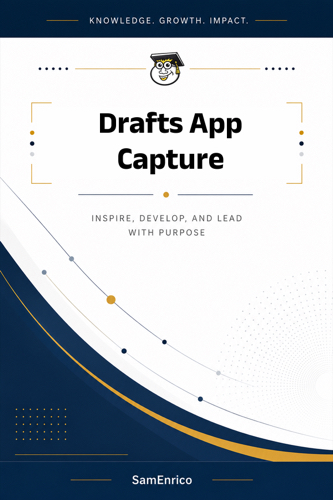
Free sample
Chapter 1: The Leaky Bucket...–- Every morning, you wake up with a mind full of ideas. By noon, most of them are gone. Not because they were bad ideas, but because you had nowhere to put them fast enough.This is not a failure of intelligence, creativity, or discipline. It is a failure of friction. And until you understand how friction silently robs you of your best thinking, you will continue to wonder where all those brilliant midnight insights, shower thoughts, and roadside inspirations disappeared to.Let me tell you about a man named David.
David is a creative director at a mid-sized marketing firm. He is smart, articulate, and genuinely innovative. But David has a problem he cannot name. Three times in the past month, he has woken up at 3:00 AM with a perfect solution to a client's branding problem. The idea arrives fully formed—a tagline, a visual direction, even the font choices.
In his half-awake state, he thinks, "I'll remember this in the morning. It's too good to forget."By 7:30 AM, the idea is gone. Not faded. Not模糊. Gone.
He remembers that he had an idea. He remembers that it felt important. But the content itself has evaporated like morning dew on a hot sidewalk.David's experience is not unique. It is the universal human condition. And it has a name: the open loop problem.The Cognitive Science of Vanishing Thoughts An "open loop," in the language of productivity psychology, is any task, idea, obligation, or commitment that you have not yet completed or stored in a trusted external system.
Your brain, for all its evolutionary majesty, is a terrible filing cabinet. It was designed to keep you alive on the savanna—to notice the rustle in the grass that might be a predator, to remember which berry bush made you sick, to track the social dynamics of your tribe. It was not designed to hold tomorrow's grocery list, next week's project deadline, and a fleeting insight about your novel's third act simultaneously.The Zeigarnik effect, discovered by Russian psychologist Bluma Zeigarnik in the 1920s, explains why. Zeigarnik observed that waiters could remember complex drink orders while they were still serving them but forgot the orders almost immediately after they were fulfilled. Her conclusion: unfinished tasks occupy a privileged place in memory.
Your brain holds onto open loops precisely because they are open. It does not want you to forget that there…
This is the end of the free sample. Get the Audiobook to keep going. Buy now
About this book
Details
- Author
- Samples Dierdre
- Publisher
- SamEnrico
- Language
- English
- Genre
- Non-Fiction, Self-Help / Quick Capture
- Released
- 2026-06-06
- Pages (approx.)
- 156
- Available as
- eBook, Audiobook

Listen in the VoxFlicks app
Audiobooks and audio dramas wherever you go. Sign in with your SamEnrico account and press play.
More by Samples Dierdre
 Parent Death Dating Again GuideSamples Dierdre$11.99
 Spin Studio Owner GuideSamples Dierdre$11.99
 The Quit Smoking Caffeine GuideSamples Dierdre$11.99
 Parent Home Office Distraction GuideSamples Dierdre$11.99
 Cognitive Reframing EQ SkillsSamples Dierdre$11.99
 Bipolar And Borderline PDSamples Dierdre$11.99
 Foreign Language ExamSamples Dierdre$11.99
 Child Loss Reading ListSamples Dierdre$11.99
 The Battle of Ipsus: The Empire Split in Two (301 BC)Samples Dierdre$11.99
 Blood and Jade: The Olmec Colossal Heads and the Lost Kings of MesoamericaSamples Dierdre$11.99
 Growing Helleborus (Hellebore)Samples Dierdre$11.99Growing Helleborus (Hellebore)Samples Dierdre$11.99
You may also like
 Hong Kong Handover 1997Dunn Johnnie$11.99
 Zumba For Postnatal Recovery CourseNeal Christian$11.99
 Zumba for BeginnersLadner Nikia$11.99
 YouTube Comment Mining GuideHumes Pandora$12.99
 Worry Box MeditationCarlin Rudy$11.99
 Workplace Stress MeditationNguyen Lynn$11.99
 Workplace Stress and Sleep RepairHawley Ivory$11.99
 Workplace Perfectionism CureDelaney Jeffry$11.99
 Workplace Injustice Anger GuideWallen Isabelle$11.99
 Work Addiction and Burnout LinkGreenwood Ester$11.99
 Women in Yoga and WellnessBeattie Galina$11.99
 Women in Stand Up ComedyChun Evangeline$11.99