
Non-FictionSelf-HelpEducationClassroom Management
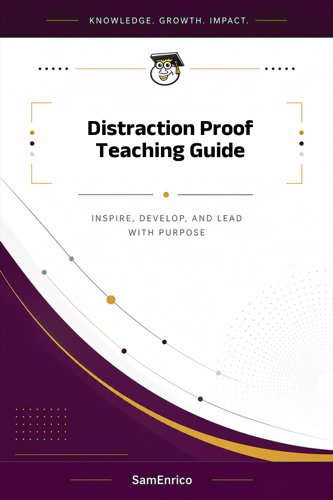
Distraction Proof Teaching Guide eBook
Manage classroom interruptions, keep lesson flow,
Manage classroom interruptions, keep lesson flow, and regain attention after disruptions.
Formats
Free sample
Chapter 1: Beyond the Gavel--–- Picture the scene. You have spent two hours prepping this lesson. You have printed the handouts, queued the slides, rehearsed the transitions. The bell rings. You launch in.
Fifteen minutes later, a phone buzzes in a backpack. A student in the third row rolls her eyes. Two boys in the back are passing a note. Someone asks when lunch is. Someone else asks to go to the bathroom.
Your voice tightens. Your pulse quickens. And a familiar voice inside your head whispers: If I were stricter, this wouldn't happen.That voice is lying to you. And chasing that lie is the reason you are exhausted.This chapter dismantles the first and most costly assumption about classroom management: the belief that authority is the antidote to distraction. We will examine why stricter rules, louder reprimands, and heavier consequences fail to produce lasting attention.
We will explore the neurobiology of why punitive systems backfire. And we will lay the foundation for a radically different approach—one that replaces the gavel with the metronome.The Punishment Trap Every teacher knows the arc. A student acts out. You respond with a consequence. The behavior stops—temporarily.
Then it returns, often worse than before. You escalate the consequence. The behavior stops again, then returns again. You escalate further. The cycle continues until the only remaining consequences are suspension, expulsion, or your own burnout.This is the punishment trap.
And it is not your fault. The trap is built into the structure of punitive systems themselves, reinforced by every classroom management program that prioritizes "consequences" over "design."Here is why the trap works the way it does. Punishment triggers the brain's threat response. When a student perceives a consequence as threatening, their amygdala (the brain's smoke detector) activates. Blood flows away from the prefrontal cortex (the thinking brain) and toward the survival circuits.
The student becomes less capable of reflection, less capable of impulse control, and more likely to react defensively. You have not increased their capacity for attention. You have reduced it.The research is unequivocal. A meta-analysis published in the Journal of Educational Psychology examined forty years of classroom management studies. The findings: punitive approaches (detentions, referrals, public reprimands) produce short-term compliance but do not improve long-term attention or engagement.
In fact, students in high-punishment classrooms showed higher rates of distraction over time than students in low-punishment classrooms. The punishment did not cure the distraction. It fertilized it.Why Authority Fails Where Rhythm Succeeds Consider two classrooms. In Classroom A, the teacher runs a tight ship. Rules are posted on the wall.
Consequences are clear and consistently applied. The teacher has a loud voice and is not afraid to use it. Students sit in rows. Talking is prohibited during instruction. Phones are confiscated on sight.In Classroom B, the teacher seems almost relaxed.
Rules are few. Consequences are rarely deployed. The teacher rarely raises their voice. Students sit in clusters. Talking is permitted during certain activities.
Phones are stored in a visible caddy but not confiscated.Which classroom has fewer interruptions?The answer, of course, is that it depends entirely on rhythm—not on rules. A high-authority classroom with poor rhythm will be interrupted constantly because students are bored, overwhelmed, or both. A low-authority classroom with strong rhythm will hum along because students are engaged, rested, and oriented. Authority is a poor predictor of distraction. Rhythm is an excellent one.This is not speculation.
It is the finding of every major observational study of classroom management conducted in the past thirty years. The most distraction-proof classrooms are not the ones with the strictest teachers. They are the ones with the most predictable structures—clear transitions, varied activities, embedded breaks, and consistent signals. Predictability, not punishment, is the enemy of distraction.The Audience Problem When you use authority to stop a disruption, you are performing for an audience. That audience is the rest of the class.
And that audience is learning something you did not intend to teach.Watch what happens when a teacher publicly reprimands a student for whispering. The reprimanded student may stop whispering. But twenty-seven other students have just watched a power struggle. Some feel anxious. Some feel entertained.
Some mentally check out until the drama ends. Some make a mental note: next time, don't get caught.The public reprimand has achieved compliance from one student at the cost of disengagement from many. This is not a good trade. Yet it is the default move for teachers trained in authority-based management systems. The system rewards visible enforcement.
The teacher gets the dopamine hit of "doing something." But the learning environment has been degraded.The alternative is what this book calls silent intervention—addressing disruptions without giving them an audience. Silent intervention takes many forms, which we will explore in depth later. For now, understand the principle: attention is a currency. Every time you stop instruction to address a disruption publicly, you spend attention currency to buy compliance. You almost always overpay.The Willfulness Fallacy Beneath the punishment trap lies an even deeper error: the assumption that distraction is an act of will.This assumption is so pervasive that it rarely gets examined.
A student looks out the window. The teacher assumes the student has chosen to look out the window. A student checks their phone. The teacher assumes the student has chosen to prioritize the phone over the lesson. A student whispers to a neighbor.
The teacher assumes the student has chosen to disrupt the learning environment.But what if these assumptions are backward?Cognitive neuroscience suggests that most distraction is not chosen at all. It is the product of automatic brain processes that operate beneath conscious awareness. The orienting response, which we will explore in depth, triggers attention shifts in response to novelty—without permission, without deliberation, without any act of will whatsoever. Working memory, which holds the contents of conscious thought, has a capacity of approximately four items for about twenty seconds. When that capacity is exceeded, attention fragments automatically—again, without choice.The willfulness fallacy matters because it determines your response.
If you believe a student is choosing distraction, you will punish the choice. If you believe the distraction is automatic, you will design around the automaticity. The first path leads to the punishment trap. The second path leads to the rhythm hypothesis.The Rhythm Hypothesis The core argument of this book is simple enough to fit on a sticky note: interruptions are not failures of authority, but failures of rhythm.A well-designed lesson does not need constant authority because it does not generate constant interruptions. The lesson's rhythm—its pattern of speaking and silence, direct instruction and independent work, high-focus and low-stakes—carries students through the class period like a current carries a boat.
The teacher's role is not to police every deviation but to maintain the current.This shifts the teacher's identity from enforcer to designer. The enforcer watches for violations and responds with consequences. The designer watches for rhythm breaks and responds with structural adjustments. The enforcer asks "Who is causing this problem?" The designer asks "What in the lesson structure allowed this problem to emerge?"Both teachers care about interruptions. But they…
This is the end of the free sample. Get the eBook to keep going. Buy now
About this book
Details
- Author
- Boykin Rosalind
- Publisher
- SamEnrico
- Language
- English
- Genre
- Non-Fiction, Self-Help, Education, Classroom Management
- Released
- 2026-06-09
- Pages (approx.)
- 146
- Available as
- eBook, Audiobook

Read better in the ZLOADR app
Your eBooks on your phone or tablet. Sign in with your SamEnrico account and start reading.
More by Boykin Rosalind
 Committee Of Public Safety GuideBoykin Rosalind$11.99
 Postpartum Depression Support Group GuideBoykin Rosalind$11.99
 Czech Republic Remote Work GuideBoykin Rosalind$11.99
 Anger in Polyamorous SystemsBoykin Rosalind$11.99
 Pelvic Floor ChecklistBoykin Rosalind$11.99
 The Crucial Conversations GuideBoykin Rosalind$11.99
 The Adopted Child in DysfunctionBoykin Rosalind$11.99
 Body Image For AlopeciaBoykin Rosalind$11.99
 The Stanford Prison Experiment: When Good Men Go BadBoykin Rosalind$11.99
 The Stanford Prison Experiment: Behind the Bars of MadnessBoykin Rosalind$11.99
 The Unseen Empire: How a Forgotten Broadcast War Shaped the Modern Media LandscapeBoykin Rosalind$11.99
 How to Start a Recreational Sports Center BusinessBoykin Rosalind$11.99
You may also like
 Hong Kong Handover 1997Dunn Johnnie$11.99
 Zumba For Postnatal Recovery CourseNeal Christian$11.99
 Zumba for BeginnersLadner Nikia$11.99
 YouTube Comment Mining GuideHumes Pandora$12.99
 Worry Box MeditationCarlin Rudy$11.99
 Workplace Stress MeditationNguyen Lynn$11.99
 Workplace Stress and Sleep RepairHawley Ivory$11.99
 Workplace Perfectionism CureDelaney Jeffry$11.99
 Workplace Injustice Anger GuideWallen Isabelle$11.99
 Work Addiction and Burnout LinkGreenwood Ester$11.99
 Women in Yoga and WellnessBeattie Galina$11.99
 Women in Stand Up ComedyChun Evangeline$11.99