
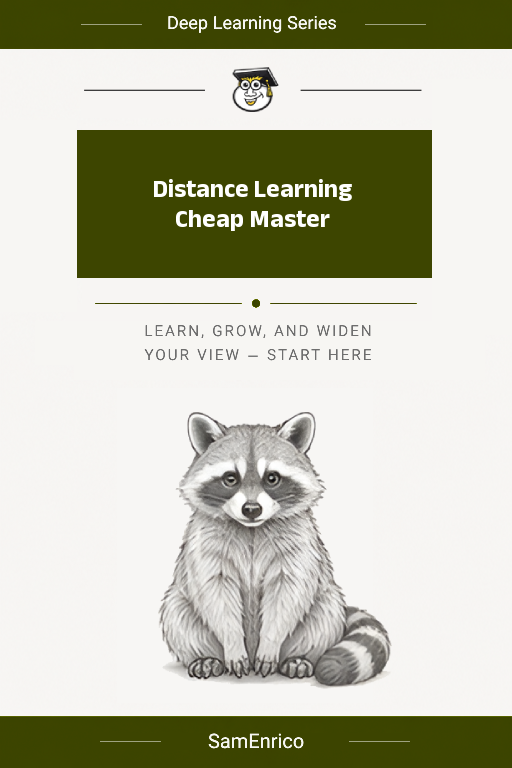
Distance Learning Cheap Master eBook
Study affordable online master degrees from Europe
Study affordable online master degrees from European universities with lower tuition and flexible schedules for working students.
Formats
Free sample
Chapter 1: The Half-Million Blindspot--–- Let me tell you about the email that changed how I think about master's degrees forever. It came from a 34-year-old logistics coordinator in São Paulo named Larissa. She had been accepted into a fully accredited, entirely online Master of Science in Renewable Energy from a German public university. Total tuition for the two-year program? €1,200.
That is not a typo. One thousand two hundred euros for an entire master's degree. Meanwhile, her coworker had just signed up for an online MBA from a mid-tier American university at $48,000 per year. Larissa wrote to me because she could not believe it herself. She kept rereading the admission letter, waiting for the catch.
"Is this real?" she asked. "How can a German degree cost less than my monthly car payment?"That question is the half-million dollar blindspot. And it is hiding in plain sight.We have been trained to believe that a master's degree is supposed to hurt financially. The narrative is baked into our culture: you suffer through the GMAT, you take out loans with interest rates that sound like mortgage terms, you graduate with a diploma in one hand and a six-figure debt statement in the other. This is normal.
This is expected. This is, as it turns out, completely insane.Because right now, sitting quietly in the middle of Europe, is an alternative system that most working professionals have never heard of. It is a system where public universities are funded by taxes rather than tuition. Where governments actually want more people to get master's degrees, not fewer. Where distance learning has been refined for decades, not slapped together during a pandemic.
And where you can earn a legitimate, globally recognized master's degree for less than the cost of a used sedan.The half-million dollar blindspot is this: we assume that all reputable master's degrees cost roughly the same. They do not. The gap between the most expensive and the most affordable is not a few thousand dollars. It is often a factor of twenty, thirty, or even fifty times. And the cheaper option is not a diploma mill.
It is not a third-rate university hiding in an office park. It is the same public university system that educated Nobel laureates, developed breakthrough engineering, and produces graduates who get hired by Mercedes, Siemens, and L'Oréal.This chapter is going to shatter the assumption that affordable means inferior. We are going to look at exactly how European public universities can charge so little, why most working professionals never hear about these programs, and why the phrase "you get what you pay for" is dangerously wrong when it comes to graduate education. By the time you finish this chapter, you will understand the economics, the psychology, and the strategy behind what I call the €500,000 loophole. And more importantly, you will see why you do not need to be wealthy, well-connected, or willing to take on decades of debt to earn a master's degree that transforms your career.The Great Tuition Divergence Let us start with a simple question: how much should a master's degree cost?
If you live in the United States, the answer is somewhere between 30,000and30,000 and 30,000and120,000. That is the range for most online master's programs from reputable universities. Add another zero if you are looking at elite private schools or executive programs. A 2023 survey by the Education Data Initiative found that the average master's degree in the US costs $66,340. That is the average.
Half cost more. Many cost substantially more.Now ask the same question in Germany. The average master's degree at a public university costs approximately €1,500 per year for international students. That is not a typo either. Some German states charge nothing at all.
Others charge modest fees that barely cover administrative costs. Norway's public universities charged zero tuition for international students until very recently, and some programs remain free. France charges between €200 and €3,700 per year depending on the program level. Belgium charges around €900 per year. Italy charges based on family income, often dropping below €1,000.The divergence is staggering.
A working professional in Ohio and a working professional in Oslo could earn the same master's degree in the same subject from equally reputable public universities. One pays 70,000.Theotherpays70,000. The other pays 70,000.Theotherpays0. This is not because the Norwegian degree is worthless. It is because the Norwegian government views education as a public good funded by taxpayers, while the American system views graduate education as a private investment funded by students.But here is where the half-million dollar blindspot gets really interesting.
Most working professionals outside Europe have no idea these affordable options exist. They assume that studying abroad means moving abroad. They assume that European degrees are taught in local languages. They assume that admission is impossibly competitive or that their non-European bachelor's degree will not be recognized. These assumptions are wrong.
All of them. And they are keeping millions of working professionals trapped in expensive local options when a better, cheaper alternative is available online from across the Atlantic.The Subsidization Secret To understand why European public universities can charge so little, you need to understand how they are funded. In most European countries, universities are primarily funded by the national government. Taxpayers contribute a percentage of their income, and that money goes directly to the university budget. The government then sets tuition caps to ensure that education remains accessible to citizens.
In Germany, for example, the constitution guarantees free education as a matter of social policy. When a few states tried to introduce tuition in the 2000s, student protests forced them to abandon the policy within a decade.This system creates a radically different incentive structure. American universities need to charge high tuition because they receive relatively little direct government funding per student. They compete for students by building luxury dorms, climbing walls, and marketing campaigns. European public universities do not need to compete for students in the same way.
They are funded to educate a certain number of citizens, and international students are often welcomed as a way to fill seats without requiring additional government spending.Here is the critical insight for working professionals: this subsidization applies to distance learning students too. You do not need to move to Germany to benefit from German tax subsidies. You just need to enroll in a German public university's distance learning program. The same government funding that keeps tuition low for German citizens also keeps tuition low for international online students. The university does not care where you live when you watch the lectures.
They care that you pay the administrative fee, complete the assignments, and eventually graduate.There is a term for this in European higher education: the konsekutive master's degree. A konsekutive master's is a consecutive program that builds directly on a bachelor's degree in the same or related field. These programs are heavily subsidized because the government views them as a natural extension of undergraduate education. They are designed for students who want to deepen their knowledge rather than switch careers. And crucially, they are the cheapest category of master's degrees available.The alternative is the weiterbildende master's degree.
These are continuing education programs designed for professionals who want to change fields or gain executive credentials. They are less…
This is the end of the free sample. Get the eBook to keep going. Buy now
About this book
Details
- Author
- Whitworth Gudrun
- Publisher
- SamEnrico
- Language
- English
- Genre
- Non-Fiction, Student's Shortcut, Distance Education, Online Learning
- Released
- 2026-06-01
- Pages (approx.)
- 151
- Available as
- eBook, Audiobook

Read better in the ZLOADR app
Your eBooks on your phone or tablet. Sign in with your SamEnrico account and start reading.
More by Whitworth Gudrun
 Diverse Perspectives MethodWhitworth Gudrun$11.99
 HIIT for Swimmers GuideWhitworth Gudrun$11.99
 Facebook Time Management CourseWhitworth Gudrun$11.99
 Survey Verbatim Response Themes AIWhitworth Gudrun$11.99
 Aging Eyes Low Vision GuideWhitworth Gudrun$11.99
 Bubbles and Blood: The Collapse of the Dutch Tulip ManiaWhitworth Gudrun$11.99
 The 72-Hour Standoff: Inside the 1979 U.S. Embassy Hostage Crisis in TehranWhitworth Gudrun$11.99
 Understanding Carbohydrate Deficient Glycoprotein SyndromeWhitworth Gudrun$17.99
 Summer Research Programs Without PubsWhitworth Gudrun$12.99
 How to Become a Injection-molding-machine TenderWhitworth Gudrun$11.99
 Maintainability EngineeringWhitworth Gudrun$11.99
 Strong PoisonWhitworth Gudrun$8.99