
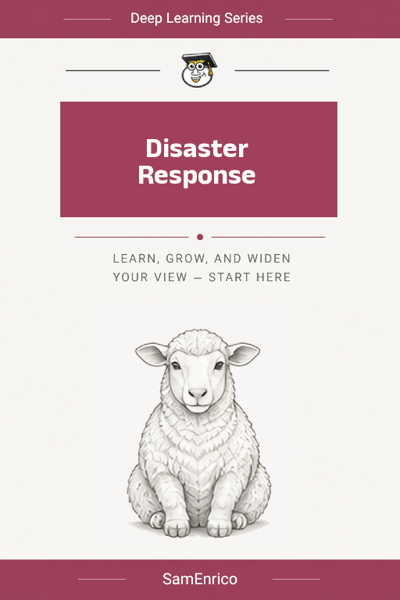
Disaster Response eBook
A Coursebook on Disaster Response
A Coursebook on Disaster Response
Formats
Free sample
Chapter 1: The Day Everything Changed--The average person will hear a tornado siren, feel the ground shake, or watch floodwaters rise exactly 1.2 times in their lifetime. Most will freeze for eleven seconds before doing anything at all. Some will never move again.On the morning of August 29, 2005, Robert Williams stood on his porch in the Lower Ninth Ward of New Orleans, Louisiana, watching dark water creep up his front steps. He had heard the warnings. He had watched the news.
He knew Hurricane Katrina was coming. But his brain refused to believe that the water would reach his front door, then his living room floor, then his chest. By the time he accepted what was happening, the current was too strong to swim against. He climbed into his attic. No axe.
No water. No way out.Robert survived. His neighbor did not.This is not a story about hurricanes. It is a story about the gap between knowing and doing, between warning and action, between the disaster that happens outside and the disaster that happens inside the human skull. Every disaster response textbook begins with maps, charts, and organizational flow diagrams.
This book begins with the eleven seconds of denial that kill more people than any storm, any earthquake, or any terrorist bomb.The Four-Letter Word That Changes Everything Let us start with a deceptively simple question: what exactly is a disaster?The word gets thrown around casually. A missed deadline is a "disaster." A spilled coffee is a "catastrophe." But in the world of emergency management, words have precise, life-or-death meanings. The distinction between an accident, an emergency, and a disaster is not academic hair-splitting. It determines who responds, when they arrive, and whether anyone survives.An accident is an unexpected event that causes harm but remains within the capacity of the people present to handle. A car rolls over on a rural highway.
The driver is injured. A passing motorist stops and calls 911. An ambulance arrives. The scene is controlled. No outside assistance beyond standard emergency services is required.
Accidents happen every minute of every day. They are tragic, but they are not disasters.An emergency is an event that requires a coordinated response from multiple agencies but remains within the capacity of the local jurisdiction. A chemical plant catches fire. Local fire departments respond. Police evacuate nearby homes.
EMS treats burn victims. The mayor might hold a press conference. The state might send a liaison. But the fundamental assumption remains: the resources of the city or county are sufficient to manage the event. Emergencies tax the system.
They do not break it.A disaster is different. A disaster is any event that exceeds the response capacity of the affected community. The local fire department is overwhelmed. The police cannot maintain order. The hospitals run out of beds, blood, and ventilators.
The mayor declares a state of emergency not as a formality but as a desperate plea: "We cannot do this alone. Send help."This definition—disaster as capacity-exceeding event—is the operational backbone of every emergency management system in the developed world. It is what triggers mutual aid agreements, state declarations, and ultimately federal intervention. It is why FEMA exists. It is why the National Guard can be activated.
It is why your local fire chief has a binder on their shelf labeled "Disaster Plan."But here is the uncomfortable truth that every responder eventually learns: the official definition has almost nothing to do with what survivors experience.Two Definitions of One Word For a survivor like Robert Williams standing in rising floodwater, a disaster is not a capacity calculation. It is a subjective, psychological event: the moment when your existing mental models of how the world works shatter into pieces. Before the disaster, you believed that your home was safe, that the government would protect you, that the worst would happen to someone else. After the disaster, none of those beliefs survive. The world has been revealed as unpredictable, indifferent, and terrifying.This book will use two definitions of disaster side by side, and it will not apologize for the tension between them.
For operational purposes—for planning, for resource allocation, for ICS forms and FEMA declarations—we will use the capacity definition. Disasters are events that overwhelm local resources. But for understanding what actually happens inside the human brain, inside communities, and inside the long arc of recovery, we will use the social definition. Disasters are moments when the ordinary rules of life are suspended, when people reveal who they really are, and when the hidden structures of inequality become impossible to ignore.Both definitions are true. Both are necessary.
And learning to hold them together—to think like a logistician and feel like a survivor—is the first and most important skill of disaster response.The Four Phases of Everything Every disaster, from a house fire to a planetary pandemic, moves through four predictable phases. Emergency managers call this the "disaster cycle." It is the closest thing the field has to a law of physics.Mitigation is everything you do before a disaster to make it less destructive. Building codes that require hurricane straps on roofs. Wetlands restoration that absorbs storm surge. Seismic retrofits for old bridges.
Vaccination campaigns. Fire-resistant roofing materials. Mitigation is boring, expensive, and invisible when it works—which is precisely why it is chronically underfunded. Every dollar spent on mitigation saves six dollars in response and recovery costs. And yet, year after year, communities choose to gamble.
"It won't happen here." "We've never had a flood that bad." "The codes are too expensive." These are the words of people who have not yet lived through a disaster. Mitigation is the phase that prevents the next disaster from becoming a catastrophe.Preparedness is what you do to get ready for the disaster you know is coming, even if you do not know exactly when. Stockpiling supplies. Running drills. Training first responders.
Installing early warning systems. Holding community education sessions. Building evacuation routes. Preparedness is the difference between a community that fragments under pressure and a community that coheres. It is also the phase where the gap between knowing and doing is most visible.
Most people know they should have a go-bag, an evacuation plan, and three days of water. Most people do not. Preparedness requires imagining a future that is worse than anything you have experienced. The human brain is remarkably bad at that.Response is what most people think of when they hear "disaster." The first 72 hours. The search and rescue.
The triage tents. The shelters. The water distribution. The body recovery. Response is chaotic, exhausting, and adrenaline-soaked.
It is where careers are made and broken, where heroes emerge and bureaucrats fail. It is also where most of the mistakes happen, because response happens under conditions of maximum uncertainty with minimum information. The first 72 hours are not when you want to be learning. The first 72 hours are when you want to be executing plans you made years ago. Most communities do not have those plans.
Most of those that do have never tested them. Response is the phase that reveals everything you should have done in mitigation and preparedness.Recovery is the…
This is the end of the free sample. Get the eBook to keep going. Buy now
About this book
Details
- Author
- Cantwell Michaele
- Publisher
- SamEnrico
- Language
- English
- Genre
- Non-Fiction, Informative, Educational
- Released
- 2026-05-04
- Pages (approx.)
- 156
- Available as
- eBook, Audiobook

Read better in the ZLOADR app
Your eBooks on your phone or tablet. Sign in with your SamEnrico account and start reading.
More by Cantwell Michaele
 Spending Visualization ExerciseCantwell Michaele$11.99
 Fentanyl Analogue OverdoseCantwell Michaele$11.99
 The Growth Team Structure GuideCantwell Michaele$11.99
 Active Listening Skills WorkbookCantwell Michaele$11.99
 The Tokyo Diamond Heist: The Perfect Crime That Shocked Japan (1980)Cantwell Michaele$11.99
 AI for RFP Response AutomationCantwell Michaele$12.99
 How to Start a Clock Case Made of Wood Business (Beginners Guide)Cantwell Michaele$11.99