
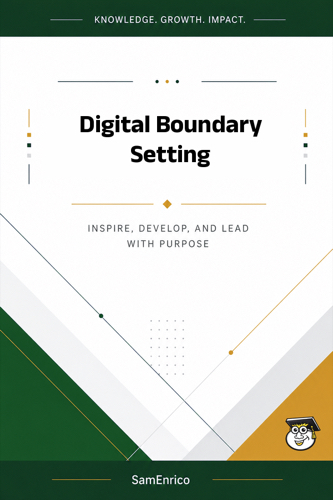
Digital Boundary Setting eBook
Protect your time and attention from email, Slack,
Protect your time and attention from email, Slack, and social media demands.
Formats
Free sample
Chapter 1: The Invisible Leash...--–- It vibrates in your pocket during dinner. It chimes on your nightstand at 11 PM. It glows on your desk while your child asks you a question. You tell yourself you are just checking one thing. Just one email.
Just one Slack message. Just one scroll through Instagram. Then you look up, and twenty minutes have vanished. The food is cold. Your child walked away.
Your partner is giving you that look—the one that says, "You did it again."You did not mean to do it. No one wakes up intending to ignore their family for a notification badge. But the device in your pocket was engineered by some of the smartest people in the world, working with billions of dollars of research, to do exactly this: to capture your attention, to hold it, and to monetize every second you spend staring at a screen. You are not fighting a habit. You are fighting a machine designed to exploit the deepest vulnerabilities of your brain.This is the invisible leash.
It is the quiet, constant, almost imperceptible tether that connects you to your work, your social obligations, and your digital life at every waking moment. Unlike a physical leash, you cannot see it. Unlike a physical leash, you put it on yourself. And unlike a physical leash, you have been taught to believe that wearing it is a sign of dedication, professionalism, and caring.It is none of those things. It is a trap.
And this chapter is about recognizing that you are in it.Before we can build digital boundaries—before we can protect your time from email, your attention from Slack, and your sanity from social media—we must first understand how you lost your boundaries in the first place. You did not simply forget to set them. They were taken from you, piece by piece, by a system that profits from your distraction. This chapter diagnoses the condition of the boundaryless professional. It names the enemy.
And it begins the work of cutting the invisible leash.The Attention Economy: Your Focus Is the Product Let us start with a truth that sounds like paranoia but is simply economics. If you are not paying for a product, you are the product. Social media platforms like Facebook, Instagram, Tik Tok, and X (formerly Twitter) do not charge you money to use their services. They charge advertisers. And what are those advertisers buying?
Your attention. Every second you spend scrolling, every like you click, every video you watch to the end is a micro-transaction in which your attention is sold to the highest bidder.The same principle applies, in a softer form, to workplace communication tools like Slack and Microsoft Teams. While your employer pays for these tools, the tools themselves are designed to maximize engagement—not productivity, not well-being, but the sheer volume of time you spend inside them. Why? Because the companies that make these tools measure their success by usage metrics.
Daily active users. Messages sent. Hours logged. Every feature that keeps you checking, replying, and scrolling is a feature that makes the tool look more valuable to your employer—and to investors.You are not a user. You are a resource.
And the entire digital economy is structured around extracting as much of your attention as possible.This is the Attention Economy, a term coined by psychologist and Nobel laureate Herbert A. Simon in 1971, long before the internet became ubiquitous. Simon wrote, "What information consumes is rather obvious: it consumes the attention of its recipients. Hence a wealth of information creates a poverty of attention." In 1971, this was a prescient observation. Today, it is the foundational reality of modern life.The industrial economy ran on natural resources—coal, oil, iron, timber.
The Attention Economy runs on you. Every time you check your phone, you are burning a non-renewable resource: the minutes of your life. And unlike coal or oil, you cannot extract more attention from the earth. You have exactly as much attention as you have waking hours. Once they are spent, they are gone forever.The companies that built your phone, your email client, your Slack workspace, and your social media feeds know this.
They know that attention is finite and precious. And they have built entire engineering departments devoted to capturing as much of it as possible. They study your behavior. They run A/B tests on your reactions. They optimize notification timing, badge colors, and scrolling mechanics to keep you engaged for "just one more minute."This is not conspiracy theory.
This is public record. Former Google design ethicist Tristan Harris has testified before Congress about the "race to the bottom of the brain stem" that characterizes the attention economy. Sean Parker, the first president of Facebook, admitted in a 2017 interview that the platform was designed to exploit "a vulnerability in human psychology." He said, "God only knows what it's doing to our children's brains."You are not weak because you check your phone. You are human. And your humanity has been weaponized against you by systems designed to exploit your deepest instincts: the need for social connection, the fear of missing out, the dopamine hit of novelty, the satisfaction of clearing a notification badge.
The invisible leash is not a metaphor. It is a business model.The Open Loop Nightmare: Why Your Brain Never Rests To understand why the invisible leash is so effective, we must look inside your skull. Your brain did not evolve in a world of endless notifications. It evolved on the savannah, where attention was a survival tool—you needed to notice the lion, find the water, track the prey. In that environment, the brain developed a remarkable feature: it remembers unfinished tasks better than finished ones.This is called the Zeigarnik Effect, named after the Russian psychologist Bluma Zeigarnik who discovered it in the 1920s.
Zeigarnik observed that waiters could remember complex orders with astonishing accuracy—but only until the food was delivered. Once the order was complete, the memory vanished. Your brain treats every unfinished task as an "open loop." It keeps the loop active in your working memory, periodically checking in to see if it has been closed yet.Now consider how many open loops your digital life creates. Every unread email is an open loop. Every unanswered Slack message is an open loop.
Every notification badge on your phone is an open loop. Every DM you have not replied to, every calendar invite you have not responded to, every task in your to-do list that remains unchecked—each one is a tiny cognitive placeholder demanding a sliver of your attention.Drawing from Anne Katherine's Boundaries in an Overconnected World, we can see how modern communication exploits the Zeigarnik Effect mercilessly. Your email inbox is designed to show you a number—the count of unread messages. That number is an open loop aggregator. Your brain sees "47 unread messages" and feels a low-grade, persistent anxiety until that number becomes zero.
But as soon as you clear it, new messages arrive. The loop never truly closes.The same dynamic plays out in Slack. The unread channels badge, the "@" mention indicator, the…
This is the end of the free sample. Get the eBook to keep going. Buy now
About this book
Details
- Author
- Singletary Henriette
- Publisher
- SamEnrico
- Language
- English
- Genre
- Non-Fiction, Self-Help, Digital
- Released
- 2026-06-08
- Pages (approx.)
- 149
- Available as
- eBook, Audiobook

Read better in the ZLOADR app
Your eBooks on your phone or tablet. Sign in with your SamEnrico account and start reading.
More by Singletary Henriette
 The Craving Busting WorkbookSingletary Henriette$11.99
 The Nap Alarm Clock GuideSingletary Henriette$11.99
 Remote Productivity FAQSingletary Henriette$11.99
 Parent Loss and Young ChildrenSingletary Henriette$11.99
 Board of Directors CrisisSingletary Henriette$11.99
 Microbiome Kidney HealthSingletary Henriette$11.99
 Mindfulness Pain ReliefSingletary Henriette$11.99
 Alibaba Inspection ServicesSingletary Henriette$11.99
 The Ballad of the Black Cowboy: Nat Love and the Wild West’s Forgotten LegendSingletary Henriette$11.99
 Hannibal's Ghosts: The Cursed March Over the AlpsSingletary Henriette$11.99
 Bridges of Time: The Lovers Who Built the Iron AgeSingletary Henriette$11.99
 How to Become a DebubblizerSingletary Henriette$11.99
You may also like
 Hong Kong Handover 1997Dunn Johnnie$11.99
 Zumba For Postnatal Recovery CourseNeal Christian$11.99
 Zumba for BeginnersLadner Nikia$11.99
 YouTube Comment Mining GuideHumes Pandora$12.99
 Worry Box MeditationCarlin Rudy$11.99
 Workplace Stress MeditationNguyen Lynn$11.99
 Workplace Stress and Sleep RepairHawley Ivory$11.99
 Workplace Perfectionism CureDelaney Jeffry$11.99
 Workplace Injustice Anger GuideWallen Isabelle$11.99
 Work Addiction and Burnout LinkGreenwood Ester$11.99
 Women in Yoga and WellnessBeattie Galina$11.99
 Women in Stand Up ComedyChun Evangeline$11.99