
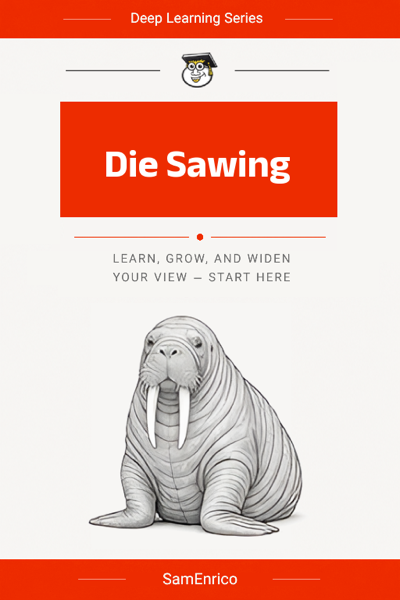
Die Sawing
A Coursebook on Die Sawing
by Gil Merlyn
A Coursebook on Die Sawing
Formats
About this book
Free sample
Chapter 1: The Billion-Dollar Blade--–- In the silent, yellow-lit sanctuaries of semiconductor manufacturing, a transformation occurs thousands of times per hour. A mirror-perfect disk of crystalline silicon—a wafer that has traveled through cleanrooms for weeks, accumulated billions of transistors, and absorbed hundreds of millions of dollars in fabrication costs—is gently sliced apart by a blade thinner than a human hair. This is die sawing, the final major step before a microchip becomes a functional product. It is a process that few outside the industry have ever heard of, yet without it, every smartphone, every car, every medical device, and every satellite would remain a collection of uncut silicon, forever useless. This chapter establishes the fundamental importance of die sawing, traces its remarkable evolution from crude scribing to nanometer-precision automation, and builds the essential vocabulary that will serve as the foundation for every technical discussion that follows.1.1 The Unseen Giant of Semiconductor Manufacturing The semiconductor industry produces roughly one trillion integrated circuits annually—about 120 chips for every person on Earth.
Each of those chips, before it can be packaged, tested, and shipped, must be separated from its neighboring circuits on the original silicon wafer. That separation is die singulation, and for more than ninety percent of all chips, singulation means mechanical die sawing.To understand why die sawing matters, one must first understand the economics of a wafer. A single 300-millimeter silicon wafer, after completing front-end-of-line fabrication, represents an investment between $5,000 and $50,000, depending on the technology node. Leading-edge logic wafers at 3-nanometer or 2-nanometer nodes can exceed $30,000 per wafer. That wafer contains between 500 and 50,000 individual dies.
The dicing process occurs after all lithography, etching, deposition, and planarization steps are complete. It is the last value-adding step before final test. If die sawing damages a wafer, the entire investment is lost.Consider a high-volume manufacturing facility running twenty dicing saws, each processing thirty wafers per hour, operating 24 hours per day, 365 days per year. That facility singulates more than five million wafers annually. A one percent yield loss at dicing—meaning one out of every one hundred dies is scrapped due…
This is the end of the free sample. Get the eBook to keep going. Buy now
Contents
- Chapter 1
- Chapter 2
- Chapter 3
- Chapter 4
- Chapter 5
- Chapter 6
- Chapter 7
- Chapter 8
- Chapter 9
- Chapter 10
- Chapter 11
- Chapter 12
Details
- Author
- Gil Merlyn
- Publisher
- SamEnrico
- Language
- English
- Genre
- Non-Fiction, Informative, Educational
- Released
- 2026-06-02
- Pages (approx.)
- 147
- Available as
- eBook, Audiobook

Read better in the ZLOADR app
Your eBooks on your phone or tablet. Sign in with your SamEnrico account and start reading.
More by Gil Merlyn
 Nightmare Rescripting For Eating Disorder Recovery WorkbookGil Merlyn$11.99
 TikTok Sound StrategyGil Merlyn$11.99
 Sports Competition AngerGil Merlyn$11.99
 The Compulsive Overeating TrackerGil Merlyn$11.99
 Nairobi Founder Work VisaGil Merlyn$11.99
 The Last Broadcast: How Radio Saved a Nation During the Great Storm of 1938Gil Merlyn$11.99
 International Economics Excel GuideGil Merlyn$12.99
 Payroll Setup Legal TrapsGil Merlyn$12.99
 Understanding Protein–energy MalnutritionGil Merlyn$17.99
 How to Become a Lather ApprenticeGil Merlyn$11.99