
Non-FictionStudent's ShortcutDevOpsCloud Careers
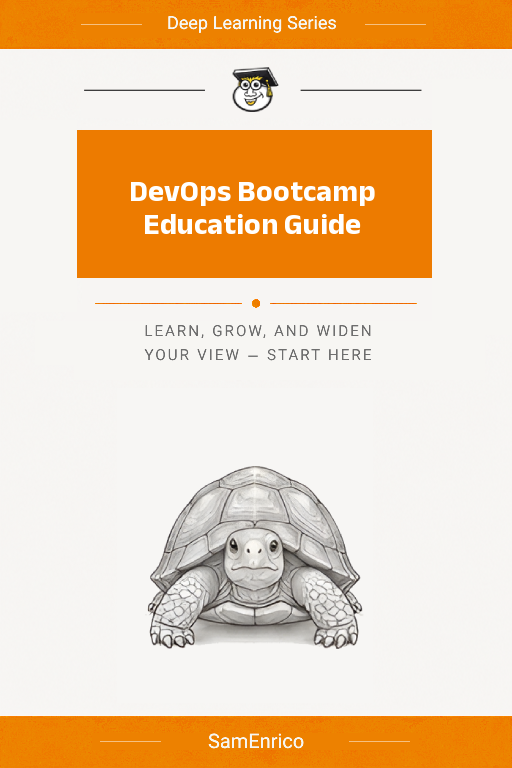
DevOps Bootcamp Education Guide eBook
Explore DevOps bootcamps and degree programs inclu
by Buford Lu
Explore DevOps bootcamps and degree programs including cloud certifications that outweigh formal education.
Formats
Free sample
Chapter 1: The Degree Trap--Maria graduated with a computer science degree in 2023. She walked across the stage, shook the dean's hand, and collected a piece of paper that cost her $98,000 in student loans. She cannot configure a load balancer. She does not know what a pod is in Kubernetes. When her manager asked her to write a simple Bash script to parse log files, she froze.Her coworker, a bootcamp-trained engineer with a philosophy degree from a state school, makes $15,000 more than her.
He also has zero debt.This chapter is for Maria. And for you.The question this chapter answers is simple: in 2026, what actually gets you hired as a Dev Ops engineer? Is it the 120,000diploma?Isitthe120,000 diploma? Is it the 120,000diploma?Isitthe15,000 bootcamp? Is it the $500 certification?
Or is it something else entirely?I am going to give you the answer now, and then spend the rest of this chapter proving it.For 80 percent of Dev Ops roles, a four-year degree is a trap. It is expensive. It is slow. It teaches theory that was obsolete two years ago. And most importantly, it is no longer required by the companies that actually pay well.I am not saying degrees are worthless.
I am saying they are overpriced, and the market knows it.The Narrative You Have Been Sold The traditional narrative says that a four-year computer science degree is the only reliable path to a high-paying career in technology. Parents believe it. High school counselors preach it. The media repeats it. And universities love it, because it justifies tuition increases that have far outpaced inflation for three decades.The narrative goes something like this: you work hard in high school, you get into a good college, you study computer science for four years, you graduate with a degree, and then the job offers roll in.
You spend thirty years climbing the corporate ladder, pay off your student loans by age forty, and retire comfortably.This narrative is not just outdated. It is dangerous.Why? Because it ignores three fundamental shifts that have transformed the technology hiring market over the past decade.Shift One: The Skills Gap Has Widened University computer science departments teach computer science. They teach algorithms, data structures, computational theory, and discrete mathematics. These are valuable subjects.
But they are not what Dev Ops hiring managers are looking for.What hiring managers want is practical competence. Can you write a Dockerfile? Can you configure a Kubernetes deployment? Can you set up a CI/CD pipeline in Git Hub Actions? Can you debug a broken Terraform apply?
Can you troubleshoot a networking issue in a cloud VPC?University curricula move slowly. It takes eighteen to twenty-four months for a new course to be proposed, approved, staffed, and taught. Cloud providers release new features weekly. By the time a university offers a course in "Cloud Computing with AWS," half of the services it covers have been deprecated or replaced.The result is a massive gap between what universities teach and what employers need. Graduates emerge with theoretical knowledge and no practical skills.
They can explain Big O notation but cannot deploy a container.Shift Two: Employers Have Dropped Degree Requirements Between 2018 and 2024, a quiet revolution happened in technology hiring. Google dropped its degree requirement. Apple did the same. IBM, Amazon, and Microsoft followed. Then the dominoes started falling across the industry.The 2024 Burning Glass Institute report analyzed millions of job postings across the United States.
The finding was stunning: 71 percent of IT job listings no longer require a four-year degree. That number has been climbing steadily year over year.Why? Because employers finally realized what many of us have known for years: a degree is a weak signal of on-the-job competence. It tells you that someone can survive four years of lectures, exams, and deadlines. It does not tell you whether they can debug a broken CI/CD pipeline at 2 AM on a Saturday.The companies that pay the most have moved to skill-based assessments.
They give candidates take-home projects. They run technical interviews that involve live coding and system design. They look at Git Hub profiles. They ask for portfolios.They do not ask for transcripts.Shift Three: The Cost of College Has Become Unsustainable The average cost of a four-year computer science degree at a public university is now between 80,000and80,000 and 80,000and120,000. At a private university, it can exceed 200,000.Studentloandebtinthe United Stateshassurpassed200,000.
Student loan debt in the United States has surpassed 200,000.Studentloandebtinthe United Stateshassurpassed1.7 trillion.Meanwhile, bootcamp tuition averages 12,000to12,000 to 12,000to15,000. Certification exams cost 150to150 to 150to400. Self-study materials are often free or low-cost.The math is not complicated. A bootcamp graduate with 15,000indebtanda15,000 in debt and a 15,000indebtanda70,000 starting salary is in a better financial position than a CS graduate with 100,000indebtanda100,000 in debt and a 100,000indebtanda75,000 starting salary. The bootcamp grad breaks even in six months.
The CS grad breaks even in twenty years.The Data That Changes Everything Let me walk you through the numbers in detail.The Degree ROI Calculator Here is the calculation that everyone should run before enrolling in a four-year CS program.Take the total cost of your degree: tuition, fees, books, room and board, and foregone income (what you would have earned working instead). For a typical four-year degree at a public university, that number is between 80,000and80,000 and 80,000and120,000. For a private university, it can exceed $200,000.Now take the average starting salary for a CS graduate in your area. According to the National Association of Colleges and Employers, the 2024 average was about $75,000.Subtract the starting salary of a bootcamp graduate in the same area. According to Course Report's 2024 data, that average is about $70,000.The degree premium is $5,000 per year.Now divide the cost of your degree by the annual premium.
100,000dividedby100,000 divided by 100,000dividedby5,000 is twenty years. It will take you two decades to break even on your degree compared to a bootcamp grad.That is assuming you get a job immediately. It is assuming you do not take out loans with interest. And it is assuming the premium persists—which it almost certainly will not, as more employers drop degree requirements and the signaling value of a degree continues to erode.The Time-to-Breakeven Comparison Let me make this even more concrete.Path A: Four-Year CS Degree Total cost: $100,000Starting salary: $75,000Annual salary increase: 5 percent Years to break even: 0 (you are starting from zero)Net position after 5 years: 431,000inearnings,431,000 in earnings, 431,000inearnings,100,000 in debt = $331,000 net Path B: Bootcamp Total cost: $15,000Starting salary: $70,000Annual salary increase: 5 percent Years to break even: 0 (you start working immediately)Net position after 5 years: 402,000inearnings,402,000 in earnings, 402,000inearnings,15,000 in debt = $387,000 net The bootcamp grad is ahead by $56,000 after five years. And that is assuming the degree premium holds.
If the premium shrinks—as it almost certainly will—the bootcamp grad pulls even farther ahead.The Exceptions I am not saying degrees are never worth it. There are specific circumstances where a degree makes sense.If you want to work in machine learning research, cryptography, or quant finance, you probably need a degree. These fields require deep theoretical knowledge that is difficult to acquire through self-study or bootcamps.If you are targeting a specific government role with…
This is the end of the free sample. Get the eBook to keep going. Buy now
About this book
Details
- Author
- Buford Lu
- Publisher
- SamEnrico
- Language
- English
- Genre
- Non-Fiction, Student's Shortcut, DevOps, Cloud Careers
- Released
- 2026-06-01
- Pages (approx.)
- 112
- Available as
- eBook, Audiobook

Read better in the ZLOADR app
Your eBooks on your phone or tablet. Sign in with your SamEnrico account and start reading.
More by Buford Lu
 Motivational Speech NervesBuford Lu$11.99
 HGH and Joint Health GuideBuford Lu$11.99
 Self Hypnosis for Letting GoBuford Lu$11.99
 Agoraphobia Airplane Flying ManualBuford Lu$11.99
 Faith Based Parental Anger HealingBuford Lu$11.99
 The Rendlesham Forest Enigma: A Military Cover-Up?Buford Lu$11.99
 The Phantom of the Paris Catacombs: The Underground Ghost Who Never LeftBuford Lu$11.99
 IT Infrastructure EngineerBuford Lu$11.99
 Understanding Breast Cancer, FamilialBuford Lu$17.99
 How to Become a Scale MechanicBuford Lu$11.99
 Ecommerce Payment Fraud OutlookBuford Lu$12.99
You may also like
 Hong Kong Handover 1997Dunn Johnnie$11.99
 Zumba For Postnatal Recovery CourseNeal Christian$11.99
 Zumba for BeginnersLadner Nikia$11.99
 YouTube Comment Mining GuideHumes Pandora$12.99
 Worry Box MeditationCarlin Rudy$11.99
 Workplace Stress MeditationNguyen Lynn$11.99
 Workplace Stress and Sleep RepairHawley Ivory$11.99
 Workplace Perfectionism CureDelaney Jeffry$11.99
 Workplace Injustice Anger GuideWallen Isabelle$11.99
 Work Addiction and Burnout LinkGreenwood Ester$11.99
 Women in Yoga and WellnessBeattie Galina$11.99
 Women in Stand Up ComedyChun Evangeline$11.99