
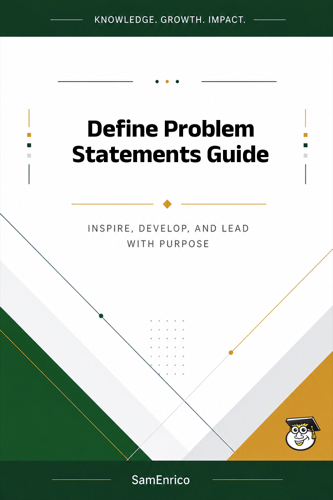
Define Problem Statements Guide Audiobook
Articulate actionable problem definitions that lea
Articulate actionable problem definitions that lead to breakthrough solutions.
Formats
Free sample
Chapter 1: The Breakthrough Paradox--Most organizations are built to reward problem-solvers, not problem-definers. This single misalignment in incentives creates the most expensive and least-discussed failure mode in business: the relentless, well-intentioned rush to solve the wrong problem perfectly.Consider a common scene in offices around the world. A manager declares, "Our customer churn is too high. We need a loyalty program." Within weeks, a cross-functional team is assembled, budgets are approved, vendors are evaluated, and a new program launches. Six months later, churn remains unchanged.
The team worked hard. They met every deadline. They executed flawlessly. And they failed completely—not because they solved the problem poorly, but because they solved the wrong problem. The real issue was not the absence of a loyalty program.
It was a product defect that caused frustration after the third use. But no one defined that problem because no one paused to ask the question that matters most: What problem are we actually trying to solve?This is the Breakthrough Paradox: the faster you rush to solve a problem, the slower you make meaningful progress. Conversely, the more time you invest in defining the problem, the faster you arrive at breakthrough solutions. Slowing down at the start is the fastest path to the finish line. Yet almost every organizational incentive—promotions, bonuses, praise, urgency—pushes teams in the opposite direction.The Cognitive Roots of Solutioneering Why do we rush to solutions?
The answer lies not in laziness or incompetence but in the fundamental architecture of the human brain. Drawing on the groundbreaking research of Christopher Chabris and Daniel Simons, authors of The Invisible Gorilla, we must confront a uncomfortable truth: our brains are designed to see what we expect to see and miss what we do not expect. This phenomenon, called cognitive blindness, operates constantly and invisibly.In their famous experiment, participants watched a video of people passing basketballs and were asked to count the number of passes. Midway through the video, a person in a gorilla suit walked directly across the screen, pounded its chest, and exited. Half the participants completely missed the gorilla.
They were so focused on counting passes (the solution-like task) that they missed the obvious (the unexpected problem). This is precisely what happens when teams rush to solve a problem. They focus on the familiar activity of solution-building and miss the gorilla standing in the middle of the room: a…
This is the end of the free sample. Get the Audiobook to keep going. Buy now
About this book
Details
- Author
- Kimbrell Cherry
- Publisher
- SamEnrico
- Language
- English
- Genre
- Non-Fiction, Self-Help
- Released
- 2026-06-07
- Pages (approx.)
- 140
- Available as
- eBook, Audiobook

Listen in the VoxFlicks app
Audiobooks and audio dramas wherever you go. Sign in with your SamEnrico account and press play.
More by Kimbrell Cherry
 Yoga Nidra for Deep RestKimbrell Cherry$11.99
 Nicotine Withdrawal ManagementKimbrell Cherry$11.99
 Empathy for Partners GuideKimbrell Cherry$11.99
 Asynchronous BrainstormingKimbrell Cherry$11.99
 Storming of the Bastille GuideKimbrell Cherry$11.99
 Blue Zone Home Design GuideKimbrell Cherry$11.99
 Deep Work for Remote EmployeesKimbrell Cherry$11.99
 Charlemagne's Golden Dawn: The Carolingian RenaissanceKimbrell Cherry$11.99
 Nefertiti’s Curse: The Pharaoh’s Forbidden LoveKimbrell Cherry$11.99
 How to Become a Power-transformer RepairerKimbrell Cherry$11.99
 How to Produce ICE BinsKimbrell Cherry$11.99
 Versioning for Cost IncreasesKimbrell Cherry$12.99
You may also like
 Workplace Stress MeditationNguyen Lynn$11.99
 Volcano Monitoring ScientistCox Alexis$11.99
 The Tech Professional NetAguiar Nevada$11.99
 The Morning Metta RitualCanales Anya$11.99
 The Chunking Memory TechniqueClanton Hyacinth$11.99
 The Beginner Mistake FixAmmons Cassondra$11.99
 Surrendering to What IsGrimm Reatha$11.99
 Self Hypnosis for Fear of FireBillups Eli$11.99
 Road Rage for Professional DriversBrackett Janise$11.99
 Psychiatric Ward Nurse StressDunning Wyatt$11.99
 Observation vs Evaluation NVCTimmons Alda$11.99
 Networking for Nonprofit ProfessionalsPoole Jesse$11.99