
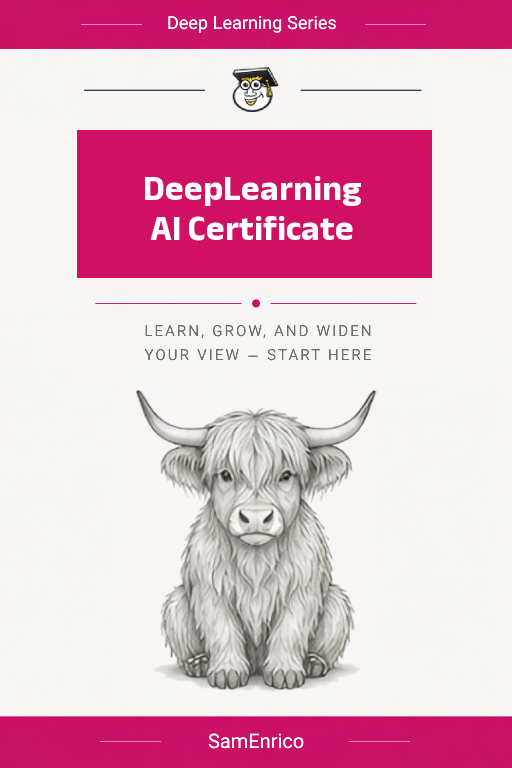
Non-FictionStudent's ShortcutDeepLearning
DeepLearning AI Certificate eBook
Take Andrew Ng's Deep Learning Specialization on C
by Abney Buford
Take Andrew Ng's Deep Learning Specialization on Coursera for AI engineering roles.
Formats
Free sample
Chapter 1: The Three Roles--The job market for artificial intelligence talent has transformed more dramatically in the past five years than any other technical field. In 2026, the demand for professionals who can build, deploy, and maintain AI systems is not just high. It is accelerating. Companies across every industry—technology, finance, healthcare, retail, manufacturing, logistics, and beyond—are racing to integrate AI into their products and operations. And they are discovering a painful truth that repeats itself in boardrooms and HR departments every single week: there are not enough qualified people to do the work.This labor shortage is not temporary.
It is structural. The number of job postings requiring AI skills has grown more than 450 percent since 2020, according to industry data from major job platforms. Yet the number of candidates who can pass a technical interview for an ML engineering role has barely kept pace. The result is a market where candidates with genuine skills can name their terms, and candidates who only know how to call APIs or follow tutorials get filtered out within the first round.This chapter will help you understand exactly where you stand in this landscape. You will learn the three distinct AI roles that have emerged, the differences between them, and where the Deep Learning Specialization fits into your career journey.
You will learn what hiring managers actually look for, what the certification signals, and what it does not. By the end of this chapter, you will know whether the ML engineering path—and this specialization—is right for you.The Three AI Roles: Data Scientist, ML Engineer, and AI Engineer Before 2020, the lines between AI roles were blurry. A job posting might ask for a "data scientist" who could build models, manage databases, and create dashboards. A "machine learning engineer" might spend half their time cleaning data and the other half writing deployment scripts. Titles were inconsistent, expectations were muddy, and candidates often discovered on the first day that the role they accepted was not the role they applied for.Today, the field has matured.
Three distinct career paths have emerged, each with its own focus, tools, outcomes, and interview expectations. Understanding these distinctions is the first step to knowing whether the Deep Learning Specialization is right for you.Data Scientists: The Detectives Data scientists extract meaning from messy data. Think of them as detectives with statistics degrees. They receive raw, chaotic data—customer transactions, website clicks, sensor readings, support tickets, inventory logs—and their job is to find patterns that help businesses make smarter decisions. A data scientist at a retail company might analyze purchase history to predict which products will sell out next month.
A data scientist at a hospital might examine patient records to identify risk factors for readmission. A data scientist at a bank might build a model to flag potentially fraudulent transactions.Data scientists spend roughly 60 to 70 percent of their time cleaning and preparing data. They use Python, SQL, and Pandas to transform raw numbers into something usable. They then apply statistical models—regression, classification, clustering—to answer business questions. Their tools include Jupyter notebooks, Scikit-learn, Statsmodels, and visualization libraries like Matplotlib and Seaborn.The output of a data scientist is usually a report, a dashboard, or a recommendation.
It shapes decisions, but the work itself is rarely the product that end users touch directly. The model that flags fraudulent transactions is often deployed by an ML engineer. The dashboard that shows predicted product sell-outs is used by the marketing team to plan promotions. The data scientist finds the signal. Other people act on it.Data science is an excellent career path, but it is not what the Deep Learning Specialization prepares you for.
If your goal is to analyze business data and create dashboards, this specialization will be too technical and too narrowly focused. You would be better served by a program that emphasizes statistics, data visualization, and SQL.Machine Learning Engineers: The Builders Machine learning engineers sit much closer to software engineering than to data science. Where a data scientist finds insights, an ML engineer builds systems that learn and improve automatically—systems that run in production, handling real users and real data every second of every day.Think of it this way. A data scientist might build a prototype model inside a Jupyter notebook that predicts customer churn with 85 percent accuracy. The notebook is messy.
The code is not modular. There are no tests. It runs only on the data scientist's laptop. An ML engineer takes that prototype and transforms it into a production-ready system that runs millions of predictions daily without breaking, drifting, or degrading under load. They containerize the model, build an API around it, set up monitoring to track performance over time, and create automated retraining pipelines that trigger when the model's accuracy drops below a threshold.ML engineers write production-grade Python and work with frameworks like Tensor Flow, Py Torch, and Scikit-learn.
They care deeply about latency, reliability, and scalability. They use Docker, Kubernetes, and cloud platforms like AWS, GCP, or Azure. They write unit tests, integration tests, and performance tests. They participate in code reviews and maintain shared codebases.They also design and maintain ML pipelines—automated workflows that move data through cleaning, training, evaluation, and deployment in a repeatable, monitored cycle. MLOps—machine learning operations—is a central part of this role, covering model monitoring, performance drift detection, and automated retraining.
When a model's performance degrades because real-world data has changed, the ML engineer is the one who catches it and fixes it.Netflix uses ML engineers to maintain its recommendation engine, processing viewing behavior from over 280 million subscribers and serving personalized suggestions in milliseconds. That infrastructure requires ML engineering expertise, not data analysis skills. Uber uses ML engineers to optimize its pricing algorithms, predicting supply and demand in real time across thousands of cities. Tesla uses ML engineers to train and deploy the neural networks that power its autonomous driving features.This is the role that the Deep Learning Specialization is designed for. If your goal is to understand how deep learning actually works, to debug training runs, to choose architectures intentionally, to build systems from scratch or fine-tune existing models, and to deploy those models into production environments, then this specialization is exactly what you need.AI Engineers: The Integrators AI engineers are the newest of the three roles, emerging rapidly with the rise of large language models.
An AI engineer works with pre-built, powerful AI models—systems like GPT-4, Claude, Gemini, and Llama—and integrates them into real-world applications.Unlike ML engineers who often train models from scratch or fine-tune them on specific datasets, AI engineers typically use APIs and prompt engineering to build products. They work with tools like Lang Chain, vector databases, and prompt management frameworks. Their job is to create intelligent features—chatbots, document summarizers, code generation tools, customer support automation—using existing model infrastructure as the foundation.A typical AI engineer might build a system that ingests customer support tickets, uses GPT-4 to summarize them, extracts action items, and routes the summary to the appropriate team. They might build a code assistant that helps developers write unit tests. They might build a meeting summarizer that joins video calls…
This is the end of the free sample. Get the eBook to keep going. Buy now
About this book
Details
- Author
- Abney Buford
- Publisher
- SamEnrico
- Language
- English
- Genre
- Non-Fiction, Student's Shortcut, DeepLearning
- Released
- 2026-05-29
- Pages (approx.)
- 132
- Available as
- eBook, Audiobook

Read better in the ZLOADR app
Your eBooks on your phone or tablet. Sign in with your SamEnrico account and start reading.
More by Abney Buford
 The Loot Box TrapAbney Buford$11.99
 Appalachian Trail Speed RecordAbney Buford$11.99
 Social Anxiety Conversation SkillsAbney Buford$11.99
 Pornography Addiction First StepsAbney Buford$11.99
 Escaping the TrunkAbney Buford$11.99
 Parental Academic Pressure GuideAbney Buford$11.99
 The Marble Whisperer: Vickrey's Lost Masterpiece of LahoreAbney Buford$11.99
 Military Service Work BoundariesAbney Buford$11.99
 The Last Transmission: The Mysterious Signals of the SOHO SpacecraftAbney Buford$11.99
 How to Start a Marquee Hire Business (Beginners Guide)Abney Buford$11.99
 Automation Testing with SeleniumAbney Buford$11.99
 Middle East Sales Follow Up RhythmAbney Buford$12.99
You may also like
 Hong Kong Handover 1997Dunn Johnnie$11.99
 Zumba For Postnatal Recovery CourseNeal Christian$11.99
 Zumba for BeginnersLadner Nikia$11.99
 YouTube Comment Mining GuideHumes Pandora$12.99
 Worry Box MeditationCarlin Rudy$11.99
 Workplace Stress MeditationNguyen Lynn$11.99
 Workplace Stress and Sleep RepairHawley Ivory$11.99
 Workplace Perfectionism CureDelaney Jeffry$11.99
 Workplace Injustice Anger GuideWallen Isabelle$11.99
 Work Addiction and Burnout LinkGreenwood Ester$11.99
 Women in Yoga and WellnessBeattie Galina$11.99
 Women in Stand Up ComedyChun Evangeline$11.99