
Deep Work Scheduling Guide eBook
Protects focused blocks for important tasks.
by Wang Hayley
Protects focused blocks for important tasks.
Formats
Free sample
Chapter 1: The Empty Block Paradox--–- The first sign that you have a scheduling problem is not exhaustion. It is not missed deadlines or a messy inbox. The first sign is a strange, quiet feeling that you have been busy all day yet cannot point to a single meaningful thing you finished.You close your laptop at 5:00 PM. You attended four meetings. You answered thirty-seven emails.
You put out a small fire involving a client’s misplaced document. You updated a spreadsheet that no one will look at until next Tuesday. And yet the one thing that actually mattered—the proposal, the analysis, the creative breakthrough, the code refactor, the strategic plan—remains exactly where it was this morning: untouched.This is the Empty Block Paradox. You have no empty blocks on your calendar. Every hour is spoken for.
And yet you have produced nothing of value.The paradox reveals a brutal truth about modern knowledge work: busyness and productivity are not only different—they are often opposites. A calendar packed with meetings, messages, and minor tasks feels productive because it is full. But fullness is a trap. The most valuable work of your career will happen not in the crowded hours but in the empty ones. The problem is that those empty hours no longer exist.
We have filled them with shallow activity, mistaking motion for progress.This book exists to give you back those empty blocks—not as gaps of idleness but as protected fortresses for work that matters. And it begins with a single, uncomfortable question: What is the one thing you are not doing because your calendar is too full?The Invention of Being Busy Before we can schedule deep work, we must understand how we lost the ability to schedule anything at all. The answer is not laziness or poor time management. The answer is that our work culture has inverted the relationship between effort and value.For most of human history, productivity was visible and measurable. A farmer who plowed ten acres was clearly more productive than a farmer who plowed five.
A factory worker who assembled one hundred widgets was obviously outperforming one who assembled fifty. The correlation between time spent and value created was nearly linear. More hours meant more output.Knowledge work broke that correlation.When your job involves thinking, creating, analyzing, or deciding, the relationship between time and output becomes nonlinear—and often inverse. A writer who stares at a blank page for three hours and then writes one brilliant paragraph has created more value than a writer who spends three hours answering emails. A programmer who solves a complex architectural problem in ninety minutes has produced more than a programmer who spends eight hours fixing trivial bugs.
A strategist who develops one breakthrough insight in a morning has outperformed a strategist who spends a week in meetings.But here is the trap: busyness is visible. Responding to emails is visible. Attending meetings is visible. Updating spreadsheets is visible. Deep thinking is invisible.
When your boss walks by and sees you staring at a wall, they do not know whether you are solving a billion-dollar problem or daydreaming about lunch. When they see you typing furiously, they assume productivity—even if you are just reorganizing folders.So we optimize for visibility. We fill our calendars to prove we are working. We answer messages instantly to signal responsiveness. We attend every meeting to avoid the suspicion of being unengaged.
And in doing so, we systematically eliminate the one thing that produces actual value: uninterrupted, cognitively demanding work.This is not a personal failing. It is a structural disease of modern knowledge work. And the cure is not working harder. It is scheduling differently.The Economic Case for Unbroken Time Let us be precise about what we are protecting. Deep work, as defined by computer scientist and author Cal Newport, is professional activity performed in a state of distraction-free concentration that pushes your cognitive capabilities to their limit.
These efforts create new value, improve your skill, and are hard to replicate.Shallow work, by contrast, is logistical, non-cognitive, or administrative tasks that can be performed while distracted. These efforts create little new value and are easy to replicate.Here is the economic reality that most knowledge workers refuse to accept: one hour of deep work is worth five to ten hours of shallow work. In some fields—research, software development, strategy, creative direction, complex analysis—the ratio is even higher. A single deep work session can produce a breakthrough that eliminates weeks of shallow effort.Yet we schedule as if the opposite were true. We protect shallow work with religious devotion—checking email on the hour, attending standing meetings, responding to Slack messages within minutes—while treating deep work as something we will “get to” if there is time left over.There is never time left over.This chapter introduces a concept that will appear throughout the book: the Deep Work Block.
A Deep Work Block is a scheduled, uninterrupted period of time dedicated exclusively to a single, cognitively demanding task. It has a defined start time, a defined end time, and a single objective. During this block, you do not check messages. You do not switch tasks. You do not answer questions.
You do one thing and one thing only.The length of this block matters. Research on ultradian rhythms—the natural 90-minute cycles of human alertness—suggests that most people can sustain peak cognitive performance for approximately 90 minutes before needing a true break. This is not a hard rule, and later chapters will help you find your personal optimal length. But it is a useful starting point. A 90-minute Deep Work Block, fully protected, produces more output than four hours of fragmented effort.The Empty Block Paradox, then, is not a paradox at all.
It is an economic miscalculation. You believe you have no time because your calendar is full. But your calendar is full of low-value activities that could be batched, delegated, eliminated, or deferred. The moment you clear space for a single 90-minute Deep Work Block, you will discover that you had time all along—you were just spending it poorly.The Four Enemies of the Empty Block If deep work is so valuable and shallow work so replaceable, why do we struggle to protect empty blocks? Because four powerful enemies stand in our way.
Understanding them is the first step to defeating them.Enemy One: The Cult of Responsiveness We have built a work culture that equates speed with professionalism. An email that goes unanswered for four hours feels like a failure. A Slack message that receives no response for thirty minutes feels rude. A meeting invitation declined feels like a personal rejection.This cult of responsiveness is toxic to deep work because it demands that you remain perpetually interruptible. Every notification becomes a demand for immediate attention.
Every message becomes an implicit contract to reply within minutes.The truth is that almost nothing in knowledge work requires a response within one hour. The exceptions—system outages, medical emergencies, safety issues—are rare enough to warrant a separate communication channel. Everything else can wait. The cult of responsiveness is not…
This is the end of the free sample. Get the eBook to keep going. Buy now
About this book
Details
- Author
- Wang Hayley
- Publisher
- SamEnrico
- Language
- English
- Genre
- Non-Fiction, Professional's Cheat Sheet, Deep Work, Self-Help, Focus
- Released
- 2026-06-05
- Pages (approx.)
- 142
- Available as
- eBook, Audiobook

Read better in the ZLOADR app
Your eBooks on your phone or tablet. Sign in with your SamEnrico account and start reading.
More by Wang Hayley
 BRCA Gene Mutation GuideWang Hayley$11.99
 The Pain Mindfulness GuideWang Hayley$11.99
 Meeting Facilitation ScriptsWang Hayley$11.99
 Pinterest VA Idea Pin ExplosionWang Hayley$11.99
 Data Leak Email Auto Reply TemplatesWang Hayley$11.99
 The Harlem Renaissance: A Revolution in Ink and SoundWang Hayley$11.99
 The Frozen Compass: Ethics and Empire in the Arctic's First Scientific ExpeditionsWang Hayley$11.99
 Understanding Coeliac DiseaseWang Hayley$17.99
 Tappi YC Application TipsWang Hayley$12.99
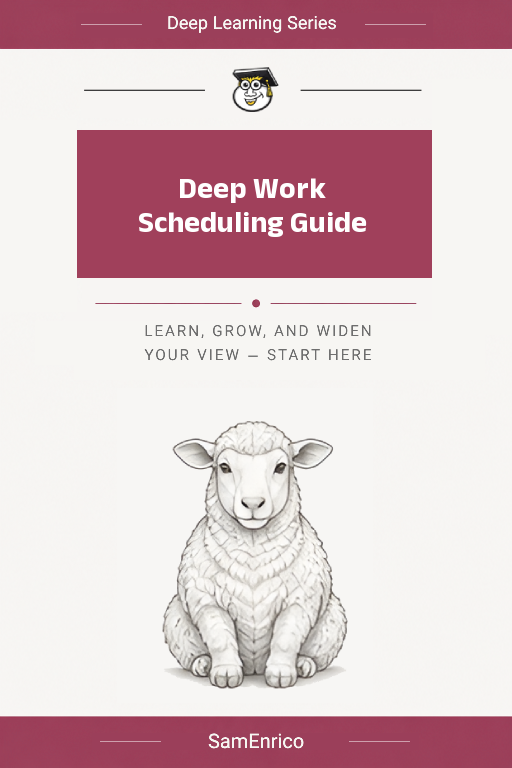 Deep Work Scheduling GuideWang Hayley$12.99
 Blending OperatorWang Hayley$11.99
 How to Start a Hobby in Lincoln Douglas DebateWang Hayley$11.99