
Non-FictionBusiness BriefOperations
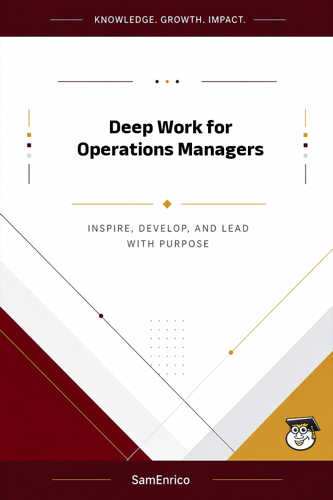
Deep Work for Operations Managers eBook
Block process improvement and system design away f
by Wall Dagny
Block process improvement and system design away from firefighting and crisis response.
Formats
Free sample
Chapter 1: The Heroic Paradox--–- The first time Marcus pulled an all-nighter to save the shipment, he was celebrated. The second time, he was promoted. The third time, he was exhausted. The fourth time, he quit.Marcus was a plant manager for a mid-sized automotive parts supplier. He was good at his job—or so everyone told him.
When the conveyor system jammed at 2 AM, he was there. When the supplier delivered the wrong grade of steel, he found a workaround. When the quality audit failed, he personally re-inspected every batch. His boss called him a "firefighter." His team called him "the guy who fixes everything." His wife called him at dinner, asking when he would be home.In his final week, Marcus sat in his office at 11 PM on a Thursday. The shipping dock was behind schedule again.
Three operators were waiting for his approval on a rush order. His email had 147 unread messages. And for the first time in his career, he realized something that would have been obvious to anyone outside the building: he was the reason nothing ever got fixed.Not because he was incompetent. Because he was too competent. Every time a fire broke out, Marcus ran toward it with a hose.
And because he was so good at putting out fires, no one ever asked why the fires kept starting. The sprinkler system was broken. The wiring was faulty. The fire alarms were disconnected. But Marcus was too busy saving the building to notice that he was the only thing standing between the plant and total collapse.When he resigned, his boss asked, "How can we replace you?" Marcus replied, "You shouldn't.
You should replace the system that needed me."This book is written for every Marcus still in that office at 11 PM. It is for the operations managers, plant supervisors, logistics directors, and supply chain leaders who have been praised for their heroics while quietly drowning in the consequences of systems they never had time to redesign. It is for the people who suspect that their value to the organization is inversely proportional to the number of emergencies they solve. And it is for those ready to hear a difficult truth: Every time you save the day, you make tomorrow more dangerous.The Addiction Nobody Talks About Let us begin with an uncomfortable confession. Most operations managers do not merely tolerate firefighting—they are addicted to it.
The evidence is neurochemical. When a human being solves a pressing, high-stakes problem under time pressure, the brain releases dopamine and norepinephrine. These are the same chemicals involved in gambling, social media scrolling, and addictive substances. A crisis solved feels good. It feels important.
It feels heroic.The problem is not the feeling. The problem is what the feeling replaces.Consider the alternative: systems design. Sitting alone in a quiet room, mapping a value stream, recalculating batch sizes, writing a standard operating procedure, cleaning master data. These activities produce no dopamine spike. They produce no immediate applause.
They produce no visible heroics. They produce, instead, prevention—which is invisible by definition.The result is a predictable behavioral trap. Firefighting provides immediate, measurable, socially rewarded feedback. Systems design provides delayed, invisible, personally rewarded feedback. Given this asymmetry, almost every operations manager will default to firefighting, even when they know it is the wrong long-term strategy.
The addiction is not moral weakness; it is structural.The Dopamine Trap in Practice Let us trace the arc of a typical firefighting day:8:00 AM: Arrive to find a machine down. Diagnose and fix within 30 minutes. Feel competent.9:30 AM: Customer calls about a late shipment. Escalate to carrier, find a solution. Feel resourceful.11:00 AM: Quality reject on the line.
Override and release with conditions. Feel decisive.1:00 PM: Staffing shortage on afternoon shift. Rearrange schedules. Feel indispensable.3:00 PM: ERP system glitch misallocates inventory. Manually correct in spreadsheet.
Feel clever.At 5:00 PM, the manager has solved five discrete problems. Each solution produced a small reward. The manager leaves feeling productive, tired, and vaguely uneasy—because nothing was actually fixed. The machine will break again next week. The carrier will be late again next month.
The quality reject will recur. The staffing shortage is chronic. The ERP glitch is a known bug that no one has time to patch.This is the hidden architecture of operational addiction. The rewards are frequent but shallow. The costs are invisible but compounding.
And the only way out—deep, undistracted systems thinking—feels, in the moment, like doing nothing.Busyness Versus Business: A Critical Distinction One of the most damaging confusions in operations management is the conflation of busyness with business. Busyness is reactive logistics: moving boxes, answering emails, attending status meetings, approving exceptions, escalating problems, putting out fires. Business is proactive design: improving workflows, removing bottlenecks, automating decisions, error-proofing processes, building buffers.The difference is not subtle. Busyness is visible, measurable, and urgent. Business is invisible, hard to measure, and important.
And because human organizations systematically favor the urgent over the important, busyness always wins—unless a manager deliberately intervenes.The 80/20 Rule of Operational Work Data from multiple industries suggests a consistent pattern: approximately 80% of operational problems are chronic—recurring, predictable, and preventable. Only 20% are truly emergent—novel, unpredictable, and requiring real-time problem-solving. Yet operations managers spend approximately 80% of their time on the emergent 20% and only 20% of their time on the chronic 80%. This inversion is not accidental. It is the direct result of the dopamine trap described above.Consider a warehouse that experiences a mis-pick rate of 2%.
Every week, 2% of orders are picked incorrectly. Every week, the supervisor investigates each mis-pick, retrains the picker, and files a report. This is busyness. The supervisor is busy. The supervisor is valuable.
The supervisor is solving problems.But the mis-pick rate has been 2% for three years. Nothing is improving. The supervisor is not designing a system to prevent mis-picks—because that would require stepping back from the weekly chaos to analyze root causes, redesign the pick path, implement barcode scanning, or add visual confirmation. That work is business. But it is not urgent.
And so it never happens.The Productivity Collapse of Context Switching The hidden cost of busyness is not just the time spent on fires—it is the cognitive destruction caused by constant context switching. Research on task switching in complex environments shows that shifting between unrelated problems reduces effective cognitive processing by 25-40%. An operations manager who spends the day jumping from a machine breakdown to a customer complaint to a staffing issue to a data entry error is not solving four problems sequentially. They are solving each problem at 60-75% of their cognitive capacity.Worse, the switching cost accumulates. Each switch requires "goal reactivation"—reloading the mental context of the previous problem.
After five or six switches, the manager is operating in a state of continuous partial attention, solving nothing well and missing the patterns that would reveal the underlying systemic failures.The data on operational expenses confirms the damage. Organizations with high rates of firefighting (defined as unplanned, reactive work) spend an additional 8-15% of their operational budgets on overtime, expediting fees, rework, and customer penalties compared to organizations with low firefighting rates. This is not a…
This is the end of the free sample. Get the eBook to keep going. Buy now
About this book
Details
- Author
- Wall Dagny
- Publisher
- SamEnrico
- Language
- English
- Genre
- Non-Fiction, Business Brief, Operations
- Released
- 2026-06-07
- Pages (approx.)
- 135
- Available as
- eBook, Audiobook

Read better in the ZLOADR app
Your eBooks on your phone or tablet. Sign in with your SamEnrico account and start reading.
More by Wall Dagny
 Polish Silent Unseen ParatroopersWall Dagny$11.99
 Downsizing Before Social Security BriefWall Dagny$11.99
 The Toxic Friend ConfrontationWall Dagny$11.99
 Remote Retreats Onboarding IntegrationWall Dagny$11.99
 Frozen Light: The Quantum Pioneers of AntarcticaWall Dagny$11.99
 Echoes of the Iron Curtain: The Radio War That Shaped the Cold WarWall Dagny$11.99
 Understanding Christian SyndromeWall Dagny$17.99
 Seasonal Budget Adjustment GuideWall Dagny$12.99
 JEE Fluid Mechanics GuideWall Dagny$12.99
 Professional Research AssistantWall Dagny$11.99
 How to Start a Post-secondary Non-tertiary Vocational Education Business (Beginners Guide)Wall Dagny$11.99
You may also like
 Hong Kong Handover 1997Dunn Johnnie$11.99
 Zumba For Postnatal Recovery CourseNeal Christian$11.99
 Zumba for BeginnersLadner Nikia$11.99
 YouTube Comment Mining GuideHumes Pandora$12.99
 Worry Box MeditationCarlin Rudy$11.99
 Workplace Stress MeditationNguyen Lynn$11.99
 Workplace Stress and Sleep RepairHawley Ivory$11.99
 Workplace Perfectionism CureDelaney Jeffry$11.99
 Workplace Injustice Anger GuideWallen Isabelle$11.99
 Work Addiction and Burnout LinkGreenwood Ester$11.99
 Women in Yoga and WellnessBeattie Galina$11.99
 Women in Stand Up ComedyChun Evangeline$11.99