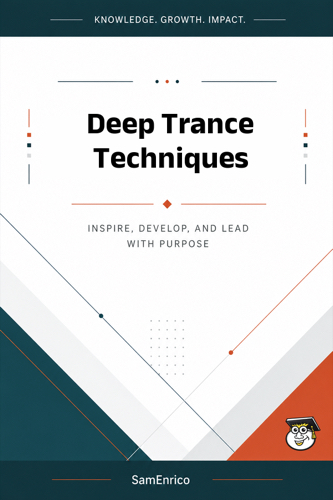
Deep Trance Techniques eBook
Advanced methods for inducing profound hypnotic st
by Dale Reid
Advanced methods for inducing profound hypnotic states for therapeutic work.
Formats
Free sample
Chapter 1: The Depth Illusion–- Most hypnotherapists believe they know what a “deep trance” looks like. They are wrong. Not partially wrong, not subtly mistaken, but fundamentally, clinically, and often dangerously incorrect. The traditional model of trance depth—the one taught in weekend certification courses, repeated in popular books, and visualized as a staircase descending from light relaxation to heavy somnambulism—is not merely oversimplified. It is an active barrier to effective therapeutic work.
This chapter dismantles that illusion and replaces it with a working model that will govern every technique in this book.Let us begin with a scene that plays out in thousands of therapy offices every week.A client—let us call her Sarah—sits in a reclining chair. Her eyes are closed. Her breathing is slow and regular. Her body is still. The therapist, having completed a progressive relaxation induction, speaks in a smooth, rhythmic tone.
“You are going deeper and deeper now. Ten times deeper than before. Every breath takes you to a deeper level of peace.” Sarah does not move. She does not open her eyes. By every external measure, she appears to be in a profound trance state.After the session, the therapist asks, “How deep was that on a scale of 1 to 10?”Sarah replies, “About a 7.”The therapist smiles, satisfied.Now consider a second scene.Another client—James—sits in the same chair.
His eyes are open. He shifts his weight occasionally. He scratches his nose once. When the therapist suggests his hand is becoming light and floating upward, James frowns slightly, then his index finger twitches. Nothing more.
By external measures, he appears to be barely in trance at all. The therapist, trained in conventional models, assumes the session is failing.Afterward, the therapist asks, “How deep was that?”James looks confused. “I don’t know. Maybe a 2? I didn’t feel very hypnotized.”Then the therapist asks a different question: “When I suggested your hand was becoming light, what happened inside?”James pauses.
“I felt something strange. My hand didn’t move, but for a moment… I wasn’t sure if it was my hand. Like it belonged to someone else.”The second client, by every meaningful clinical measure, was in a deeper trance than the first. But traditional depth models could not see it. They were looking at the wrong phenomena entirely.The Problem with Staircases The dominant metaphor for trance depth for the past century has been the staircase.
Light trance is the first step. Medium trance is the fifth step. Deep trance is the tenth step. Somnambulism is the fifteenth step. This model, popularized by early researchers like Davis and Husband (1931) and later by Arons (1967), assumes that trance is a single, linear, quantitative dimension.
More depth equals more relaxation, more suggestibility, more amnesia, more of everything.This assumption is false.It fails on three grounds: neurophysiological, phenomenological, and clinical.Neurophysiologically, the staircase model predicts that as trance deepens, brain activity should show a monotonic progression—for example, steady increases in theta waves or steady decreases in beta waves. But functional neuroimaging studies reveal a different picture. Deep trance is not a linear intensification of a single brain state but a reconfiguration of functional networks. The Default Mode Network (DMN)—which integrates self-referential thought, autobiographical memory, and mental time travel—does not simply “turn down” like a volume knob. It disengages in a non-linear fashion, often abruptly, while other networks (salience network, central executive network) shift their coupling patterns.
Theta activity does increase, but it does so in relation to gamma activity in ways that vary dramatically between individuals and even between sessions with the same individual.Phenomenologically, the staircase model predicts that clients should report “more” of the same subjective experiences as trance deepens—more relaxation, more detachment, more floating sensations. But clinical experience and systematic self-reports show that deep trance often involves qualitative shifts, not quantitative increases. Clients do not report “more relaxation” at the deepest levels. They report experiences that are categorically different: dissociation from body parts, distortions in time perception, spontaneous amnesia, positive or negative hallucinations. These are not louder versions of light trance experiences.
They are different kinds of experiences altogether.Clinically, the staircase model leads therapists to chase the wrong targets. A therapist who believes depth equals visible relaxation will interpret Sarah’s still body as evidence of deep trance and James’s fidgeting as evidence of shallow trance. The therapist will then reinforce the wrong behaviors—praising stillness, missing the significance of subtle ideomotor movements. The result is a therapeutic blind spot that leaves genuinely deep trance unrecognized and therefore underutilized.A New Framework: The Unified Depth Hierarchy This book replaces the staircase with a hierarchy of observable phenomena organized by the degree of dissociation from consensual reality. The deeper the trance, the greater the client’s ability to dis-experience what is present (negative hallucination) and to experience what is absent (positive hallucination).
This framework, which we will call the Unified Depth Hierarchy, has five functional levels. Each level is defined by specific, observable markers that are not matters of degree but matters of kind.Level 1: Light Trance Markers: Eyelid flutter, lid lag (the eyelids close slowly or incompletely when suggested), small swallowing movements, slight changes in skin color, minor ideomotor responses (finger twitches). The client remains fully oriented to time, place, and person. Suggestibility is mildly enhanced but not dramatically different from waking state. Most importantly, the client experiences trance as a state they are in—they know they are in trance, they can report on it continuously, and they retain full executive control.At Level 1, the therapist’s primary task is to build momentum.
This is the foundation, not the destination.Level 2: Medium Trance Markers: Arm catalepsy (the arm remains suspended when lifted and released, or the client cannot lower an arm suggested to be “stiff”), partial amnesia (the client may forget one or two suggestions but not the session as a whole), ideomotor responses that follow suggestions smoothly rather than as isolated twitches. The client begins to experience what researchers call “the classic effect”: the sense that responses are happening to them rather than being produced by them. For example, when the therapist suggests the arm is becoming heavy, the client does not actively lower the arm; rather, the arm feels heavy and seems to lower itself.At Level 2, the client may still report being “in trance,” but the quality of that report changes. Instead of saying “I am relaxed,” they may say “Something is happening to my arm” or “I feel like I’m watching myself.”Level 3: Somnambulism (Entry-Level Deep Trance)Markers: Total amnesia for selected suggestions (or for the entire induction) when suggested, glove anesthesia (numbness in one hand that can be transferred to other body parts), catalepsy of the eyelids (inability to open the eyes when suggested), time distortion (overestimation or underestimation of elapsed time by a factor of two or more). At Level 3, the client no longer experiences trance as a state they are “in.” Instead, they experience the content of suggestions directly, without a meta-awareness of the trance state itself.
This is a critical distinction: a Level 3 client can report on what they are experiencing within the trance (e.g.…
This is the end of the free sample. Get the eBook to keep going. Buy now
About this book
Details
- Author
- Dale Reid
- Publisher
- SamEnrico
- Language
- English
- Genre
- Non-Fiction, Self-Help, Advanced Hypnosis
- Released
- 2026-06-07
- Pages (approx.)
- 121
- Available as
- eBook, Audiobook

Read better in the ZLOADR app
Your eBooks on your phone or tablet. Sign in with your SamEnrico account and start reading.
More by Dale Reid
 Freight Forwarder SelectionDale Reid$11.99
 Rainforest Relaxation JourneyDale Reid$11.99
 Perfectionism Failure Link GuideDale Reid$11.99
 The Metta for Anger ManagementDale Reid$11.99
 The Red Turban Rebellion: Peasants Rise, Dynasties Fall (1351–1368)Dale Reid$11.99
 Understanding Rectal NeoplasmDale Reid$17.99
 Hygiene Service TechnicianDale Reid$11.99
 Real Estate InvestmentDale Reid$12.99Real Estate InvestmentDale Reid$12.99Real Estate InvestmentDale Reid$12.99Real Estate InvestmentDale Reid$12.99Real Estate InvestmentDale Reid$12.99