
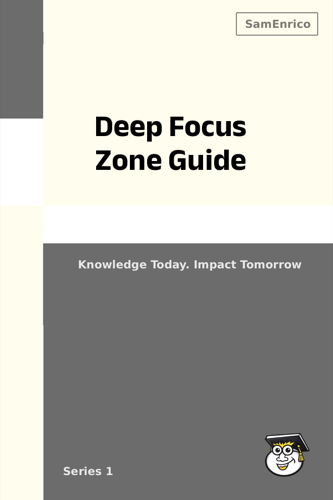
Deep Focus Zone Guide eBook
Create an interruption free environment and train
Create an interruption free environment and train focus endurance for complex tasks.
Formats
Free sample
Chapter 1: The 40-Second Fracture--–- I sat down to write one email. Ninety minutes later, I had checked the weather in a city I do not live in, read a 2,000-word article about the mating habits of deep-sea anglerfish, preheated my oven for no reason, and watched a Tik Tok of a dog playing the piano. I had not written the email. And here is the worst part: during those ninety minutes, I genuinely believed I was working.This is not a confession of laziness, nor is it an invitation for you to judge my self-discipline. I am a reasonably motivated adult.
I have completed graduate-level work, run a business, and raised children. I am not addicted to my phone in the clinical sense—I do not reach for it during meals with loved ones or feel phantom vibrations in my pocket. And yet, on that ordinary Tuesday afternoon, I lost ninety minutes to absolutely nothing. The dog playing piano was cute. The anglerfish article was fascinating.
Neither moved my life forward by a single millimeter.If you have ever closed your laptop at the end of a workday feeling exhausted yet unaccomplished—as though you ran a marathon but ended up exactly where you started—you already know the feeling I am describing. You worked. You were busy. Your inbox is emptier than it was this morning, and you replied to fourteen people who needed replies. But the big thing, the complex thing, the thing that requires your full cognitive firepower, remains untouched.
It sits on your to-do list like a stone you keep walking around. Another day has passed, and you are still afraid to pick it up.Here is the truth that this entire book is built upon: you are not lazy. Your mind is not broken. Your willpower is not weak. You are operating inside an environment that has been meticulously designed to fracture your attention every forty seconds, and you have been blaming yourself for not being able to hold it together.
That is like blaming a fish for drowning in poisoned water. The fish is fine. The water is the problem.This chapter will do three things. First, it will introduce you to the concept of The 40-Second Fracture—the specific cognitive pattern that steals your attention thousands of times per day without you even noticing. Second, it will show you, with hard data, why task switching is not a harmless habit but an expensive cognitive tax that costs up to forty percent of your productive time.
Third, it will shift your entire understanding of focus from a moral virtue (discipline) to an engineering problem (environmental design). By the end of this chapter, you will stop asking “What is wrong with me?” and start asking “What is wrong with my environment?” That single question changes everything.The Invention of the Fracture Let us travel back in time for a moment. Before smartphones, before Slack, before email, before the telephone, before the telegraph, human beings performed complex work in environments that were, by modern standards, almost comically quiet. A monk copying a manuscript in the twelfth century might experience an interruption when his candle burned out or when another monk coughed. A farmer plowing a field might pause when a stone needed to be moved.
A seamstress sewing a dress might stop to rethread a needle. These interruptions were rare, predictable, and brief. Between interruptions, there were long, uninterrupted stretches of time—hours, sometimes entire afternoons—during which a single task received the full weight of a human mind.Now consider your typical Tuesday morning. You sit down to write a proposal. Before you open the document, your phone buzzes—a news alert about something that does not matter.
You glance at it. You put the phone down. You open the proposal. Before you write the first sentence, an email arrives. You do not need to read it, but you see the sender’s name, and your brain wonders what they want.
You resist the urge to check. You write two sentences. Slack pings. Someone needs an answer to a question that is not urgent but feels urgent because Slack is open. You switch to Slack.
You answer. You return to the proposal. You have forgotten what your second sentence was going to say. You re-read it. A notification from Instagram.
You do not even open Instagram, but the banner was enough—you saw a friend’s face, and now you are thinking about them. You write one more sentence. Your phone rings. It is your child’s school. You answer.
You hang up. What were you writing? The proposal. Where were you? Sentence three.
What was sentence three going to be? Gone. Completely gone.This is not a caricature. This is the average modern knowledge worker’s morning, documented in dozens of time-use studies over the past fifteen years. And here is the crucial insight: each of those interruptions—the buzz, the ping, the banner, the ring—was deliberately placed there by a product designer whose explicit goal was to capture your attention.
Not to inform you. Not to help you. To capture you.Gloria Mark and the Forty-Second Discovery The most important research on this topic comes from Dr. Gloria Mark, a professor of informatics at the University of California, Irvine. For more than two decades, Mark has been doing something deceptively simple: she watches knowledge workers at their desks and records, with stopwatch precision, how long they stay on a single task before switching to something else.In 2004, Mark and her team observed that the average knowledge worker stayed on a single task for approximately three minutes before switching.
Three minutes. By 2012, that number had dropped to two minutes and fifteen seconds. By 2018, the most recent year for which comprehensive data has been published, the average knowledge worker stayed on a single task for just forty seconds before switching.Let me repeat that number because it is the central fact of this entire book. Forty seconds. You sit down to do something important.
Forty seconds later, you switch. Forty seconds later, you switch again. Forty seconds later, you switch again. Over the course of an eight-hour workday, that is more than seven hundred task switches. Seven hundred times, you interrupt your own brain.
Seven hundred times, you pay the cognitive tax that we are about to discuss.Mark’s research revealed another shocking pattern: when people switched tasks voluntarily (because they finished one thing and moved to another), the switch was relatively low-cost. But when people switched tasks involuntarily (because a notification, an email, a colleague, or a random thought pulled them away), the cognitive cost was enormous. And here is the worst part: the vast majority of modern task switches are involuntary. You are not deciding to check your phone. Your phone is deciding for you.Attention Residue: The Tax You Did Not Know You Were Paying Sophie Leroy, a professor of management at the University of Washington Bothell, coined the term attention residue in a landmark 2009 paper.
The concept is simple but devastating. When you switch from Task A to Task B, your brain does not fully release Task A.…
This is the end of the free sample. Get the eBook to keep going. Buy now
About this book
Details
- Author
- Lawson Donald
- Publisher
- SamEnrico
- Language
- English
- Genre
- Non-Fiction, Self-Help
- Released
- 2026-06-09
- Pages (approx.)
- 153
- Available as
- eBook, Audiobook

Read better in the ZLOADR app
Your eBooks on your phone or tablet. Sign in with your SamEnrico account and start reading.
More by Lawson Donald
 Meerkat Influencer StoryLawson Donald$11.99
 Stress Induced Hormone ImbalanceLawson Donald$11.99
 Group Idea Evaluation GuideLawson Donald$11.99
 Persuasive Cover Letter FormulaLawson Donald$11.99
 NVC for Couples WorkbookLawson Donald$11.99
 The Stowaway RatLawson Donald$11.99
 Blue Zone Breakfast HabitsLawson Donald$11.99
 Office Desk Nap SetupLawson Donald$11.99
 The Maestro of Sound: Granville T. Woods and the Electric RevolutionLawson Donald$11.99
 The Art of the Steal: How a Billion-Dollar Art Heist Funded a Crime EmpireLawson Donald$11.99
 Descartes and the Birth of Modern Thought: The Architect of ReasonLawson Donald$11.99
 The Mineral Guide to MoganiteLawson Donald$11.99
You may also like
 Hong Kong Handover 1997Dunn Johnnie$11.99
 Zumba For Postnatal Recovery CourseNeal Christian$11.99
 Zumba for BeginnersLadner Nikia$11.99
 YouTube Comment Mining GuideHumes Pandora$12.99
 Worry Box MeditationCarlin Rudy$11.99
 Workplace Stress MeditationNguyen Lynn$11.99
 Workplace Stress and Sleep RepairHawley Ivory$11.99
 Workplace Perfectionism CureDelaney Jeffry$11.99
 Workplace Injustice Anger GuideWallen Isabelle$11.99
 Work Addiction and Burnout LinkGreenwood Ester$11.99
 Women in Yoga and WellnessBeattie Galina$11.99
 Women in Stand Up ComedyChun Evangeline$11.99