
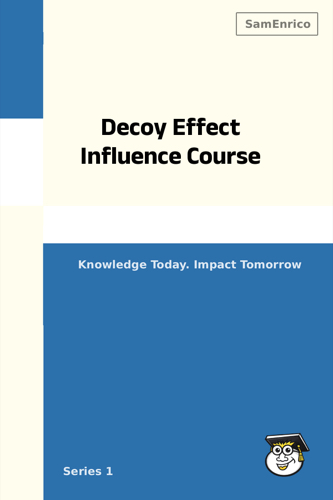
Decoy Effect Influence Course
Adds inferior option to make target option more at
Adds inferior option to make target option more attractive.
Formats
About this book
Free sample
Chapter 1: The Impossible Option...--–- In 1982, three marketing researchers walked into a laboratory at the University of North Carolina expecting to prove a simple, obvious fact about human behavior. They believed, as most economists and marketers did at the time, that adding more options to a choice set could never hurt the existing options. At worst, a new option would steal some market share from the existing products. At best, it would attract entirely new customers. But they were about to discover something that violated every textbook written about rational choice.
They were about to discover that adding an option nobody wanted could make a specific target option suddenly, dramatically, and predictably more attractive. This discovery would upend decades of economic theory and give birth to one of the most powerful, yet invisible, forces in modern marketing: the decoy effect.The experiment was simple. Huber, Payne, and Puto presented consumers with two options for a product—say, a beer. Option A was a high-quality beer at a higher price. Option B was a lower-quality beer at a lower price.
As expected, consumers split their preferences roughly evenly between the two, with slight variations depending on whether they valued quality or price more. Then the researchers introduced a third option. This third option was not designed to be chosen. It was designed to be ignored. It was a beer that was slightly more expensive than Option A but with slightly lower quality than Option B—in other words, worse than one option on price, worse than the other on quality, and worse than both on overall value.
By every rational measure, it was an inferior choice. Nobody in their right mind would select it.And yet, when that inferior third option appeared, something strange happened. Suddenly, Option A—the high-quality, high-price option—began winning a significantly larger share of consumer preferences. The presence of an option that nobody wanted had shifted the entire landscape of choice. The researchers called this phenomenon "asymmetric dominance," because the third option was asymmetrically dominated by the target option.
The marketing world would later give it a simpler name: the decoy effect.This is the puzzle at the heart of…
This is the end of the free sample. Get the eBook to keep going. Buy now
Contents
- Chapter 1
- Chapter 2
- Chapter 3
- Chapter 4
- Chapter 5
- Chapter 6
- Chapter 7
- Chapter 8
- Chapter 9
- Chapter 10
- Chapter 11
- Chapter 12
Details
- Author
- Cleveland Aide
- Publisher
- SamEnrico
- Language
- English
- Genre
- Non-Fiction, Self-Help, Decoy
- Released
- 2026-06-09
- Pages (approx.)
- 157
- Available as
- eBook, Audiobook

Read better in the ZLOADR app
Your eBooks on your phone or tablet. Sign in with your SamEnrico account and start reading.
More by Cleveland Aide
 Pushing Heavy DoorsCleveland Aide$11.99
 Meth Addiction Dental Health Recovery HandbookCleveland Aide$11.99
 Stress and Crohn's Disease FlaresCleveland Aide$11.99
 Purpose for FirefightersCleveland Aide$11.99
 Russian Mafia in NetherlandsCleveland Aide$11.99
 Non Hodgkin Lymphoma SurvivorCleveland Aide$11.99
 Nobel Laureates Who Denied PrizesCleveland Aide$11.99
 Nefertiti's Lost Amulet: The Curse of the Sun DiskCleveland Aide$11.99
 The Great Bullion Heist: The 1855 Gold Robbery That Shocked Victorian LondonCleveland Aide$11.99
 Service Providers Guide to Self-improvement SeminarsCleveland Aide$11.99
 How to Produce Weighing ScalesCleveland Aide$11.99
 UN FAO Agriculture CareerCleveland Aide$12.99