
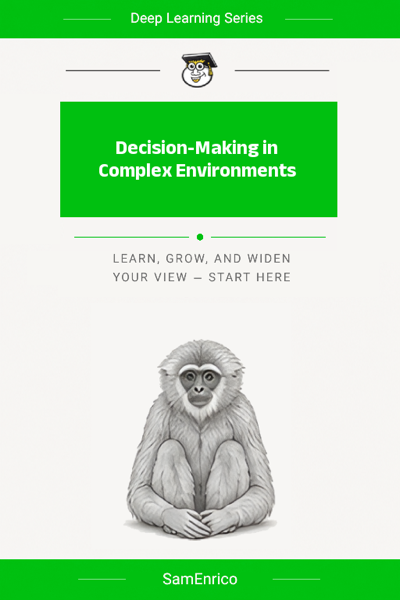
Non-FictionInformativeEducational
Decision-Making in Complex Environments eBook
A Coursebook on Decision-Making in Complex Environ
A Coursebook on Decision-Making in Complex Environments
Formats
Free sample
Chapter 1: The Poker Paradigm--–- The conference room was silent. Twelve executives sat around a mahogany table, each holding a forty-page analysis prepared by a team of data scientists. The question before them was simple in form but monstrous in consequence: should the company acquire a smaller competitor for $400 million? The spreadsheets showed 18% projected returns. The consultants had run ten thousand Monte Carlo simulations.
The decision seemed clear.The CEO, a former chess champion in his youth, stood up. "The numbers don't lie," he said. "We have perfect information. We've modeled every variable. This is a chess move, and we're going to win."Eighteen months later, the acquisition had destroyed $1.2 billion in shareholder value.
The competitor's key technology was obsolete. A regulatory change no one had predicted made the business model illegal in three countries. And the CEO's career was over.He wasn't wrong because he made a bad decision. He was wrong because he was playing the wrong game.The Most Dangerous Mistake in Decision-Making Every day, in boardrooms, government agencies, hospitals, and living rooms, intelligent people make catastrophic decisions. They do not make these decisions because they are stupid, lazy, or uninformed.
They make them because they have been trained to play chess in a world that is actually poker.This distinction – between chess and poker – is the single most important concept in this entire book. If you understand nothing else, understand this: the tools and strategies that work brilliantly in complicated, predictable environments will destroy you in complex, uncertain ones. And most of the decisions that actually matter – the ones that shape your career, your company, your family's future – happen in the second type of environment.Let me prove this to you.Chess: The Beautiful Illusion Chess is a closed system. Every piece is visible to both players. Every rule is fixed and known.
There is no hidden information, no random chance, no unpredictable behavior from the pieces themselves. A pawn does not wake up one morning and decide to move diagonally three spaces because it "feels right." The board does not change size mid-game.In chess, if you lose, it is because you made an inferior move. There is no luck to blame, no hidden variable you could not have known, no act of God that intervened. The better player wins almost every time. Over a thousand games, the ranking difference predicts outcomes with near-perfect accuracy.This is why chess has become the dominant metaphor for strategic thinking in Western business culture.
We say someone is "playing three-dimensional chess" when they are being strategically sophisticated. We admire the grandmaster who can see fifteen moves ahead. We teach our children that careful planning, thorough analysis, and perfect execution lead to victory.The problem is not that chess is a bad game. The problem is that life is not chess.Poker: The Uncomfortable Reality Poker is an open system. You cannot see the other players' cards.
You do not know how they will behave, because their behavior depends on their personality, their mood, their risk tolerance, their assessment of you, and a hundred other variables. The rules are fixed, but the game state is fundamentally hidden.In poker, you can make a perfect decision – mathematically optimal, based on everything you know – and still lose. The other player might get lucky on the river card. They might make an irrational bet that, by sheer accident, beats your rational one. They might have a tell you could not possibly have observed.And here is the crucial insight: over a single hand, the worse player can beat the better player.
Over a hundred hands, the better player will come out ahead. But in between – in the messy reality of most high-stakes decisions – you are never playing a hundred identical repetitions. You are playing one hand, with unique conditions, and luck is a real factor.Most organizational, economic, geopolitical, and personal decisions occur in poker-like environments. You do not have perfect information. The future is not fixed.
Other actors have their own goals and hidden cards. Random events – a pandemic, a regulatory change, a competitor's irrational move – can overturn your best-laid plans.Yet we train people to play chess. We give them spreadsheets that assume the future is knowable. We reward them for certainty and punish them for acknowledging uncertainty. And then we wonder why so many decisions go catastrophically wrong.The Cynefin Framework: Your Environmental Diagnostic Tool The chess-versus-poker metaphor is powerful, but we need a more precise vocabulary for diagnosing the environment you are actually in.
The Cynefin Framework (pronounced "kuh-NEV-in"), developed by Dave Snowden at IBM, provides exactly that.Cynefin categorizes environments into four domains:Simple Environments (formerly called "Obvious"): Here, cause and effect are clear to everyone. The relationship is direct, repeatable, and predictable. "If I flip this switch, the light turns on." Best practices apply. You can sense, categorize, and respond. Example: processing a routine invoice, brewing a cup of coffee, following a standard operating procedure.Complicated Environments: Here, cause and effect are not obvious to everyone, but they are discoverable through expert analysis.
There is a predictable relationship, but it requires expertise to see. Multiple correct answers may exist. Example: diagnosing a rare medical condition, engineering a bridge, auditing a complex financial statement. Chess belongs here.Complex Environments: Here, cause and effect can only be discerned in retrospect. The same action in the same circumstances can produce different outcomes because the system is emergent, not linear.
Relationships are non-linear, and the environment changes as you interact with it. Example: launching a startup, managing a geopolitical crisis, raising a teenager. Poker belongs here.Chaotic Environments: Here, there is no discernible cause-effect relationship. The system is in turmoil. The priority is not analysis but action – stabilize the situation first.
Example: a building on fire, a sudden market crash, an active shooter situation.The critical mistake – the one that destroyed the CEO in our opening story – is treating a complex environment as if it were merely complicated. He analyzed. He modeled. He ran simulations. All of these tools are appropriate for complicated systems.
But in a complex system, analysis alone fails because the system changes as you observe it and as you act within it.The Skill-Luck Continuum Every decision exists somewhere on a spectrum between pure skill and pure luck. At the pure skill end, outcomes are entirely determined by the quality of your decision. At the pure luck end, outcomes are entirely random.Chess sits at the extreme skill end of the continuum. Over a single game, skill dominates. Over a thousand games, luck is statistically invisible.
The best player wins almost every time.Roulette sits at the extreme luck end. No amount of skill changes the outcome. The ball lands where it lands. Over a thousand spins, the house edge is mathematically certain, but any individual spin is pure chance.Most real-world decisions sit somewhere in the middle. A startup founder's decision to pivot or persevere involves substantial skill – market understanding, product sense, team leadership – but also substantial luck – timing, competitor behavior, regulatory changes, global events.Here is the crucial insight that most decision-makers miss: the skill-luck continuum is not just about outcomes; it is about…
This is the end of the free sample. Get the eBook to keep going. Buy now
About this book
Details
- Author
- Pederson Kirstie
- Publisher
- SamEnrico
- Language
- English
- Genre
- Non-Fiction, Informative, Educational
- Released
- 2026-06-03
- Pages (approx.)
- 158
- Available as
- eBook, Audiobook

Read better in the ZLOADR app
Your eBooks on your phone or tablet. Sign in with your SamEnrico account and start reading.
More by Pederson Kirstie
 Imposter Syndrome For TherapistsPederson Kirstie$11.99
 Vacation Comparison SyndromePederson Kirstie$11.99
 Compulsive Gaming And ADHD GuidePederson Kirstie$11.99
 Cancel Culture Fear WorkbookPederson Kirstie$11.99
 The Rotavirus Vaccine GuidePederson Kirstie$11.99
 The Poverty Childhood WoundPederson Kirstie$11.99
 Postpartum Depression After LossPederson Kirstie$11.99
 Self Talk for Parenting PatiencePederson Kirstie$11.99
 Resilience JournalPederson Kirstie$11.99
 Rommel's Gambit: The Price of Sand and Steel in North AfricaPederson Kirstie$11.99
 Ravana's Last Gambit: The Asura King's Final StandPederson Kirstie$11.99
 Growing SmilacinaPederson Kirstie$11.99
You may also like
 Hong Kong Handover 1997Dunn Johnnie$11.99
 Zumba For Postnatal Recovery CourseNeal Christian$11.99
 Zumba for BeginnersLadner Nikia$11.99
 YouTube Comment Mining GuideHumes Pandora$12.99
 Worry Box MeditationCarlin Rudy$11.99
 Workplace Stress MeditationNguyen Lynn$11.99
 Workplace Stress and Sleep RepairHawley Ivory$11.99
 Workplace Perfectionism CureDelaney Jeffry$11.99
 Workplace Injustice Anger GuideWallen Isabelle$11.99
 Work Addiction and Burnout LinkGreenwood Ester$11.99
 Women in Yoga and WellnessBeattie Galina$11.99
 Women in Stand Up ComedyChun Evangeline$11.99