
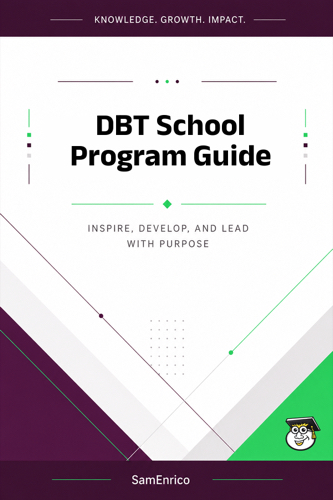
DBT School Program Guide eBook
Implement emotion regulation curriculum in educati
Implement emotion regulation curriculum in educational settings.
Formats
Free sample
Chapter 1: The Calm Deficit--–- Every school in America has a fire alarm. It hangs on the wall in a bright red box, clearly marked, tested monthly. When it activates, everyone knows exactly what to do: stop, line up, proceed to the nearest exit, assemble on the lawn, wait for the all-clear. The drill is practiced so many times that even kindergarteners can do it in their sleep.Now consider this. What if a school had no fire alarm?
What if, when a fire started, no one knew what the sound meant, no one had practiced evacuation, and the only response was for teachers to shout "Behave better!" at the smoke? That would be absurd, even negligent. And yet, every single day in classrooms across the country, students experience emotional fires—rage, shame, panic, despair—and schools have no equivalent alarm system, no practiced drill, no universal protocol. Instead, we call it "misbehavior" and assign detention.This book exists because that approach is not only failing; it is actively harming students.The problem is not that educators lack compassion or skill. The problem is that we have been trained to manage behavior rather than teach regulation.
We have discipline policies designed for students who choose to act out, not for students whose nervous systems have been hijacked by stress, trauma, or developmental immaturity. And we have adopted Social-Emotional Learning (SEL) frameworks that name the problem—students need to be self-aware, self-managed, responsible decision-makers—but provide almost no discrete, teachable, repeatable skills for getting there.This is what the clinical world calls a "skills deficit." And the solution is not more punishment or more abstract character education. The solution is a curriculum. A real, structured, evidence-based curriculum that teaches emotion regulation the same way we teach long division: explicitly, sequentially, with practice and feedback and a clear progression from simple to complex.That curriculum is Dialectical Behavior Therapy Skills Training, adapted for the classroom. And this chapter makes the case for why it belongs not in the counselor's office, not in the special education room, but in front of every student, in every grade, as a core subject.The Unspoken Crisis in Classrooms Walk into any middle school in America around 1:45 PM.
Walk past the main office, past the bulletin board with the anti-bullying poster, past the water fountain where a student is crying alone. Find a classroom—any classroom—and watch what happens when the teacher asks a simple question: "Who can tell me what happened to the main character in chapter four?"Three hands go up. One student in the back is drawing on his arm with a pen. Another has her head down on the desk. A third is staring out the window with the hollow look of someone who has not slept in days.
A fourth is tapping his pencil so rapidly that the student in front of him finally whips around and hisses, "Stop it."The teacher ignores the tapping, calls on a raised hand, and the lesson moves forward. But the tapping continues. The head stays down. The student by the window is still gone. And somewhere beneath the surface of this ordinary classroom scene, a dozen emotional fires are smoldering.That student drawing on his arm?
He got into a screaming fight with his mother this morning about whether he could wear a hoodie with holes in it. She called him worthless. He has been replaying that word for four hours. That student with her head down? She was up until midnight finishing a project while also managing her younger siblings because her single parent works the night shift.
She is running on four hours of sleep and a granola bar. That student staring out the window? He was just told by his only friend that they "need a break" from the friendship, and he has no idea why. That student tapping the pencil? He has undiagnosed anxiety, and the ticking clock of the school day feels like a countdown to an explosion he cannot name.None of these students are "bad kids." None of them chose to be dysregulated.
And none of them have any idea what to do about how they feel. They have never been taught.This is the calm deficit. Not a deficit of calmness as a personality trait, but a deficit of the skills that produce calm. We have assumed for generations that children will simply absorb emotional regulation by osmosis—by watching adults, by maturing, by experiencing consequences. But that is like assuming they will learn calculus by sitting in a room with a blackboard.
It does not work.The data are stark. According to the National Center for Education Statistics, more than 80% of public schools have reported that the pandemic exacerbated behavioral and emotional problems among students. Office referrals for disruptive behavior have not returned to pre-2020 levels in most districts. Suspension rates are rising, particularly for elementary-aged children. And yet, when researchers ask teachers what training they have received in emotion regulation instruction, the most common answer is "none."Why Traditional Discipline Fails the Dysregulated Student To understand why DBT belongs in schools, we first have to understand why what we are currently doing does not work.
Most schools operate on a behavioral management model that assumes three things:First, that students have control over their behavior in the moment it occurs. Second, that misbehavior is a choice. Third, that consequences—rewards and punishments—will shape future choices.These assumptions are not always wrong. For a student who is bored, mildly annoyed, or testing boundaries, a well-timed consequence can be effective. Detention for talking back, a sticker for finishing work, a call home for chronic disruption—these operate on the behavioral principle of operant conditioning.
And for a certain subset of students, they work fine.But for the dysregulated student—the one whose amygdala is screaming DANGER while their prefrontal cortex has gone offline—these assumptions are catastrophic.Here is what neuroscience tells us about emotional dysregulation. When a human perceives a threat (and remember, for an adolescent, a harsh look from a peer activates the same brain regions as a physical threat), the amygdala initiates a cascade of stress hormones. Cortisol and adrenaline flood the system. Heart rate increases. Digestion slows.
The prefrontal cortex—the part of the brain responsible for impulse control, planning, and rational decision-making—literally reduces its activity. This is the "flip the lid" phenomenon that we will explore in detail in Chapter 2. The brain's CEO has left the building.In this state, a student cannot "choose" to behave well any more than someone with a broken leg can choose to run a sprint. The neural pathways required for calm, thoughtful decision-making are temporarily unavailable. The student is in survival mode: fight, flight, or freeze.Now watch what happens when a teacher uses traditional discipline on this student.
The student is yelling. The teacher says, "Stop yelling or you will get a detention." The student yells louder. The teacher writes a referral. The student gets suspended. And what has the student learned?
They have learned that when they are in crisis, the school responds by excluding them. They have not learned a…
This is the end of the free sample. Get the eBook to keep going. Buy now
About this book
Details
- Author
- Reynoso Dorathy
- Publisher
- SamEnrico
- Language
- English
- Genre
- Non-Fiction, Self-Help, Education
- Released
- 2026-06-08
- Pages (approx.)
- 142
- Available as
- eBook, Audiobook

Read better in the ZLOADR app
Your eBooks on your phone or tablet. Sign in with your SamEnrico account and start reading.
More by Reynoso Dorathy
 Pomodoro For Gaming BreaksReynoso Dorathy$11.99
 ABC Prioritization for CreativesReynoso Dorathy$11.99
 Pelvic Floor for Nursing MothersReynoso Dorathy$11.99
 Delegation Trust Building GuideReynoso Dorathy$11.99
 Healing Praise Starved ChildhoodReynoso Dorathy$11.99
 Breath Meditation Before SleepReynoso Dorathy$11.99
 Antwerp Heist SociologyReynoso Dorathy$11.99
 The Trial of the Century: The First War Crimes Tribunal in Victorian BritainReynoso Dorathy$11.99
 The Banshee's Last Waltz: Slavic Spirits and the Music of the DeadReynoso Dorathy$11.99
 How to Become a StonemasonReynoso Dorathy$11.99
 How to Produce Studio Lighting ControlsReynoso Dorathy$11.99
 How to Produce Hand LoomsReynoso Dorathy$11.99
You may also like
 Hong Kong Handover 1997Dunn Johnnie$11.99
 Zumba For Postnatal Recovery CourseNeal Christian$11.99
 Zumba for BeginnersLadner Nikia$11.99
 YouTube Comment Mining GuideHumes Pandora$12.99
 Worry Box MeditationCarlin Rudy$11.99
 Workplace Stress MeditationNguyen Lynn$11.99
 Workplace Stress and Sleep RepairHawley Ivory$11.99
 Workplace Perfectionism CureDelaney Jeffry$11.99
 Workplace Injustice Anger GuideWallen Isabelle$11.99
 Work Addiction and Burnout LinkGreenwood Ester$11.99
 Women in Yoga and WellnessBeattie Galina$11.99
 Women in Stand Up ComedyChun Evangeline$11.99