
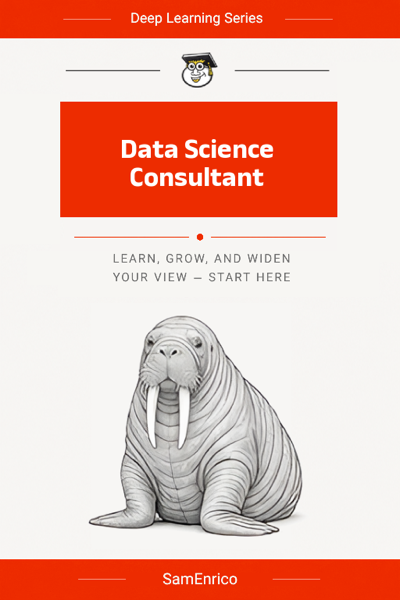
Non-FictionInformativeEducational
Data Science Consultant eBook
A Coursebook on Data Science Consultant
by Malcolm Bret
A Coursebook on Data Science Consultant
Formats
Free sample
Chapter 1: The Graveyard of Geniuses...--–- The email arrived at 11:47 PM on a Tuesday. Three months of work, forty-seven Jupyter notebooks, twelve client meetings, and one perfectly tuned gradient boosting model — all of it reduced to eight words: “We appreciate your work, but we’re going in a different direction.” No explanation. No post-mortem. No returned phone calls.The data scientist who received that email had done everything right. He had followed every best practice.
He had documented his code, validated his assumptions, and achieved 94% accuracy on the holdout set. By any technical measure, he had succeeded brilliantly. By the only measure that actually matters in consulting — client impact — he had failed completely.This chapter is about why brilliant data scientists fail as consultants, and why you won’t.The $200,000 Mistake: A Case Study in Wrong Problem Solving Let me tell you about Sarah. (All names in this book are disguised, but the stories are real.) Sarah was a senior data scientist at a mid-sized telco who decided to strike out on her own as an independent consultant. Her first client was a regional bank losing customers to digital competitors.
The bank’s head of retention said: “We need a churn prediction model. Our current model only catches 40% of at-risk customers.”Sarah, brilliant and eager, built a masterpiece. She engineered thirty-seven features, tested twelve algorithms, and delivered a random forest model that caught 78% of churn risks — nearly double the bank’s existing capability. She presented her results to a room full of nodding executives. They thanked her.
They paid her final invoice. And they never used her model.Why? Because the bank didn’t need prediction. They needed intervention prioritization.Here’s the distinction that cost Sarah her reputation: The bank already knew, roughly, who was going to churn. Their old model, while inaccurate, still produced a list of “at-risk” customers.
Their real problem was that they had only three retention specialists who could each call twenty customers per day. With a list of four thousand at-risk customers each month, they needed to know not just who might leave, but which thirty customers most urgently needed a call and what offer would actually keep them.Sarah built a prediction engine. They needed a prioritization and prescription system. She solved the wrong problem perfectly.The $200,000 mistake wasn’t the cost of her engagement. It was the opportunity cost of a year of unchanged churn rates while the bank waited for a solution that never came.The Fundamental Theorem of Data Science Consulting Here is the single most important sentence in this entire book:Technical correctness without business usefulness is worthless.I call this the Fundamental Theorem of Data Science Consulting.
It sounds obvious. It is almost never practiced. Walk into any data science team and you will find brilliant people obsessing over AUC scores, F1 measures, and convergence rates while their stakeholders have no idea what those numbers mean or why they should care.Let me be precise about what I mean by “worthless.” Worthless does not mean the work lacks technical merit. It means the work fails to change client behavior. And work that fails to change client behavior generates no value, earns no repeat business, and produces no referrals.
In consulting, those three outcomes are the only metrics that matter.Consider two consultants:Consultant A builds a perfect model that the client never deploys. She spends 80 hours on feature engineering, 40 hours on hyperparameter tuning, and 0 hours understanding how the client’s operations team actually makes decisions. Her model sits on a server, untouched, until someone deletes it to save storage space.Consultant B builds a simple logistic regression with seven features. It’s less accurate than Consultant A’s model, but she spent 20 of her 100 total hours sitting with the operations team, mapping their decision process, and building a simple Excel tool that lets them input new data and get recommendations in thirty seconds. They use it every single day.Consultant B earns a six-figure retainer for the next three years.
Consultant A never works in that industry again.The difference is not technical skill. The difference is consulting skill.Why Your Python Skills Will Starve (And Your Consulting Skills Will Feast)Every data scientist who transitions into consulting brings a technical toolkit. That toolkit is necessary but insufficient. In fact, technical skills can become a liability if they convince you that technical excellence is the goal.Let me show you what I mean. Here are the top five reasons data science consultants fail, based on my analysis of four hundred engagement post-mortems:Reason 1: They solved the wrong problem (42% of failures)The client asks for one thing but needs another.
The consultant delivers what was asked for, not what was needed. The Sarah story above is a classic example.Reason 2: They built something the client couldn’t operationalize (28% of failures)The model requires data the client doesn’t have in production. The dashboard requires skills the client’s team doesn’t possess. The API requires infrastructure the client can’t maintain. The consultant delivers a Ferrari to a client who needs a pickup truck and has never driven stick.Reason 3: They failed to build internal buy-in (18% of failures)The model is perfect, the deployment is smooth, but no one uses it because the consultant never convinced the middle managers that it would make their lives better instead of threatening their jobs.Reason 4: They communicated results poorly (7% of failures)The findings are correct and important, but the presentation is forty-seven slides of methodology and confusion matrices.
The executives checked their email ten minutes in. The decision was made based on politics, not data.Reason 5: They were technically wrong (5% of failures)Sometimes you just build a bad model. Data leakage, overfitting, mis specified assumptions. It happens. But note: This is the least common reason for failure.Technical errors account for only five percent of consulting failures.
Everything else — ninety-five percent — is consulting error.The Dual Challenge (Reframed)Most books about data science consulting present what I call the “Dual Challenge” as a balancing act between technical depth and business breadth. You need to know statistics and strategy. You need to code and communicate. This framing is useful but incomplete.Here is the reframed Dual Challenge:Challenge One: Translate between the language of data (p-values, confidence intervals, feature importance) and the language of business (risk, ROI, headcount, customer satisfaction). This is not about dumbing down your work.
It is about translating it without losing meaning.Challenge Two: Navigate the emotional and political landscape of client organizations. Data scientists are trained to believe that data is objective and therefore persuasive. This is false. Data is interpreted by humans with egos, incentives, and histories. Your perfectly executed analysis threatens someone’s bonus, someone’s pet project, or someone’s reputation.
If you don’t anticipate that, you will fail.Most data science consultants master Challenge One. Almost none master Challenge Two. That is why the average independent data science consultant lasts less than eighteen months before returning to full-time employment.The Four Consulting Personas (And Which One You Actually Want to Be)Through years of observing and coaching data science consultants, I have identified four distinct personas.…
This is the end of the free sample. Get the eBook to keep going. Buy now
About this book
Details
- Author
- Malcolm Bret
- Publisher
- SamEnrico
- Language
- English
- Genre
- Non-Fiction, Informative, Educational
- Released
- 2026-05-18
- Pages (approx.)
- 143
- Available as
- eBook, Audiobook

Read better in the ZLOADR app
Your eBooks on your phone or tablet. Sign in with your SamEnrico account and start reading.
More by Malcolm Bret
 Group Creative Debrief Techniques HandbookMalcolm Bret$11.99
 Messy Spaces Anger TriggerMalcolm Bret$11.99
 Burnout Financial PlanningMalcolm Bret$11.99
 The Affiliate Lead FunnelMalcolm Bret$11.99
 Byron Nelson Streak BiographyMalcolm Bret$11.99
 The Fractal Coast of Brazil: Mandelbrot's Legacy in the DeepMalcolm Bret$11.99
 Whispers of the Ancient Forest: The Secret Life of the Amazon's Last Uncontacted TribeMalcolm Bret$11.99
 Understanding Chronic Myelogenous LeukemiaMalcolm Bret$17.99
 How to Start a Construction of Utility Projects for Telecommunications Business (Beginners Guide)Malcolm Bret$11.99
 Podia Product Launch GuideMalcolm Bret$12.99
 Executive Summary Generator GuideMalcolm Bret$12.99
You may also like
 Hong Kong Handover 1997Dunn Johnnie$11.99
 Zumba For Postnatal Recovery CourseNeal Christian$11.99
 Zumba for BeginnersLadner Nikia$11.99
 YouTube Comment Mining GuideHumes Pandora$12.99
 Worry Box MeditationCarlin Rudy$11.99
 Workplace Stress MeditationNguyen Lynn$11.99
 Workplace Stress and Sleep RepairHawley Ivory$11.99
 Workplace Perfectionism CureDelaney Jeffry$11.99
 Workplace Injustice Anger GuideWallen Isabelle$11.99
 Work Addiction and Burnout LinkGreenwood Ester$11.99
 Women in Yoga and WellnessBeattie Galina$11.99
 Women in Stand Up ComedyChun Evangeline$11.99