
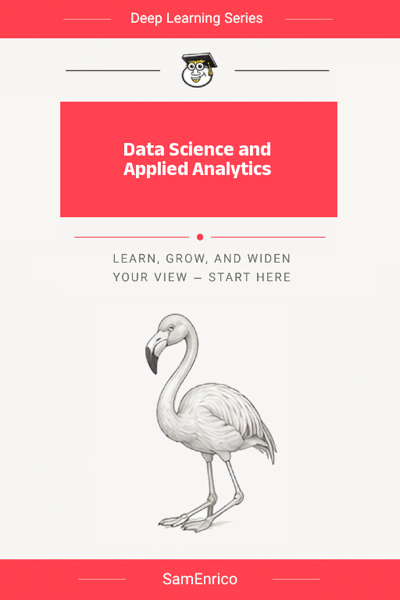
Data Science and Applied Analytics eBook
A Coursebook on Data Science and Applied Analytics
A Coursebook on Data Science and Applied Analytics
Formats
Free sample
Chapter 1: The 85% Graveyard...--Every year, over $400 billion is invested in data science and artificial intelligence projects across the global economy. More than 200,000 people will earn new degrees or certificates in data-related fields. Thousands of companies will hire their first data scientist, build their first dashboard, or train their first model. And by this time next year, eighty-five percent of those projects will have failed.Not partially succeeded. Not delivered some value.
Failed. Dead. Buried in the graveyard of half-built Jupyter notebooks, abandoned Tableau dashboards, and Power Point decks that were presented once and never opened again.If you are reading this book, someone has probably told you that data science is the sexiest job of the twenty-first century. That data is the new oil. That AI will transform everything.
And all of that is true in the same way that a gym membership transforms your body while it sits in your wallet. Potential is not outcome. Tools are not results. Algorithms are not answers.The uncomfortable truth that no bootcamp, no You Tube tutorial, and no vendor sales pitch will tell you is this: The difference between a data science project that changes a business and one that wastes six months of everyone's time has almost nothing to do with which algorithm you choose. It has everything to do with how you think before you write a single line of code.This chapter is not about Python or Pandas or Py Torch.
You will get to those soon enough. This chapter is about rewiring your brain. It is about understanding why smart people build brilliant models that no one uses. It is about learning to ask the one question that separates professionals from amateurs. And it is about deciding, before you go any further in this book, whether you want to learn to write code or whether you want to learn to solve problems.
Only one of those will make you valuable.The Great Analytics Graveyard: Why Most Projects Die Let us walk through a typical failure. Not an outlier. Not a cautionary tale from a dysfunctional company. The normal, everyday, statistically average data science project.A mid-sized retail company hires a new data science team. The team is smart.
They have advanced degrees from good programs. They know Python. They understand random forests and gradient boosting. They are given access to the company's customer database and told to "find insights."The team spends two weeks exploring the data. They find that customers who buy diapers are more likely to buy beer on Thursday nights.
This is an actual real pattern discovered in the 1990s, and it has become the cliché of data science success stories. The team gets excited. They build a recommendation engine. They present it to the marketing director.The marketing director asks three questions: How much will this cost to implement? Which of my existing campaigns should I cancel to fund this?
And can you guarantee that the increased sales will exceed the implementation cost within six months?The data science team has no answers. They have accuracy metrics. They have ROC curves. They have a beautiful confusion matrix. They do not have a business case.
The project dies. The team feels unappreciated. The marketing director adds another data point to her growing conviction that data scientists live in a fantasy world.This scene plays out thousands of times every day. The problem is not technical skill. The problem is not bad data, although the data is often bad.
The problem is a fundamental mismatch between how data scientists are trained and what organizations actually need.You have been taught to ask, "What can I build with this data?" The question you need to learn to ask is, "What problem, if solved, would create measurable value for a specific decision-maker?" Those two questions are separated by an ocean. Most people drown in the middle.The DIKW Pyramid: From Noise to Wisdom To understand why so many projects fail, we must first understand what data actually is and what it is not. The DIKW Pyramid, first formalized by Russell Ackoff in the late 1980s, remains the most useful framework for distinguishing between mere information and genuine insight.Data is raw, unprocessed facts. The number 37. A timestamp of 2024-11-15T14:32:01Z.
The string "customer_churned = True". Data has no meaning by itself. It is the exhaust of reality, not the interpretation of it.Information is data that has been structured, labeled, and contextualized. The number 37 becomes information when you know it represents the temperature in Celsius at noon in Phoenix. The timestamp becomes information when you know it records the exact moment a user clicked a checkout button.
Information answers the question "what."Knowledge is information that has been synthesized into patterns, rules, or relationships. Not just that a user clicked checkout at 2:32 PM, but that users who click checkout between 2:00 PM and 3:00 PM on weekdays have a 40 percent higher average order value than users who click at any other time. Knowledge answers the question "how."Wisdom is knowledge applied to make better decisions. It is knowing that you should not send a push notification at 2:30 PM even though that is when order values are highest, because doing so will annoy users and increase churn in the long run. Wisdom answers the question "why" and "whether you should at all."Here is the painful reality that most data science education ignores: You cannot skip levels.
You cannot start at knowledge without first building information. You cannot start at wisdom without first building knowledge. But most projects jump directly from data to modeling, skipping the information and knowledge layers entirely. They attempt to extract wisdom from raw numbers using algorithms as magic wands.That is why 85 percent of projects fail. Not because the algorithms are wrong, but because the foundation was never built.Consider a healthcare example.
A hospital has millions of patient records. A data scientist runs a clustering algorithm and discovers three patient segments. This is knowledge. But is it wisdom? Only if the hospital can answer: What actions will we take differently for each segment?
Which segment is most profitable to target? Which segment has the worst outcomes under current care protocols? Without those answers, the clusters are just interesting patterns. They are not actionable. And non-actionable insights are not insights at all.
They are trivia.The Four Analytics Questions: From Past to Future The DIKW Pyramid tells us what data becomes. The four levels of analytics tell us what questions we can answer at each stage. Understanding these levels is the single most important conceptual foundation in this entire book. Memorize them. Internalize them.
Refer back to them every time you start a new project.Descriptive Analytics answers the question: What happened?This is the baseline. It is counting, summing, averaging, and visualizing historical data. A dashboard showing last month's sales by region is descriptive. A report showing customer churn over the past twelve months is descriptive. Descriptive analytics requires no modeling, no predictions, no complicated statistics.
It requires accurate data and basic arithmetic. And yet, most organizations struggle to get even this right. If your company cannot reliably tell you what happened last…
This is the end of the free sample. Get the eBook to keep going. Buy now
About this book
Details
- Author
- Moniz Jerrell
- Publisher
- SamEnrico
- Language
- English
- Genre
- Non-Fiction, Informative, Educational
- Released
- 2026-05-09
- Pages (approx.)
- 151
- Available as
- eBook, Audiobook

Read better in the ZLOADR app
Your eBooks on your phone or tablet. Sign in with your SamEnrico account and start reading.
More by Moniz Jerrell
 Meditation for Beginner WidowersMoniz Jerrell$11.99
 Stress HGH SuppressionMoniz Jerrell$11.99
 Chunking Inventory CodesMoniz Jerrell$11.99
 Hearst's Art Collection HeistMoniz Jerrell$11.99
 The Silk Road's Shadow AgentsMoniz Jerrell$11.99
 Ghana Import Duty Relief Programs for DropshippersMoniz Jerrell$12.99
 How to Produce BreadfruitMoniz Jerrell$11.99
 How to Become a Passenger Service RepresentativeMoniz Jerrell$11.99