
Non-FictionStartup GuideData RoomDocument Prep
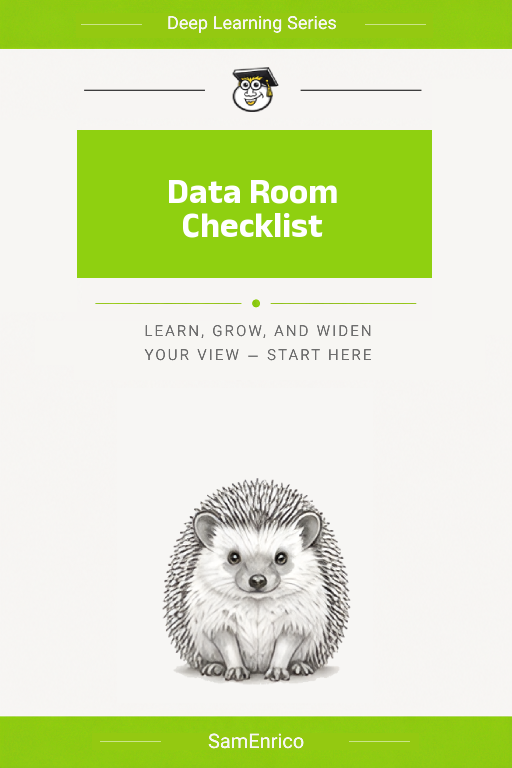
Data Room Checklist eBook
Organize 5 folders: legal, financial, customer, pr
Organize 5 folders: legal, financial, customer, product, and team before first ask.
Formats
Free sample
Chapter 1: The Chaos Tax--–- The email arrived at 2:17 PM on a Tuesday. “Love the pitch deck. When can we see the data room?” For most founders, this is the moment of triumph—the signal that diligence is beginning and a term sheet is near. For Sarah, the founder of a promising B2B Saa S company, it was the beginning of a nightmare.She had ninety days of runway left. The lead investor had given her a verbal commitment at a $20 million valuation.
All she had to do was share the documents. She opened her Google Drive, where she had been storing “everything” for the past three years. There were 847 files spread across fourteen folders, many with names like “Final Actual v3 REAL” and “Old Contracts DO NOT USE.” The cap table was a spreadsheet that hadn’t been updated since the previous funding round. Three founder IP assignment agreements were missing entirely—one founder had never signed anything. Two customer contracts had expired six months ago.
The SOC2 audit she had promised to complete? It was still on a to-do list.She spent the next ten days scrambling. She emailed lawyers, begged customers for updated signatures, and worked until 2 AM reconstructing financials. By the time she finally shared the data room, the lead investor had cooled off. “We have some concerns,” the email said.
“The cap table is difficult to reconcile. Several documents appear to be missing.” Another investor who had been ready to join the round quietly withdrew. Three weeks later, the term sheet arrived at a $15 million valuation—a 25 percent reduction from the verbal commitment. The investor cited “diligence friction” and “organizational risk.”Sarah’s company was identical to a competitor that had raised the same week at $20 million. The only difference was the data room.This is the Chaos Tax.
It is invisible, unspoken, and absolutely devastating. No investor will ever tell you, “We are lowering your valuation because your folder structure is messy.” They will simply find other reasons: “We have concerns about your cap table.” “We need more time to understand your unit economics.” “We’re not sure about the IP assignment.” But beneath each of these polite objections is the same brutal truth: you signaled that you are disorganized, and disorganization is the first cousin of risk.This book exists because that tax is entirely optional. You can choose to pay it—many founders do, losing millions of dollars without ever understanding why—or you can eliminate it entirely by building a data room that does not just store documents but sells your competence, accelerates trust, and closes deals faster. The difference between a chaotic data room and a championship data room is not the quality of your company. It is the quality of your preparation.The First Ask Is Not What You Think Let us reframe the single most important moment in your fundraising journey.Most founders believe that due diligence begins when an investor requests access to documents.
They treat the data room as a storage unit—a place to dump contracts and spreadsheets so that lawyers can check boxes. This is fundamentally wrong, and it is the reason most data rooms fail.Due diligence is not a fact-finding mission. It is a risk-assessment ritual.Investors have already decided that they like your market, your product, and your team. They would not have issued a term sheet or requested access if they were not interested. What they are doing now is looking for reasons to say no.
They are hunting for broken windows, missing signatures, and inconsistencies that suggest deeper problems. Every minute they spend searching for a document that should be obvious, every outdated file they encounter, every gap in your cap table—these are not minor inconveniences. They are evidence that you are not ready, that you are hiding something, or that you do not respect their time.The first ask—the moment an investor says, “Please share your data room”—is not the beginning of diligence. It is the end of your preparation. By the time that email arrives, your data room should have been ready for weeks or months.
The documents should be indexed, the permissions should be set, and the READ ME FIRST file should be written. When you click “send,” you are not opening a room. You are delivering a verdict on your own competence.This book will teach you to build that room. But before we open a single folder, you must understand the psychological forces that determine whether you pay the Chaos Tax or escape it entirely.The Three Faces of Investor Fear Every investor who enters your data room is afraid. Not of you—of looking foolish to their partners, of missing a problem that destroys the fund, of backing a founder who cannot execute.
These fears are not irrational. They are the product of thousands of deals gone wrong, of startups that looked perfect until the diligence revealed the cracks.Through my analysis of best-selling due diligence books, interviews with venture capitalists, and direct observation of hundreds of fundraising processes, I have identified three distinct fears that govern investor behavior inside a data room. I call them the Three Faces of Investor Fear, and every chapter of this book will return to them. Master these fears, and you master the diligence process. Ignore them, and you will pay the Chaos Tax.Face One: Loss Aversion Loss aversion is the most powerful force in behavioral economics.
It states that humans feel the pain of a loss approximately twice as strongly as they feel the pleasure of an equivalent gain. For investors, this means that the fear of losing their capital—or worse, missing a problem that later destroys the company—drowns out the excitement of potential upside.Inside your data room, loss aversion manifests as hypervigilance. Investors are not looking for reasons to invest; they have already decided to invest. They are looking for reasons to walk away. Every missing signature, every expired insurance certificate, every inconsistency in your financial model is a potential loss trigger.
They will not think, “This is a small mistake.” They will think, “If they missed this, what else did they miss?”This is why the Broken Window Theory, which we will explore in depth later in this chapter, is so devastating. A single missing document is not a single problem. It is a signal that your entire organization is neglectful. Investors will generalize from one broken window to a building full of them.Face Two: Skepticism Investors are professional skeptics. It is their job to assume that your numbers are optimistic, your customer retention is overstated, and your technology is less defensible than you claim.
Skepticism is not personal; it is the operating system of venture capital.Inside your data room, skepticism focuses on any claim that cannot be independently verified. If you say your gross margin is 80 percent, the skeptical investor will spend twenty minutes examining how you calculated cost of goods sold. If you say your churn is 2 percent, they will demand cohort charts. If you say your code is proprietary, they will ask for an open-source audit.The antidote to skepticism is…
This is the end of the free sample. Get the eBook to keep going. Buy now
About this book
Details
- Author
- Greer Micheal
- Publisher
- SamEnrico
- Language
- English
- Genre
- Non-Fiction, Startup Guide, Data Room, Document Prep
- Released
- 2026-06-01
- Pages (approx.)
- 129
- Available as
- eBook, Audiobook

Read better in the ZLOADR app
Your eBooks on your phone or tablet. Sign in with your SamEnrico account and start reading.
More by Greer Micheal
 Koresh and the GuitarGreer Micheal$11.99
 Tenzing Everest Cigarette StoryGreer Micheal$11.99
 The Work Addiction Spiritual RecoveryGreer Micheal$11.99
 NVC For Kids GuideGreer Micheal$11.99
 Water Storage and Purification GuideGreer Micheal$11.99
 Female Rulers Financial Mastery HandbookGreer Micheal$11.99
 Cash Flow for Pool ServiceGreer Micheal$11.99
 Type A Burnout SolutionsGreer Micheal$11.99
 Forgiveness Cognitive RestructuringGreer Micheal$11.99
 The Lost Caravan of the Sahara: Ibn Battuta’s Miraculous SurvivalGreer Micheal$11.99
 Neural Odyssey: The Forgotten AI of Ancient AlexandriaGreer Micheal$11.99
 Crown & Code: The Digital Succession of the British MonarchyGreer Micheal$11.99
You may also like
 Hong Kong Handover 1997Dunn Johnnie$11.99
 Zumba For Postnatal Recovery CourseNeal Christian$11.99
 Zumba for BeginnersLadner Nikia$11.99
 YouTube Comment Mining GuideHumes Pandora$12.99
 Worry Box MeditationCarlin Rudy$11.99
 Workplace Stress MeditationNguyen Lynn$11.99
 Workplace Stress and Sleep RepairHawley Ivory$11.99
 Workplace Perfectionism CureDelaney Jeffry$11.99
 Workplace Injustice Anger GuideWallen Isabelle$11.99
 Work Addiction and Burnout LinkGreenwood Ester$11.99
 Women in Yoga and WellnessBeattie Galina$11.99
 Women in Stand Up ComedyChun Evangeline$11.99