
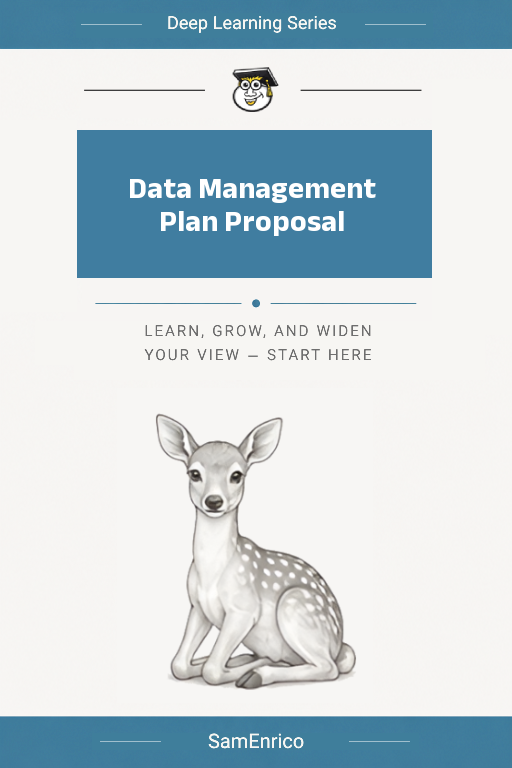
Non-FictionStudent's ShortcutData ManagementSharing Plan
Data Management Plan Proposal eBook
Write data management and sharing plans required b
Write data management and sharing plans required by funders including storage backup and access protocols.
Formats
Free sample
Chapter 1: The Seven D's--–- Every rejected grant application tells a story. For most, the story ends with a polite form letter citing "insufficient attention to data management" or "lack of clarity in preservation planning." But beneath those bureaucratic phrases lies a deeper truth: the principal investigator treated the Data Management Plan as an afterthought, a box to check, a technical appendix to be drafted the night before the deadline. This book exists because that approach fails. It fails the researcher, who loses funding. It fails the funder, who cannot ensure reproducibility.
And it fails science itself, which drowns in unmanaged data while starving for usable information.The problem is not laziness or incompetence. The problem is a fundamental misunderstanding of what a Data Management Plan actually is. Most researchers—brilliant in their domains, meticulous in their methods—approach the DMP as an IT document. They write about server specifications, software versions, and storage quotas. They describe their lab's network-attached storage device or their institutional cloud allocation.
They list file formats without explaining why those formats matter. And then they wonder why a review panel composed of fellow scientists, not systems administrators, finds the plan lacking.This chapter dismantles that misunderstanding. It introduces a new framework—the Seven D's—that transforms the DMP from a technical checklist into a strategic roadmap for reproducibility. It redefines the plan as a living document that evolves with your research. And it provides the foundational language you will use throughout every subsequent chapter of this book.
By the time you finish reading, you will never look at a DMP the same way again.The Anatomy of Failure: Why Most DMPs Get Rejected Let us begin with a thought experiment. Imagine you are reviewing a grant application for a three-year longitudinal study of adolescent mental health. The proposed research will collect survey data from five thousand participants, biometric measurements from a subset, and semi-structured interviews from two hundred families. The science is sound. The methodology is rigorous.
Then you reach the Data Management Plan. It reads:"Data will be stored on the university's secure server with daily backups. Access will be restricted to approved personnel. At project completion, data will be deposited in a suitable repository. All data will follow FAIR principles."What is wrong with this plan?
On the surface, nothing. It mentions storage, backups, access, and repositories. It even invokes the FAIR principles (Findable, Accessible, Interoperable, Reusable), which have become a required incantation in modern DMPs. Yet this plan would likely receive a score of "Poor" or "Fair" from most funder review panels. Here is why.First, it lacks specificity.
Which secure server? Whose daily backups—automated or manual? What counts as "approved personnel"? Which repository is "suitable"? FAIR principles are meaningless without concrete actions.
Second, it confuses infrastructure with strategy. The reviewer learns nothing about how data will be organized, documented, or transformed for sharing. Third, it treats the DMP as a static declaration rather than a dynamic process. There is no mention of when the plan will be updated, who is responsible for updates, or what triggers a revision.The most common mistake, however, is deeper than any of these. The typical DMP describes where data will sit, not how data will live.
It focuses on containers rather than content, on bits rather than meaning. A server is just a box. Backups are just copies. A repository is just a parking lot. What funders actually want to know is: will this data be usable by another researcher five years from now?
Will it be interpretable? Will it be trustworthy?This question—the question of reproducibility—is the true subject of every DMP. And answering it requires a framework that goes far beyond IT checklists.Introducing the Seven D's Framework The Seven D's framework emerged from a systematic analysis of successful DMPs across three major funders: the National Science Foundation (NSF), the National Institutes of Health (NIH), and UK Research and Innovation (UKRI). While each funder uses different terminology and emphasizes different sections, their underlying concerns cluster into seven distinct domains. These seven domains form the backbone of every chapter in this book.The Seven D's are:Details – What data will be created or collected?Data Collection – How will data be captured, recorded, and processed?Storage – Where and how will data be stored during active research?Documentation – What metadata and supporting information will accompany the data?Risks – What could go wrong, and how will you prevent or mitigate it?Long-term – How will data be preserved after the project ends?Dissemination – How and when will data be shared with others?Notice what this framework includes and what it excludes.
It includes storage (D3) but not as the centerpiece. It includes technical elements like backups and encryption, but only as part of risk mitigation (D5). It elevates documentation (D4) to equal status with data collection (D2). And it separates preservation (D6) from sharing (D7), because keeping data safe is not the same as making data available.Throughout this book, each chapter maps explicitly to one or more of the Seven D's. Chapter 2 (defining your digital footprint) covers D1 (Details).
Chapter 3 (roles and responsibilities) spans D3, D4, and D5. Chapters 4 through 7 address active management—storage, documentation, and risks. Chapters 8 through 11 cover long-term preservation and dissemination. Chapter 12 synthesizes everything into a grant-ready DMP.But before we dive into individual D's, we must understand how they work together as a system.The Logic of the Seven D's: Why Order Matters The Seven D's are not a random list. They follow a logical progression from the concrete to the abstract, from the present to the future, from creation to reuse.D1 (Details) asks the most fundamental question: what are you making?
You cannot manage data you cannot describe. This seems obvious, yet most DMPs fail at precisely this point. They say "we will collect survey data" without specifying the number of variables, the types of questions, or the expected file sizes. D1 forces specificity.D2 (Data Collection) asks how the data will come into existence. Will it be entered manually by research assistants?
Streamed automatically from sensors? Extracted from electronic health records? The method of collection determines everything that follows: error rates, format choices, backup frequency, and documentation needs.D3 (Storage) asks where the data will live during the active project. This is the domain that most researchers know to address, but they often address it poorly by focusing on hardware rather than workflow. D3 encompasses not just the primary storage location but also backup copies, version control, and synchronization across team members.D4 (Documentation) asks how anyone else will understand the data.
This is the most undervalued domain in typical DMPs. Researchers assume that their file names and folder structures are self-explanatory. They are not. D4 covers metadata standards, data dictionaries, README files, and codebooks.D5 (Risks) asks what could disrupt data integrity, security, or availability. This includes obvious risks like hardware failure and ransomware, but also less obvious risks like staff turnover, format obsolescence, and legal challenges to data sharing.
D5 is where you demonstrate that you have thought about things going wrong.D6 (Long-term) asks how data will survive after the grant ends. This is not…
This is the end of the free sample. Get the eBook to keep going. Buy now
About this book
Details
- Author
- Slocum Virgil
- Publisher
- SamEnrico
- Language
- English
- Genre
- Non-Fiction, Student's Shortcut, Data Management, Sharing Plan
- Released
- 2026-06-01
- Pages (approx.)
- 151
- Available as
- eBook, Audiobook

Read better in the ZLOADR app
Your eBooks on your phone or tablet. Sign in with your SamEnrico account and start reading.
More by Slocum Virgil
 Refinancing and Recapitalization GuideSlocum Virgil$11.99
 LBO Sponsor to Sponsor GuideSlocum Virgil$11.99
 Forged Documents ExposedSlocum Virgil$11.99
 Bariatric Surgery Binge Eating WorkbookSlocum Virgil$11.99
 Gluten Free Label Reading CourseSlocum Virgil$11.99
 The Germ Detective: Snow’s Hunt for the Cholera KillerSlocum Virgil$11.99
 The Devouring Deep: How the Sea Reclaimed the SS Edmund FitzgeraldSlocum Virgil$11.99
 Understanding Cataract, Congenital, With Microcornea Or Slight MicrophthalmiaSlocum Virgil$17.99
 AI Financial Data Cleaning GuideSlocum Virgil$12.99
 Special Events ServerSlocum Virgil$11.99
 How to Start a Posts (of Wood) Production Business (Beginners Guide)Slocum Virgil$11.99
You may also like
 Hong Kong Handover 1997Dunn Johnnie$11.99
 Zumba For Postnatal Recovery CourseNeal Christian$11.99
 Zumba for BeginnersLadner Nikia$11.99
 YouTube Comment Mining GuideHumes Pandora$12.99
 Worry Box MeditationCarlin Rudy$11.99
 Workplace Stress MeditationNguyen Lynn$11.99
 Workplace Stress and Sleep RepairHawley Ivory$11.99
 Workplace Perfectionism CureDelaney Jeffry$11.99
 Workplace Injustice Anger GuideWallen Isabelle$11.99
 Work Addiction and Burnout LinkGreenwood Ester$11.99
 Women in Yoga and WellnessBeattie Galina$11.99
 Women in Stand Up ComedyChun Evangeline$11.99