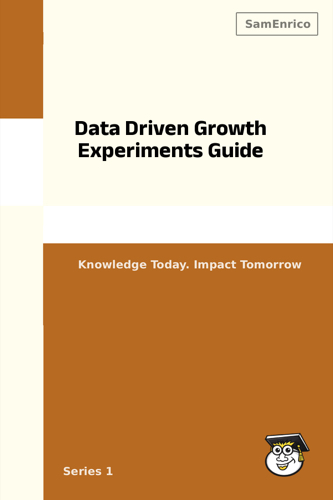
Data Driven Growth Experiments Guide eBook
Run parallel A/B tests to identify winning growth
Run parallel A/B tests to identify winning growth channels faster than competitors.
Formats
Free sample
Chapter 1: The Graveyard of Certainty--The most expensive sentence in business is not “We need to pivot” or “We missed our numbers.” It is four words spoken in a conference room by someone with a title and a temper: “I have a gut feeling.”That sentence has killed more companies than bad products, more startups than running out of cash, and more careers than missed promotions. It sounds harmless. It sounds experienced. It sounds like leadership. It is none of those things.
It is the sound of a company betting its future on a single untested assumption while a competitor somewhere is running experiment number forty-seven this quarter.This book exists because of a simple observation that most founders, marketers, and product leaders refuse to accept: you do not lose to competitors who are smarter than you. You lose to competitors who test more things more quickly than you. They learn faster. You guess slower. They run ten experiments while you debate one.
They discover three small wins while you celebrate your one big idea that never worked.By the time you finish reading this chapter, one hundred and twenty companies will have launched a new A/B test. Twenty of them will learn something useful. Three of them will find a breakthrough that changes their trajectory. None of them will have asked permission from a committee. None of them will have spent three weeks writing a requirements document.
None of them will have said “I have a gut feeling.”They will have simply started.This chapter dismantles the traditional annual marketing plan, the “big bet” culture, and the illusion that strategic brilliance beats experimental volume. It introduces the framework that underpins every successful growth organization in the world: the Experimentation Flywheel. And it reveals the single most important metric you are not measuring — the one that predicts with shocking accuracy which companies will dominate their markets in three years and which will be footnotes in someone else’s case study.The Funeral for the Annual Plan Once a year, in boardrooms across the world, a ritual takes place. Teams gather. Spreadsheets are projected on whiteboards.
Someone from finance says “we need to be realistic.” Someone from product says “we need to be ambitious.” Someone from marketing says “we need to be creative.” They negotiate. They compromise. They produce a document called the “Annual Marketing Plan.”This plan is a lie.Not because the people writing it are dishonest. They are hardworking, intelligent, well-intentioned professionals. The plan is a lie because it assumes something fundamentally untrue about the world: that you can predict, twelve months in advance, which channels will work, which messages will resonate, and which offers will convert.
You cannot. No one can. The companies that pretend otherwise are not more strategic. They are more delusional.Consider the data. According to a study of over two thousand B2B companies, fewer than eight percent of annual marketing plans achieve their stated objectives within twenty percent of the original forecast.
Ninety-two percent fail. Not “slightly miss.” Fail. The most common reason cited? “Market conditions changed.” Which is another way of saying “we guessed wrong and had no mechanism to correct course.”The annual plan is a relic of an era when information moved slowly, when you could place a television ad in September and not know its effectiveness until December, when “test and learn” meant “try something and pray.” That era is over. Today, you can know within hours whether an email subject line is working.
You can know within days whether a landing page converts. You can know within weeks whether a pricing change will stick.And yet, most companies still plan like it is 1995.They allocate budgets annually. They commit to channels quarterly. They debate tactics monthly. And by the time they discover that their big bet on Tik Tok ads is failing, they have already spent three months of budget and lost the opportunity to reallocate to Linked In, where their actual customers were waiting.This is not a planning problem.
This is a philosophy problem.The Big Bet Lie The technology industry has a creation myth. It goes something like this: a visionary founder has a brilliant insight, bets everything on that insight, defies the skeptics, and changes the world. Steve Jobs and the i Phone. Brian Chesky and Airbnb. Reed Hastings and streaming.
These stories are inspiring. They are also survivorship bias at its most dangerous.For every Steve Jobs, there are ten thousand founders who made a big bet, lost, and never appeared in a magazine. You do not hear about them because their failure was not dramatic or interesting. It was simply a company that ran out of money after placing all its chips on a single untested channel, a single unproven message, a single unreleased feature that customers did not actually want.The big bet lie is the belief that concentration of resources produces concentration of results. It does not.
Concentration of resources produces concentration of risk. When you bet everything on one campaign, one channel, one hypothesis, you are not being brave. You are being statistically illiterate.Here is what the data actually shows. Across more than fifteen thousand experiments run by companies in the portfolio of a major venture capital firm, the average success rate for a “big bet” (defined as a test requiring more than fifty thousand dollars or two engineering months) was eleven percent. The average success rate for a “small bet” (less than five thousand dollars or one engineering week) was twenty-three percent.
Small bets were twice as likely to succeed. And because they took less time and money to run, teams could afford to run twenty small bets in the time it took to run one big bet.The math is brutal. One big bet at eleven percent success rate yields a 0.11 expected wins per cycle. Twenty small bets at twenty-three percent success rate yields 4.6 expected wins per cycle. The small-bet portfolio is forty-two times more productive.This is not opinion.
This is arithmetic.And yet, almost every organization defaults to big bets. Why? Because big bets feel strategic. They feel decisive. They feel like leadership.
Small bets feel like tinkering. They feel like you are not sure. They feel like you are admitting that you do not have all the answers.Which is precisely the point. You do not have all the answers. No one does.
The only sustainable competitive advantage in a world of infinite information is the rate at which you learn. And the rate at which you learn is directly proportional to the number of experiments you run and the speed at which you run them.Introducing the Crawl-Walk-Run-Fly Maturity Model Not every organization is ready for parallel testing. Trying to run twenty experiments simultaneously when you have not yet mastered running one is like giving a teenager the keys to a race car. You will crash. You will crash spectacularly.
And you will conclude that “parallel testing doesn’t work” when the real problem was that you skipped foundational steps.To avoid this fate, this book uses the Crawl-Walk-Run-Fly maturity model. It is a simple framework for assessing where your organization is today…
This is the end of the free sample. Get the eBook to keep going. Buy now
About this book
Details
- Author
- Najera Sherlyn
- Publisher
- SamEnrico
- Language
- English
- Genre
- Non-Fiction, Business Brief, Data Analytics
- Released
- 2026-06-06
- Pages (approx.)
- 147
- Available as
- eBook, Audiobook

Read better in the ZLOADR app
Your eBooks on your phone or tablet. Sign in with your SamEnrico account and start reading.
More by Najera Sherlyn
 IBS Eating Out Social Situations CourseNajera Sherlyn$11.99
 The Sasquatch Witness DisappearancesNajera Sherlyn$11.99
 Anansi Weaves the Sky: The Spider’s Great DeceptionNajera Sherlyn$11.99
 The Ghosts of Mumbai Central: The 1993 Bombings That Shook IndiaNajera Sherlyn$11.99
 Understanding Hutchinson IncisorsNajera Sherlyn$17.99
 Ultimate Handbook Guide to Tampa : (United States) Travel GuideNajera Sherlyn$11.99
 Safety WatchNajera Sherlyn$11.99
 Dynamic Equity Split HandbookNajera Sherlyn$12.99
 China Digital Payments OutlookNajera Sherlyn$12.99