
Non-FictionInformativeEducational
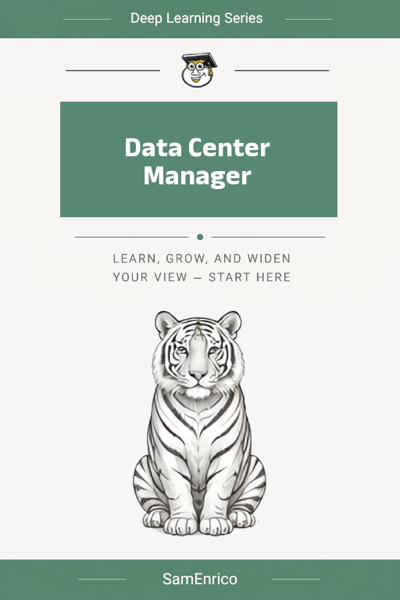
Data Center Manager eBook
A Coursebook on Data Center Manager
by Ng Janeen
A Coursebook on Data Center Manager
Formats
Free sample
Chapter 1: The Bilingual Paradox...--Most data center managers enter the profession through one of two doors. The first door is facilities: you started as an electrician, a plumber, an HVAC technician, or a building engineer. You understand chillers, generators, three-phase power, and the elegant dance of a variable frequency drive. The second door is IT: you started as a network administrator, a systems engineer, a storage architect, or a server technician. You understand routing protocols, hypervisors, RAID arrays, and the strange magic of a content delivery network.Here is the problem that no one tells you on day one.
The facilities people rarely speak the language of IT, and the IT people rarely speak the language of facilities. But the data center manager must speak both. Not fluently enough to design a chiller plant from scratch or rewrite a kernel driver, but fluently enough to sit in a room with both tribes and translate. You are the bridge. And bridges that are not anchored on both sides collapse.This chapter is not about how to rack a server or calculate a load curve.
Those come later. This chapter is about something more fundamental: understanding what the hell you are actually managing, why it matters to the business, and why the role you are about to step into is simultaneously the most thankless and most critical job in modern industry. Because here is the truth that keeps data center managers awake at three in the morning: when everything works, no one knows your name. When something breaks, everyone knows your name, and they are not saying it softly.The data center is no longer a basement room with some servers and a noisy air conditioner. It is the physical substrate of the digital economy.
Every credit card swipe, every video call, every stock trade, every hospital record, every text message you have ever sent passes through a data center somewhere. The manager of that facility holds in their hands the operational continuity of entire industries. And yet, most managers are hired for their technical expertise and then abandoned to figure out the strategic part on their own. This book exists to close that gap.We begin with a paradox that will follow you throughout your career. You must know enough technical detail to earn the respect of your engineers.
If you do not understand why a UPS in double-conversion mode is different from a line-interactive UPS, your facilities team will eat you alive. If you do not understand the difference between a spine-leaf and a three-tier network topology, your network team will walk around you. But at the same time, you must be able to translate that technical reality into business language that the C-suite understands. No chief financial officer cares about your UPS topology. They care about downtime cost per minute, capital expenditure efficiency, and risk mitigation.
You are a bilingual human being living in two worlds that do not share a dictionary.This chapter will give you that dictionary. We will explore the evolution of data centers from glass houses to hyperscale clouds to edge computing. We will define the tier classification system that determines how much uptime you can actually promise. We will walk through the economics of cloud versus colocation versus on-premises, because those decisions will shape your entire strategy. And we will introduce a framework for thinking about risk that will reappear throughout this book.
By the end of this chapter, you will understand not just what a data center is, but why it exists and how to talk about it in a room full of people who think it is just a really expensive closet.The Glass House Era: Where We Came From Before the cloud, before the internet as we know it, there was the mainframe. In the 1960s, 1970s, and 1980s, computing meant a mainframe computer the size of a small apartment, surrounded by tape drives and disk packs and operators in white lab coats. These facilities were called glass houses because the computer room was literally encased in glass walls and floors, often raised, with strict temperature and humidity controls. You could not just walk into a glass house. You needed permission, a badge, and usually a change request signed by three people.The glass house era established the first principles of data center management.
Redundancy mattered, because a mainframe crash meant the entire company stopped working. Cooling mattered, because those mainframes generated enormous heat. Physical security mattered, because the mainframe was the single most valuable asset in the building. But the glass house also established a mindset that persists today: the data center as a fortress, separate from the business, managed by specialists who spoke a language no one else understood.Then came the client-server revolution of the 1990s. Instead of one massive mainframe, companies bought hundreds or thousands of smaller servers.
Each department wanted its own server. The marketing team had a server. The finance team had a server. The HR team had a server. These servers lived in closets, under desks, in repurposed supply rooms.
This was the opposite of the glass house, and it was chaos. No one knew where all the servers were. No one tracked power consumption. No one had a consolidated view of cooling. The term server sprawl was invented to describe this mess, and it is still a problem in organizations that have not matured their data center practices.The response to server sprawl was the enterprise data center.
Companies began consolidating their distributed servers into centralized facilities with proper power, cooling, and security. These facilities were often built on corporate campuses or in leased industrial spaces. They were managed by dedicated teams. And they introduced a new problem: capacity planning. When you have a hundred servers distributed across closets, no one notices if one closet runs out of power.
When you have a thousand servers in one room, running out of power means the whole room shuts down. Capacity management shifted from a nice-to-have to a mission-critical discipline.The Cloud Disruption: Where We Are In the mid-2000s, something changed. Amazon, Google, and Microsoft began building massive data centers not for their own operations, but to sell compute capacity to anyone with a credit card. This was the birth of the cloud. The promise was seductive: stop buying servers, stop hiring facilities engineers, stop worrying about power and cooling.
Just rent what you need, when you need it, and let someone else manage the basement.For many companies, the cloud delivered on that promise. Startups could launch without millions of dollars of capital expenditure. Enterprises could shut down entire data centers and move to a pure operating expense model. The cloud offered elasticity: you could spin up a thousand servers for a holiday shopping surge and spin them down in January. The data center manager, as a role, seemed threatened.
If everything is in the cloud, who needs a data center manager?The answer, as it turns out, is almost everyone. By 2020, the narrative had shifted again. Companies that moved everything to the cloud discovered something uncomfortable: cloud costs are unpredictable. A development team accidentally leaving a hundred virtual machines running over the…
This is the end of the free sample. Get the eBook to keep going. Buy now
About this book
Details
- Author
- Ng Janeen
- Publisher
- SamEnrico
- Language
- English
- Genre
- Non-Fiction, Informative, Educational
- Released
- 2026-05-08
- Pages (approx.)
- 157
- Available as
- eBook, Audiobook

Read better in the ZLOADR app
Your eBooks on your phone or tablet. Sign in with your SamEnrico account and start reading.
More by Ng Janeen
 Phone Porn Addiction Detox WorkbookNg Janeen$11.99
 Remote Sales Communication GuideNg Janeen$11.99
 Dreams After Neglect Trauma GuideNg Janeen$11.99
 Menstrual Health And FertilityNg Janeen$11.99
 Dreamwork for Dissociative TraumaNg Janeen$11.99
 The Unseen Playbook: How a High School Coach Built a Dynasty in the Shadow of the NFLNg Janeen$11.99
 The Silk and Steel of Empress Wu Zetian: China's Only Female RulerNg Janeen$11.99
 Australian Student PR Pathway GuideNg Janeen$12.99
 Renewable Energy Merger OutlookNg Janeen$12.99
 Understanding Heide SyndromeNg Janeen$17.99
 How to Start a Brush Case (not of Leather or Plastics) Business (Beginners Guide)Ng Janeen$11.99
You may also like
 Hong Kong Handover 1997Dunn Johnnie$11.99
 Zumba For Postnatal Recovery CourseNeal Christian$11.99
 Zumba for BeginnersLadner Nikia$11.99
 YouTube Comment Mining GuideHumes Pandora$12.99
 Worry Box MeditationCarlin Rudy$11.99
 Workplace Stress MeditationNguyen Lynn$11.99
 Workplace Stress and Sleep RepairHawley Ivory$11.99
 Workplace Perfectionism CureDelaney Jeffry$11.99
 Workplace Injustice Anger GuideWallen Isabelle$11.99
 Work Addiction and Burnout LinkGreenwood Ester$11.99
 Women in Yoga and WellnessBeattie Galina$11.99
 Women in Stand Up ComedyChun Evangeline$11.99