
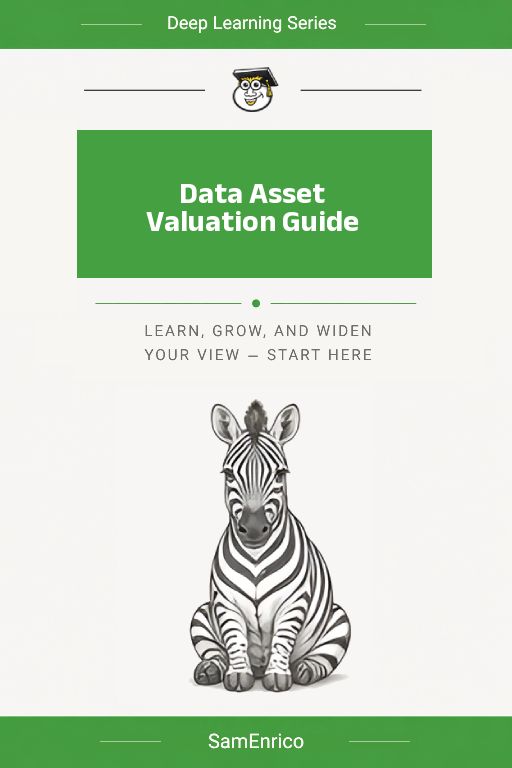
Non-FictionCapital & Valuation RegisterData Assets
Data Asset Valuation Guide eBook
Values proprietary data assets and databases using
by Burk Ilse
Values proprietary data assets and databases using replacement cost, income approach, and market comparable transactions.
Formats
Free sample
Chapter 1: The Million-Dollar Question--–- The CEO’s voice was calm, but the room felt the weight of her question. “We sit on fifty petabytes of customer transaction data. Our engineers call it an asset. Our auditors call it nothing. Our competitors would kill for it.
So tell me—what is it actually worth?”The head of data science shifted uncomfortably. The CFO stared at his laptop. The chief data officer, newly hired to “unlock value,” realized he had no framework to answer. The company had spent eight figures building data infrastructure, yet on the balance sheet, all that value rounded to zero.This scene plays out in boardrooms across the world every single day. Companies have invested billions in data collection, storage, and processing.
They speak of data as “the new oil.” But when asked to put a price tag on a specific database—for a sale, a licensing deal, an insurance claim, or an internal investment decision—they fall silent. Not because the data lacks value, but because the tools to measure that value have not kept pace with the technology to create it.This chapter answers the question that the CEO asked. But before we can calculate a number, we must understand why data refuses to behave like any other asset on the balance sheet. We must confront the uncomfortable truth that most of what finance professionals learned about valuation—depreciation, scarcity, consumption—does not apply to data. And we must establish the foundational framework that will guide every valuation in this book: the distinction between what data can do for you internally versus what someone will pay you for it externally.The answer to the million-dollar question is not a single number.
It is a range, a perspective, and a mandate. By the end of this chapter, you will understand why a customer list can be worth 800,000toonepartyand800,000 to one party and 800,000toonepartyand150,000 to another—and why both valuations can be simultaneously correct. You will learn to write a valuation mandate that prevents the most common and costly errors in data valuation. And you will never again answer the CEO’s question with a blank stare.The Factory That Burned Down Imagine two companies. The first owns a factory that manufactures bicycle parts.
The factory contains machinery worth 10million,inventoryworth10 million, inventory worth 10million,inventoryworth3 million, and a brand valued at $5 million. One night, a fire destroys the factory. The next morning, the CEO files an insurance claim. Adjusters arrive, assess the damage, and within weeks, a check arrives for the replacement cost of the machinery, the lost inventory, and the business interruption. The process is routine because physical assets have well-established valuation methods.Now imagine the second company.
It owns no factory, no machinery, no inventory. It owns a server containing fifty million customer transaction records—purchase history, browsing behavior, payment methods, returns. This server, like the factory, is destroyed in a fire. The next morning, the CEO asks the same question: “What do we claim?” The insurance adjuster asks for evidence of value. The company has none.
There is no purchase receipt for the data because it was generated internally. There is no market price because this specific dataset has never been sold. There is no depreciation schedule because accounting standards do not recognize internally generated data as an asset.The data is gone. The insurance claim is denied. The company collapses not because it lost a physical asset, but because it lost the ability to personalize recommendations, predict churn, and optimize pricing—capabilities that generated eighty percent of its revenue.
The data was worth millions, but no one had ever bothered to measure it.This thought experiment reveals the first lesson of data valuation: Data is an asset whether or not it appears on a balance sheet. The absence of a number does not mean the absence of value. It means the absence of measurement. And in business, what you cannot measure, you cannot manage, protect, or monetize effectively.Three Economic Characteristics That Break Traditional Valuation Data defies traditional asset accounting not because of any conspiracy, but because of three fundamental economic characteristics that distinguish it from every other asset class. Understanding these characteristics is not academic—it is the prerequisite for every valuation method in this book.Characteristic One: Non-Rivalry A rival asset is one that cannot be used by two parties simultaneously.
If you eat an apple, I cannot eat the same apple. If you drive a car, I cannot drive that same car at the same moment. If you use a patent to manufacture a drug, I cannot use the identical patent without a license. Rivalry creates scarcity, and scarcity creates the foundation for traditional valuation models.Data is non-rival. When you sell a customer list to a competitor, you still have the customer list.
When you license a database to a research partner, you can continue using it yourself. When you share an analytics model with a subsidiary, your own operations remain unchanged. This non-rivalry destroys the scarcity assumption that underlies most financial valuation.The practical implication is profound. In a traditional asset sale, the seller gives up the asset and the buyer gains exclusive use. The price reflects this transfer of control.
In a data transaction, the seller retains the asset while the buyer gains additional use. The price should be lower because the seller does not forego future use. Yet many data sellers price as if they were selling a rival asset, and many buyers negotiate as if they were buying one. Both are wrong.The non-rivalry characteristic also creates the possibility of simultaneous use by multiple parties. A single weather database can be licensed to a hundred airlines, each using it for route planning, and each paying a fraction of the cost to build it.
This is the economic miracle of data as an asset class—but it also means that traditional cost-based valuation must be adjusted for the number of potential licensees.Characteristic Two: Zero Marginal Cost of Replication The second characteristic follows directly from the first. If a factory produces one additional bicycle, it incurs the cost of steel, rubber, labor, and electricity. That marginal cost is positive and significant. If a server copies one additional database, it incurs the cost of electricity for a few seconds and a tiny amount of storage. That marginal cost is effectively zero.Zero marginal cost of replication means that the cost to produce the first copy of a dataset may be millions of dollars, but the cost to produce the second copy is pennies.
This severs the relationship between cost of production and value that exists for most physical goods. A diamond is expensive to mine and cut. A database may be expensive to assemble, but copying it costs nothing.The practical implication is equally profound. In traditional markets, price is anchored by cost—no seller will sell below cost for long, and competition pushes price toward cost. In data markets, cost provides a floor, but the ceiling is determined entirely by the value the data creates for the buyer.
A database that cost 1milliontobuildmightbeworth1 million to build might be worth 1milliontobuildmightbeworth10 million to a buyer who can use it…
This is the end of the free sample. Get the eBook to keep going. Buy now
About this book
Details
- Author
- Burk Ilse
- Publisher
- SamEnrico
- Language
- English
- Genre
- Non-Fiction, Capital & Valuation Register, Data Assets
- Released
- 2026-06-01
- Pages (approx.)
- 157
- Available as
- eBook, Audiobook

Read better in the ZLOADR app
Your eBooks on your phone or tablet. Sign in with your SamEnrico account and start reading.
More by Burk Ilse
 Candidate Experience BenchmarksBurk Ilse$11.99Candidate Experience BenchmarksBurk Ilse$11.99
 Battle Of Leipzig Nations Battle CourseBurk Ilse$11.99
 The Assertive Customer ServiceBurk Ilse$11.99
 The Child Circadian Rhythm GuideBurk Ilse$11.99
 Wise Mind Decision Making GuideBurk Ilse$11.99
 The Dragon Tamer of the Black ForestBurk Ilse$11.99
 How to Become a Staff ToxicologistBurk Ilse$11.99
 Extrusion Blow Molding TechnicianBurk Ilse$11.99
 Price Negotiation Chinese GuideBurk Ilse$12.99
 Understanding Symphalangism BrachydactylyBurk Ilse$17.99
You may also like
 Hong Kong Handover 1997Dunn Johnnie$11.99
 Zumba For Postnatal Recovery CourseNeal Christian$11.99
 Zumba for BeginnersLadner Nikia$11.99
 YouTube Comment Mining GuideHumes Pandora$12.99
 Worry Box MeditationCarlin Rudy$11.99
 Workplace Stress MeditationNguyen Lynn$11.99
 Workplace Stress and Sleep RepairHawley Ivory$11.99
 Workplace Perfectionism CureDelaney Jeffry$11.99
 Workplace Injustice Anger GuideWallen Isabelle$11.99
 Work Addiction and Burnout LinkGreenwood Ester$11.99
 Women in Yoga and WellnessBeattie Galina$11.99
 Women in Stand Up ComedyChun Evangeline$11.99